Static Floodlights vs. Tracking Spotlights: What the Evidence Actually Says
Outdoor lighting genuinely works: a randomized NYC street-lighting experiment (NBER, 2019) cut nighttime outdoor index crimes by roughly 36 percent, with effects lasting about three years — evidence for light itself, the thing floodlights and searchlights share. But fixed lights are predictable, and people habituate to them. A tracking searchlight adds the one signal a static light can't send — individual acknowledgment. Here's the honest comparison.
 View photo
Your view and PerimeterEye’s view
You don’t see anyone. PerimeterEye does.
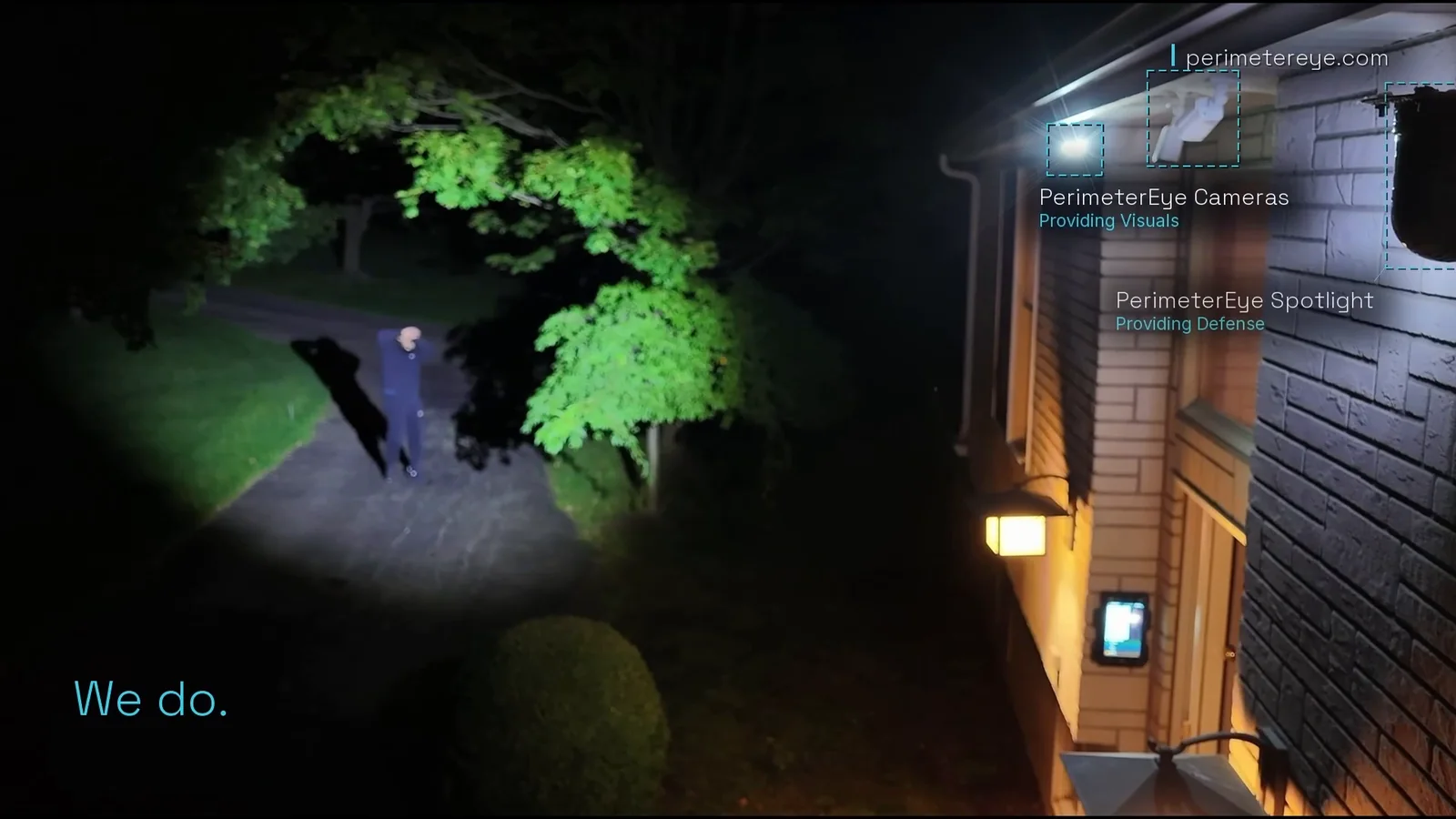
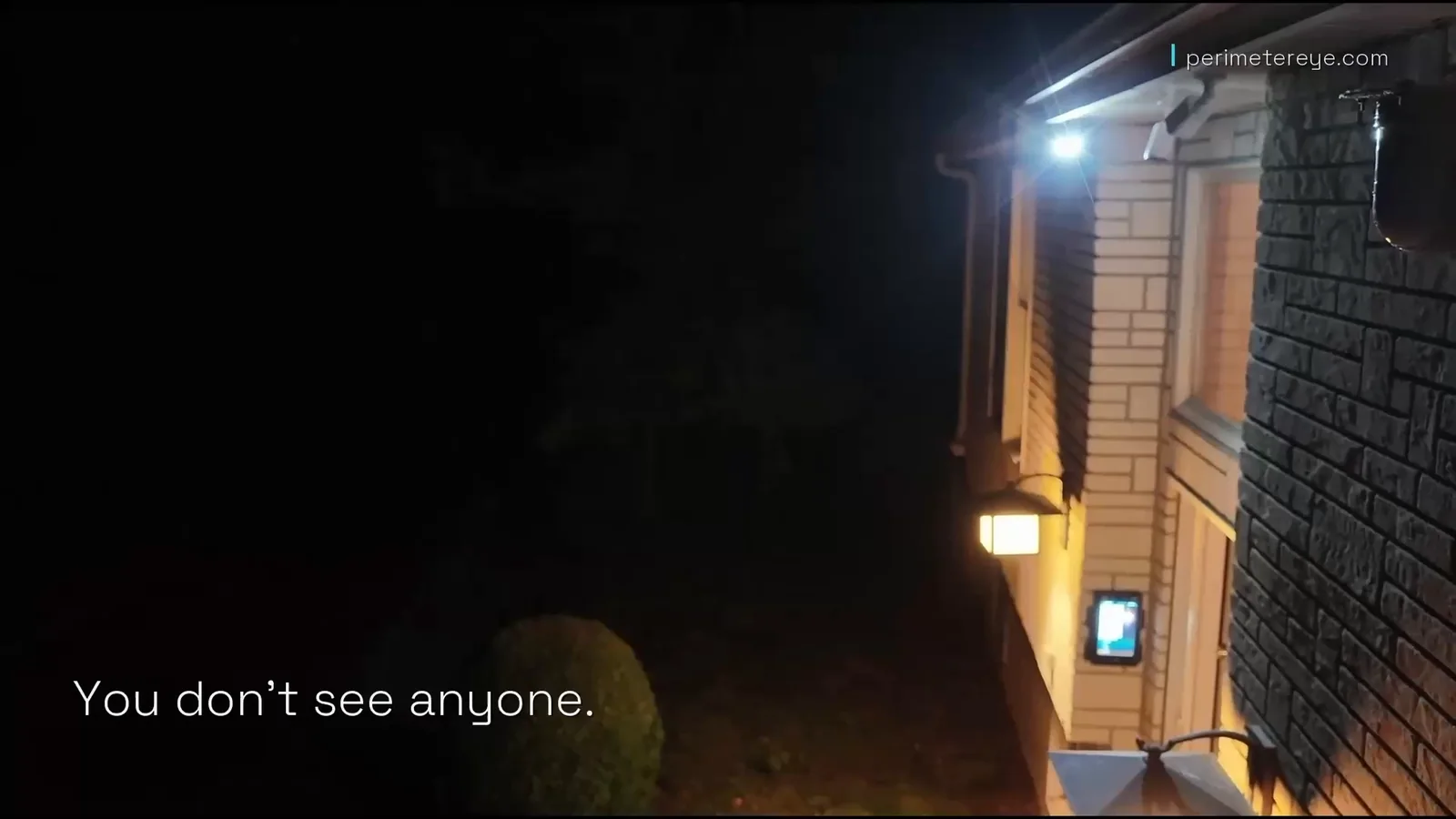
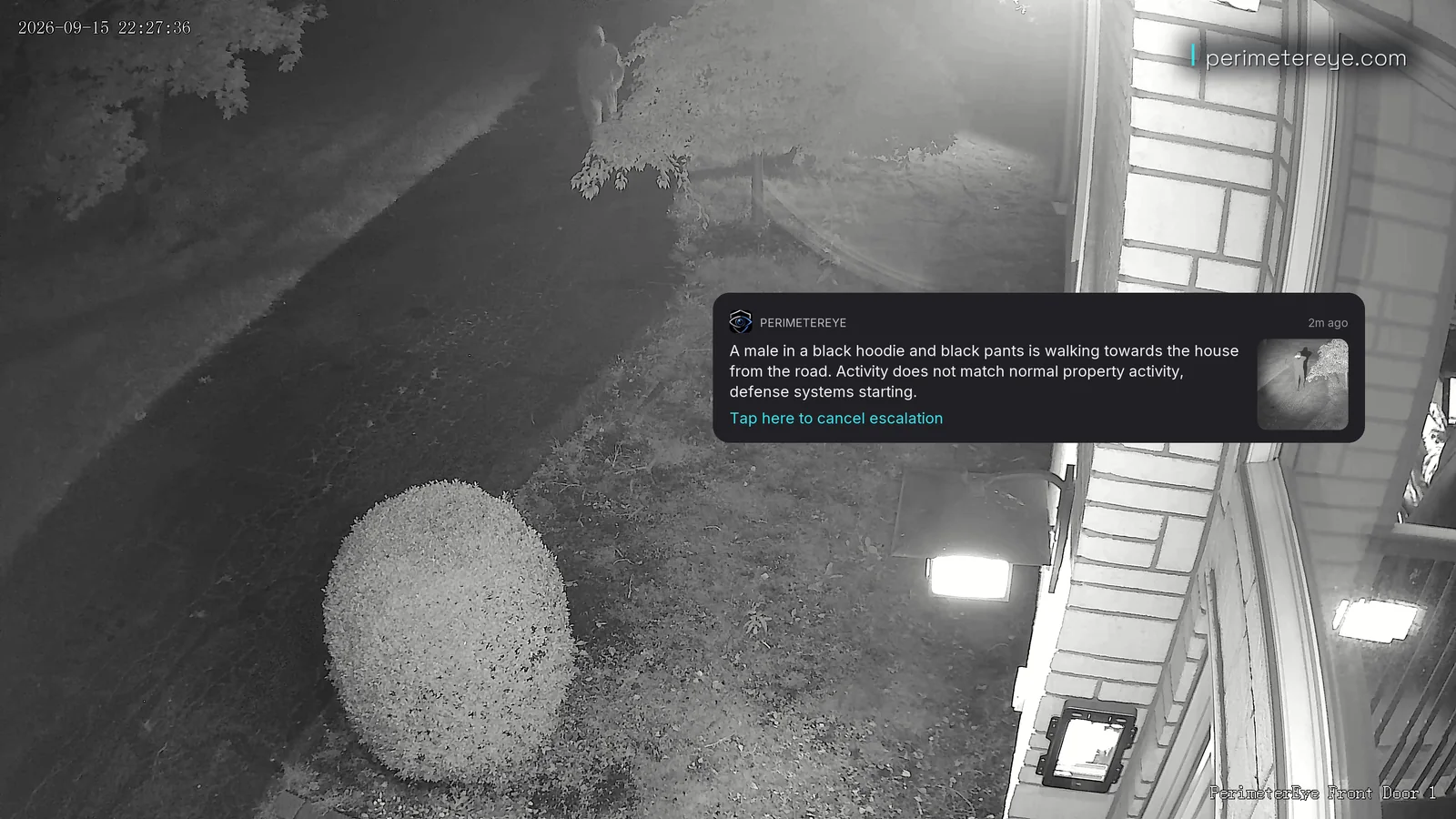
The same approach three ways: what you see from the house at night, what the camera sees in infrared, and the moment the searchlight catches the person.
1 of 3 · Your viewView full size
You don’t see anyone.
From the house, the driveway is dark. Whoever is out there is invisible to you.
2 of 3 · PerimeterEye’s viewView full size
The camera sees them in infrared
In infrared the person is in plain view, and the alert is already describing them: walking toward the house from the road, not normal activity for the property.
3 of 3 · The searchlightView full size
We do.
The searchlight catches the person on the driveway, and their hands go up against the light. The cameras provide the view; the searchlight provides the defense.
Filmed on a real property with PerimeterEye cameras and a searchlight. The approach was staged for filming; the system’s response was automatic, with no operator.
What changes
Two Lights, Two Different Messages
- A randomized NYC experiment (NBER, 2019) is honest evidence that static lighting cuts nighttime crime — roughly 36 percent.
- Fixed cones habituate and can be walked around; a beam that follows can't be tuned out.
- Only a tracking searchlight sends individual acknowledgment: you, specifically, have been seen.
This is an explainer, not a takedown. Motion floodlights are cheap, evidenced, and far better than darkness — the randomized NYC lighting experiment is the strongest crime-and-light study ever run, and it favors light. Read it as the case for illumination as a floor.
The comparison is about what a fixed cone cannot do: verify, follow, or acknowledge. PerimeterEye's tracking searchlights exist for exactly that gap, and they never work alone — they are one rung of an automatic ladder that adds a live targeted voice, a 130 dB siren, and priority alerts with live video.
What every system includes
- On-site edge computer (the Brain)
- 4K AI cameras
- Tracking searchlights
- Live targeted AI voice
- 130 dB siren escalation
- Doorbell video intercom
- Wall panel command center
- iOS app with live 4K video
01
Start with the strongest evidence: static lighting works
The best lighting study available is a randomized NYC street-lighting experiment (NBER, 2019): researchers assigned new lighting across 77 New York City public-housing developments and measured what happened. Nighttime outdoor index crimes fell by roughly 36 percent where the lights went in, and a 2022 follow-up in Criminology & Public Policy found the effect persisted for about three years.
Two honest caveats. That was static street lighting, not motion floodlights on a house — so read it as evidence for light itself, the thing floodlights and searchlights share. And it measured outdoor nighttime crime in public housing, not suburban burglary. Still, it is a randomized experiment, the gold standard, and it says illumination changes offender behavior.
02
Where static floodlights fall short
A fixed floodlight has three structural problems. It is predictable: the cone covers the same wedge of yard every night, and anyone who watches the house for ten minutes knows where it points and what sets it off. Step two feet outside the cone and the light might as well not exist.
It habituates: after the hundredth raccoon trigger, you stop looking up, and so do your neighbors. A light nobody reacts to loses most of what made it a deterrent. And it is anonymous: the same ninety-second cone fires for a cat, a courier, and a prowler, so the light itself tells the prowler nothing about whether anyone actually noticed them.
None of this makes floodlights useless — the evidence above says otherwise, and dark corners deserve light. It makes them a floor rather than a ceiling. If your budget stops at a motion floodlight, install the motion floodlight; the comparison here is about what the next step up actually buys you.
03
What a tracking searchlight adds: acknowledgment
A motorized tracking searchlight — PerimeterEye's rotate 355 degrees and tilt 90 at searchlight-class output — doesn't wait inside a fixed cone. When the system's AI verifies a person who shouldn't be there, the beam locks onto them and follows as they move. Step left, and the light steps left with you.
That converts the message from something moved here to you, specifically, have been seen — and we are still watching. Interviews with 422 incarcerated burglars (Kuhns et al., 2013 — an industry-funded academic survey) found signs of security among the top factors in target selection, and about 60 percent said they would seek another target if an alarm was present. Deterrence runs on the offender's belief they've been noticed; a beam that follows makes that belief unavoidable.
It also resists habituation, because it is rare, it is aimed, and it moves. Neighbors don't tune out a searchlight tracking across a lawn the way they tune out fixed-cone trigger number one hundred — and neither does the person standing inside the beam.
04
Side by side
Coverage is the clearest split. A floodlight covers a fixed wedge and leaves the rest of the property to other fixtures; a tracking searchlight covers wherever the verified subject actually goes, which is the only spot that matters during an incident. One is a zone defense with seams; the other follows its man.
Follow-through is the second split. A floodlight is the whole response: light happens, then nothing. In PerimeterEye, the searchlight is step two of a ladder — verification first, then lock-and-follow, then a live targeted AI voice, then a 130 dB siren with priority alerts and live video. The light opens the encounter; it doesn't end it.
- Trigger: any warm motion vs. an AI-verified person or vehicle
- Coverage: one fixed cone vs. 355-degree rotation and 90-degree tilt that follows the subject
- Signal sent: "motion happened" vs. "you have been seen"
- Habituation: high — nightly animal triggers — vs. low — rare, aimed, and moving
- After the light: nothing vs. a targeted live voice, a 130 dB siren, and live-video alerts
05
The honest bottom line
If you do exactly one thing, add light — the randomized NYC evidence is real, and a cheap floodlight over a dark side door is a good trade. Just make peace with what it cannot do: distinguish a prowler from a possum, follow anyone anywhere, or tell the person in the beam that they in particular have been noticed.
If you want the property itself to respond, the step up is not a brighter cone — it is tracking plus escalation. One caution applies to every option on this page: lights deter, they don't guarantee, and no security system can guarantee prevention of every incident. Choose based on what the equipment demonstrably does.
What separates PerimeterEye
What the person experiences.
Light deters when it makes someone feel seen. How the light behaves decides whether they do.
| Option | When someone walks in | What they experience |
|---|---|---|
| Static floodlight | Lights a fixed area when anything moves. | A light that came on. They can wait it out or walk around it. |
| Dusk-to-dawn light | Lights a fixed area all night. | A lit area they can plan around. |
| Tracking searchlight | Finds the person and follows them. | A beam that stays on them, wherever they go. |
Watch it at full speed
The same response, on film.
Real footage of the working system. Play it with sound to hear the voice warning and the siren.
Detection, tracking searchlight, spoken warning and siren escalation, end to end — all recorded output from a working system.
Play with sound to hear the voice warning and siren.What it costs
See what a system costs for your property.
Essential system
As low as$146/mo*Essential covers a driveway and the approaches to the house. Larger properties usually suit Advanced or Estate; a specialist can size it with you before you order.
What’s included
- 5 ultra-HD 4K cameras
- 1 tracking spotlight
- 1 speaker/siren unit
- PerimeterEye Access intercom, included with every complete system
- 1 PerimeterEye control panel
- 1 PerimeterEye AI processor
*Essential system, $0 down: 36 monthly payments of $145.17 at 10% APR on the hardware price before sales tax, shown rounded up to the dollar. Affirm rates 0–36% APR; Klarna terms are shown at checkout. Subject to eligibility and lender approval; your rate, term and down payment may differ. US only; not available in all states. Software is billed separately: first 6 months included, then $99/month.
Before you choose
Common questions
Do motion floodlights actually deter crime?
The best evidence says lighting helps: a randomized NYC street-lighting experiment (NBER, 2019) across 77 public-housing developments cut nighttime outdoor index crimes by roughly 36 percent, with effects lasting about three years. That tested static street lighting rather than residential floodlights — but it is strong evidence that illumination changes offender behavior.
Why do floodlights lose effectiveness over time?
Habituation and predictability. A cone that fires nightly for raccoons trains you and your neighbors to ignore it, and its fixed coverage is easy to map and simply walk around. The light still works as illumination; what fades is its power as a signal that a person actually noticed something.
Is a tracking spotlight just a brighter floodlight?
No — the difference is behavior, not brightness. PerimeterEye's searchlights move: 355-degree rotation and 90-degree tilt, locking onto an AI-verified person and following them, backed by a live targeted voice and a 130 dB siren. A floodlight announces motion; a tracking searchlight announces that a specific person has been seen.
Can I add a tracking searchlight to my existing cameras?
PerimeterEye's spotlights aren't a bolt-on — they track because the on-site Brain verifies targets and drives the motors as part of one coordinated escalation ladder. Every PerimeterEye package includes tracking searchlights alongside the 4K cameras, siren, doorbell intercom, and wall panel, in sizes from smaller properties up through estates.
Is a static floodlight enough on its own?
Lighting shifts the odds, and static light is evidenced and cheap. A tracking searchlight adds what a fixed light can’t: individual acknowledgment, following the person, and escalation to a live AI voice and a 130 dB siren. Both belong inside a plan that also includes locks, sight lines, and documentation.
Keep exploring
Related reading
Put a response behind your property.
Tell a specialist about your property, your driveway, and where people approach. They’ll size the cameras, searchlights, and sirens with you, or book a call first if you’d rather talk it through.
Explore an upgrade for your existing camerasSystem launch offer
Your first 6 months
of service included.
First 6 months included from activation. Then $99/month.
Compare system packages