Security Cameras vs. Active Deterrence: The Three Tiers
Security cameras record what happens. "Active deterrence" cameras add a strobe and siren that fire on detection. Active response identifies the specific person, locks a tracking searchlight on them, and addresses them out loud. All three are real tiers with real differences — this guide compares them honestly, including where strobe cameras genuinely earn their keep and where they hit a ceiling.
 View photo
Frame by frame, from the demonstration
Voice first. Then the light. Then the siren.
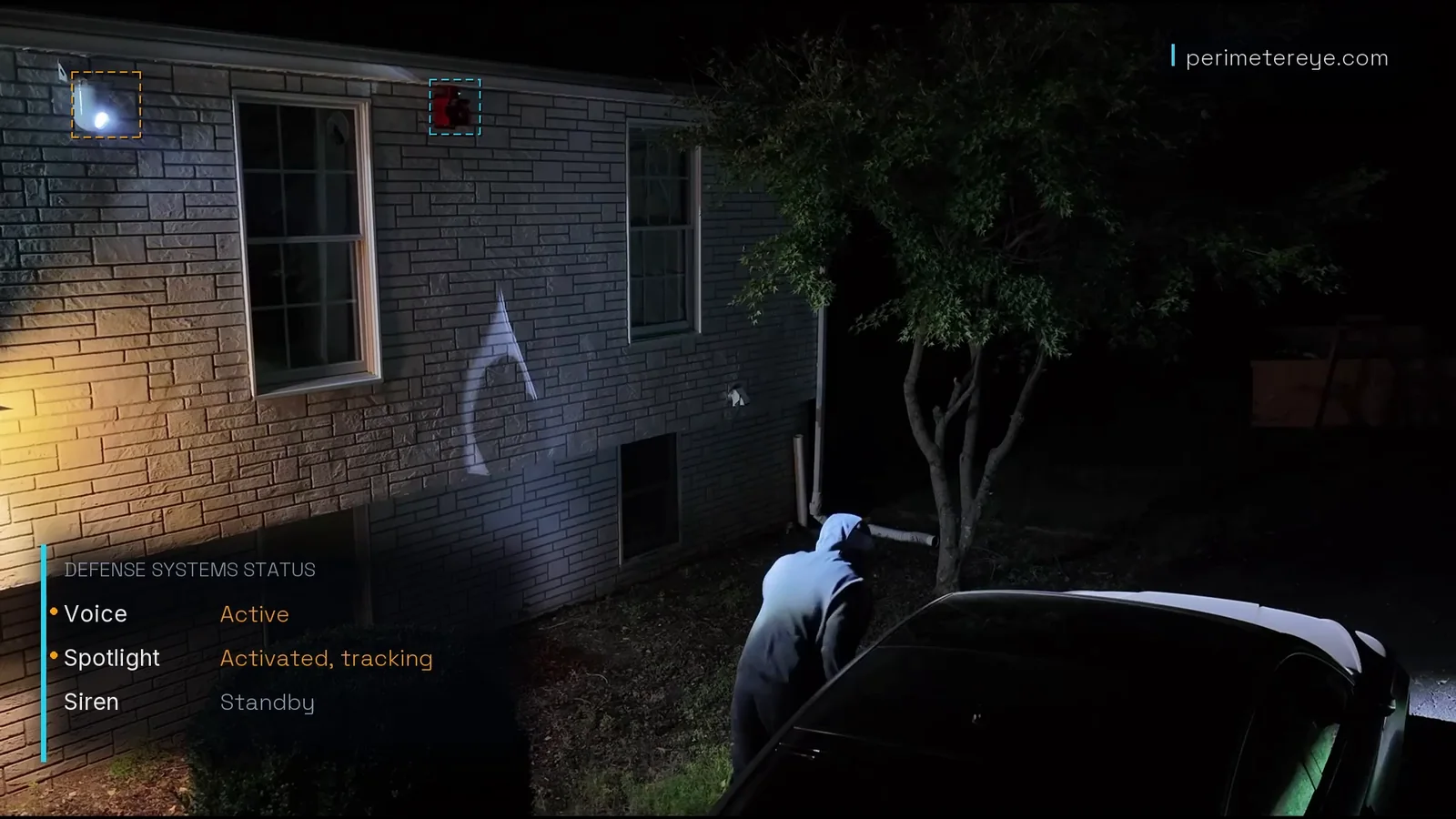
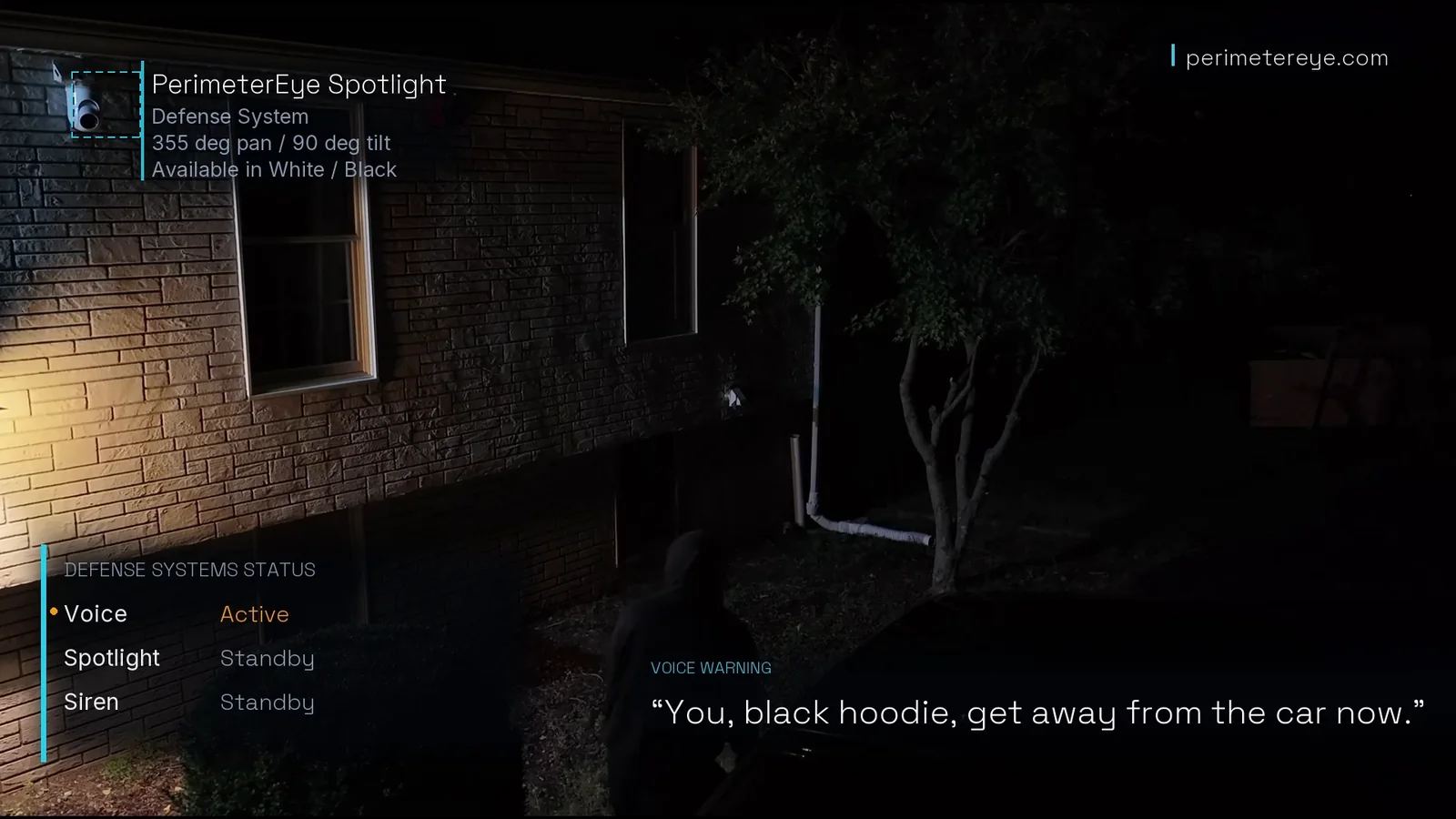
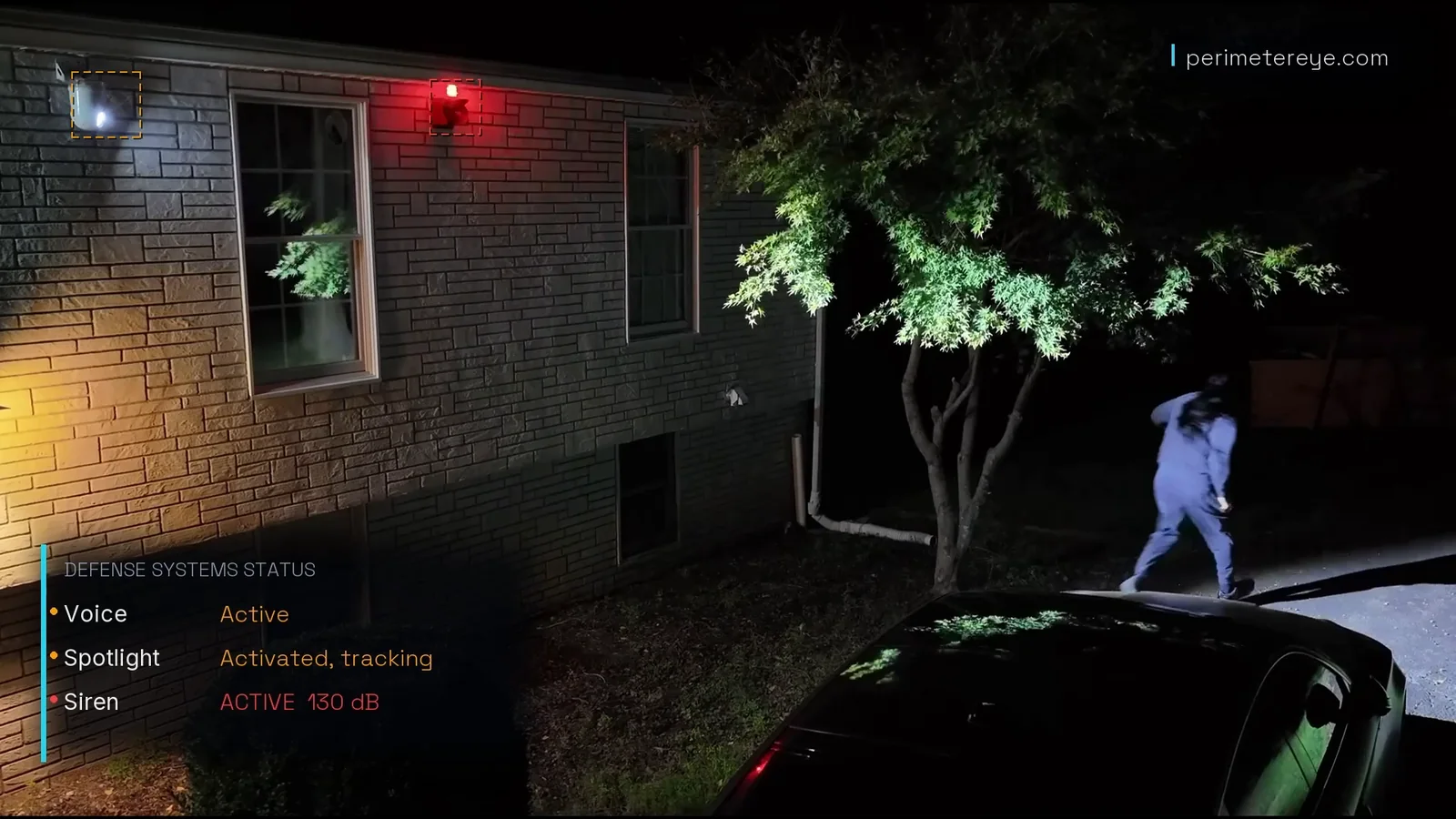
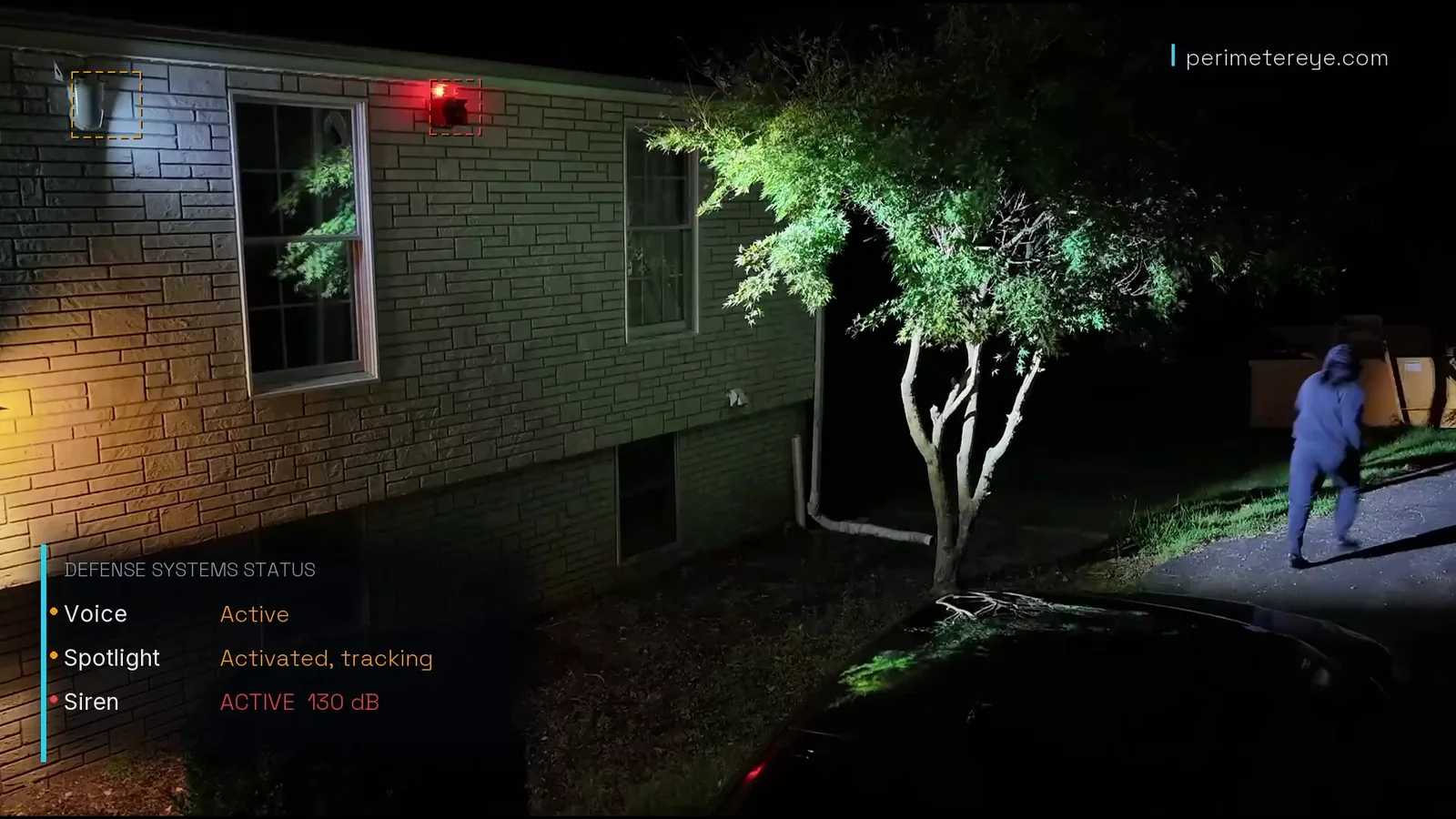
Stills from the demonstration with the system’s status on screen. Each part of the response switches on as the person keeps going, automatically.
1 of 4 · VoiceView full size
A warning with their description
The first response is spoken, and it is about them: “You, black hoodie, get away from the car now.” The searchlight and siren are on standby.
2 of 4 · SearchlightView full size
Then the light finds them
The person stays at the car, so the searchlight activates and tracks. They are lit up where they stand.
3 of 4 · SirenView full size
Then the 130 dB siren
The siren joins the voice and the light, and the person runs from the car.
4 of 4 · FollowedView full size
Followed as they go
The beam stays on them as they run past the tree, with every part of the response still active.
Filmed on a real property. The attempt was staged for filming; the system’s response was automatic, with no operator.
What changes
Three Tiers, One Honest Question
- Passive cameras document; strobe cameras react; active response addresses the specific person in frame.
- Canned deterrence treats a raccoon and a burglar identically — verification is what separates the tiers.
- A searchlight that follows you and a voice that describes you cannot be mistaken for a canned response.
The question that separates the tiers isn't hardware — it's whether anything is paying attention. A passive camera pays none; it remembers. A strobe camera pays the same attention to everything, which rounds down to none. Active response pays attention to the specific person: who they are, where they're moving, and whether they belong.
PerimeterEye — an Automatic Property Defense System — sits firmly in the third tier. Every event gets a written AI analysis and a live threat level, and a verified threat gets a response built for that person: a searchlight that locks on and follows, live speech that describes them, a 130 dB siren if they push it — with you watching live and able to take over at any moment.
What every system includes
- On-site edge computer (the Brain)
- 4K AI cameras
- Tracking searchlights
- Live targeted AI voice
- 130 dB siren escalation
- Doorbell video intercom
- Wall panel command center
- iOS app with live 4K video
01
Tier One: Passive Recording
The classic security camera watches, records, and notifies. Its value is real: evidence for police, remote check-ins, and some deterrent weight just by being visible. In the best-known survey of offenders — 422 incarcerated burglars interviewed for the AIREF-funded UNC Charlotte study (Kuhns et al., 2013) — outdoor cameras ranked among the signs of security that shaped which homes got targeted.
But the picture has a wrinkle. In KGW-TV's 2017 journalistic survey of 86 Oregon inmates, some burglars read cameras as a deterrent while others read them as a hint that something inside was worth protecting. And when someone does hop the fence anyway, a passive camera's whole contribution is a well-lit recording of the crime.
02
Tier Two: Strobe-and-Siren Cameras
"Active deterrence" cameras — the strobe-and-siren models several major camera brands now sell — are a genuine step up. Light and sound on detection beats silence, and against a casual trespasser, a sudden strobe may be all it takes. If your budget stops here, they're a defensible buy.
Their ceiling is that nothing is actually watching. The response is canned: the same flash and the same chirp fire at a raccoon at 3 a.m. and a burglar at 3:05, and the neighbors learn to tune it out about as fast as the raccoons do. A returning intruder learns the response never varies, never follows, and never escalates — which tells them exactly what they're dealing with.
The category is evolving — Alarm.com introduced an automated AI deterrence service called AID at CES 2025, and RAD launched its RADCam talking camera in 2024 — but the question to ask stays the same: does the response know who it's responding to?
03
Tier Three: Active Response
True active response starts where canned deterrence stops: with verification. PerimeterEye's AI writes an analysis of every event, classifies who it's seeing, and holds a live threat level. Routine motion never wakes the hardware. A verified intruder gets the full ladder — automatically, in seconds, while you watch live.
A motorized searchlight locks onto the person and physically follows them — 355 degrees of rotation, 90 degrees of tilt, searchlight-class output that homeowners compare to a police helicopter's light. Then the AI addresses them specifically, in live speech: "You, in the dark hoodie — you are not authorized to be on this property." Persist, and a 130 dB siren fires with priority alerts and live video to the owner.
That specificity is the whole point. A generic strobe says a sensor tripped. A light that follows your movements and a voice that describes your clothing says you have been seen, individually — and that everything you do next is being documented.
04
What the Evidence Says About Light and Attention
In the UNC Charlotte survey, roughly 60 percent of burglars said they would seek another target if they discovered an alarm, and over half said they would abort a burglary already in progress upon discovering one (Kuhns et al., 2013 — an industry-funded study, worth noting). The lesson: consequences that arrive early and unmistakably change decisions.
Lighting carries the strongest causal evidence of all. A randomized experiment across 77 NYC public-housing developments found added nighttime lighting cut outdoor nighttime index crimes by roughly 36 percent (Chalfin, Hansen, Lerner and Parker, NBER Working Paper 25798, 2019). A tracking searchlight applies that principle to one person at a time, at the exact moment it matters.
05
The Honest Comparison
None of this makes passive cameras worthless or strobe cameras a scam. It's a ladder, and each rung costs more than the last. The question is what you're buying: a record of what happened, a reflex that fires at anything, or a response aimed at the specific person on your property.
One caveat applies to all three tiers equally: no security system can guarantee prevention of every incident. What changes as you climb is how much happens before you even pick up your phone — and how much evidence exists afterward.
- Passive recording: documents everything, deters somewhat, responds never
- Strobe/siren cameras: respond instantly but identically — to raccoons, headlights, and burglars alike
- Active response: verifies first, then tracks, addresses, and escalates against the specific person
- Only active response keeps a human option open mid-event — watch live, talk, or take manual control
What separates PerimeterEye
During the incident, and after.
Cameras are a witness. Active deterrence is a response.
| Option | During the incident | Afterward |
|---|---|---|
| Security cameras | Record it and send a notification. | A clip. |
| Cameras with a light or siren you trigger | Whatever you trigger from the app, if you see the alert in time. | A clip. |
| PerimeterEye active deterrence | Voice, then the tracking searchlight, then a 130 dB siren, automatically. | The Event Timeline with the camera views and every response. |
Watch it at full speed
The same response, on film.
Real footage of the working system. Play it with sound to hear the voice warning and the siren.
Detection, tracking searchlight, spoken warning and siren escalation, end to end — all recorded output from a working system.
Play with sound to hear the voice warning and siren.What it costs
See what a system costs for your property.
Essential system
As low as$146/mo*Essential covers a driveway and the approaches to the house. Larger properties usually suit Advanced or Estate; a specialist can size it with you before you order.
What’s included
- 5 ultra-HD 4K cameras
- 1 tracking spotlight
- 1 speaker/siren unit
- PerimeterEye Access intercom, included with every complete system
- 1 PerimeterEye control panel
- 1 PerimeterEye AI processor
*Essential system, $0 down: 36 monthly payments of $145.17 at 10% APR on the hardware price before sales tax, shown rounded up to the dollar. Affirm rates 0–36% APR; Klarna terms are shown at checkout. Subject to eligibility and lender approval; your rate, term and down payment may differ. US only; not available in all states. Software is billed separately: first 6 months included, then $99/month.
Before you choose
Common questions
Are strobe light security cameras actually effective?
Somewhat — and honestly more effective than passive cameras against casual intrusion, since sudden light and sound beat silence. Their weakness is habituation: the response is identical for every trigger, so false activations train neighbors and repeat visitors to ignore it. A deterrent that can't distinguish targets slowly loses its credibility.
What's the difference between "active deterrence" and active response?
Active deterrence, as camera brands use the term, means automated light and sound on detection — no judgment, same response every time. Active response verifies a threat first, then reacts to the specific person: a searchlight that physically follows them, live AI speech describing them, and a siren only when escalation is warranted.
Isn't a recorded warning message just as good as live AI speech?
A recording announces that a sensor tripped. Live, targeted speech — naming the gray jacket, the position by the garage door — announces that a system has seen this person, right now, specifically. Intruders can safely ignore the first; the second strips away the anonymity that trespassing depends on.
Will PerimeterEye's siren and searchlight fire at animals?
The escalation ladder is gated on verification — that's the core difference from strobe cameras. Routine wildlife, headlights, and weather get analyzed and documented, not blasted. Deterrence is reserved for verified threats, which is precisely what keeps the response credible in the moments that actually deserve it.
Why does active deterrence work better than recording?
Early, unmistakable consequences change decisions: most surveyed burglars said discovering an alarm would push them elsewhere (Kuhns et al., 2013). Active response makes those consequences personal and immediate, during the incident rather than after it, and documents all of it. No security system can guarantee prevention of every incident.
Keep exploring
Related reading
Put a response behind your property.
Tell a specialist about your property, your driveway, and where people approach. They’ll size the cameras, searchlights, and sirens with you, or book a call first if you’d rather talk it through.
Explore an upgrade for your existing camerasSystem launch offer
Your first 6 months
of service included.
First 6 months included from activation. Then $99/month.
Compare system packages