Security Cameras That Talk to Intruders — and the System That Talks First
Every security camera that talks to intruders falls into one of three buckets: canned clips, owner two-way talk, or a paid call center. The fourth option is not a camera at all — PerimeterEye is an Automatic Property Defense System whose live AI speaks first, in seconds, describing the specific person in frame while a tracking searchlight holds them and a 130 dB siren waits one rung up.
 View photo
Frame by frame, from the demonstration
Voice first. Then the light. Then the siren.
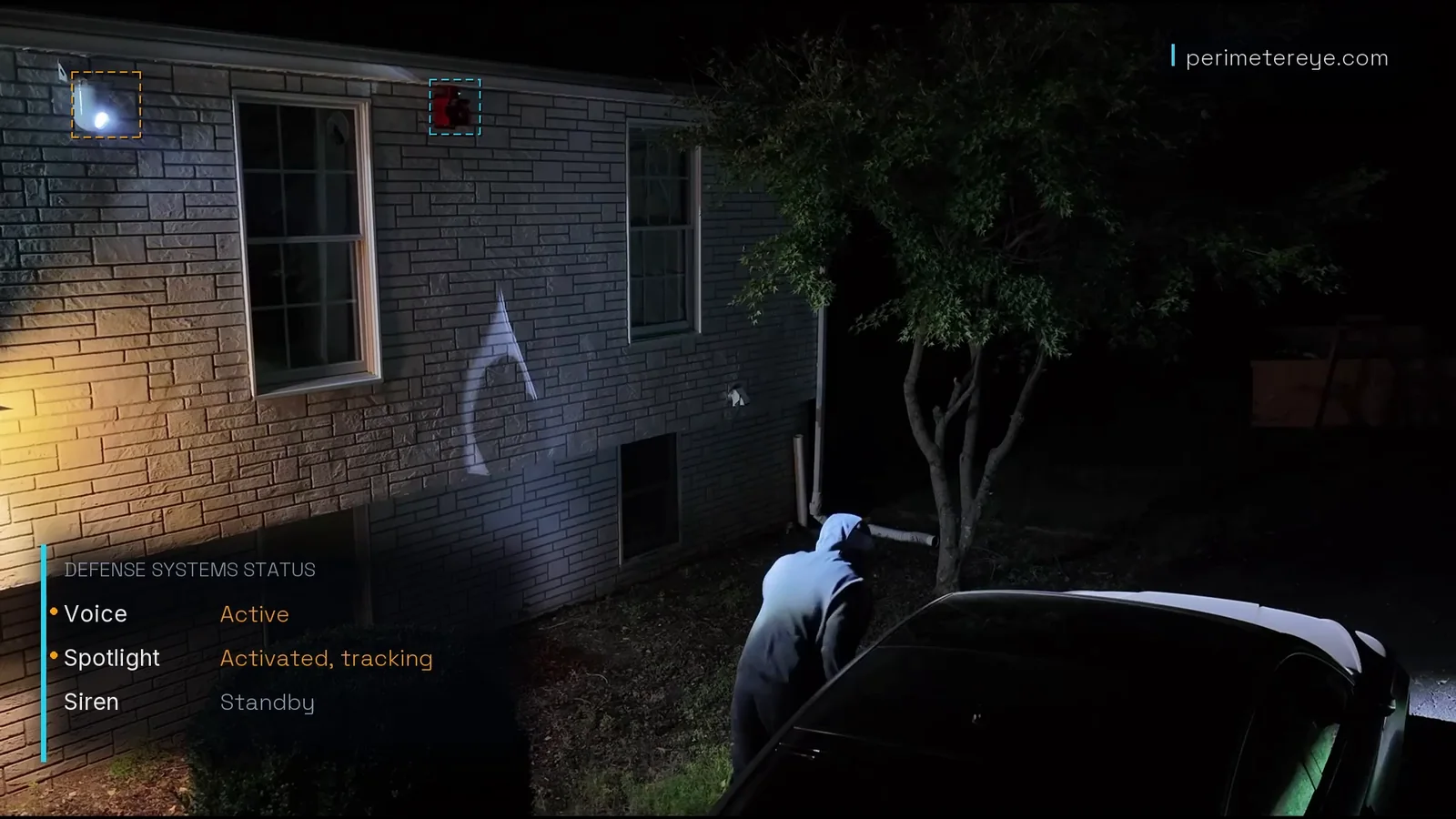
Stills from the demonstration with the system’s status on screen. Each part of the response switches on as the person keeps going, automatically.
1 of 4 · VoiceView full size
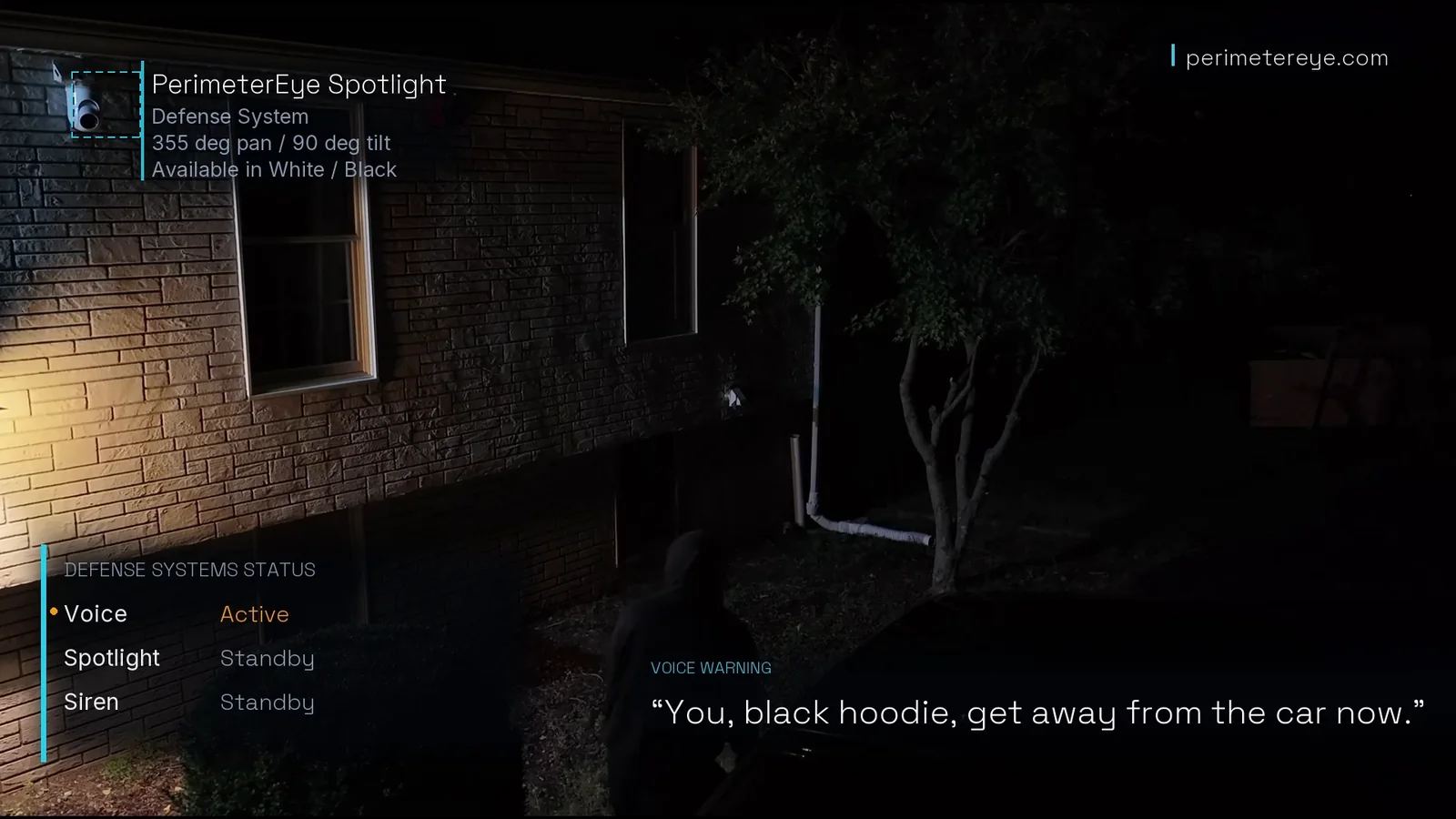
A warning with their description
The first response is spoken, and it is about them: “You, black hoodie, get away from the car now.” The searchlight and siren are on standby.
2 of 4 · SearchlightView full size
Then the light finds them
The person stays at the car, so the searchlight activates and tracks. They are lit up where they stand.
3 of 4 · SirenView full size
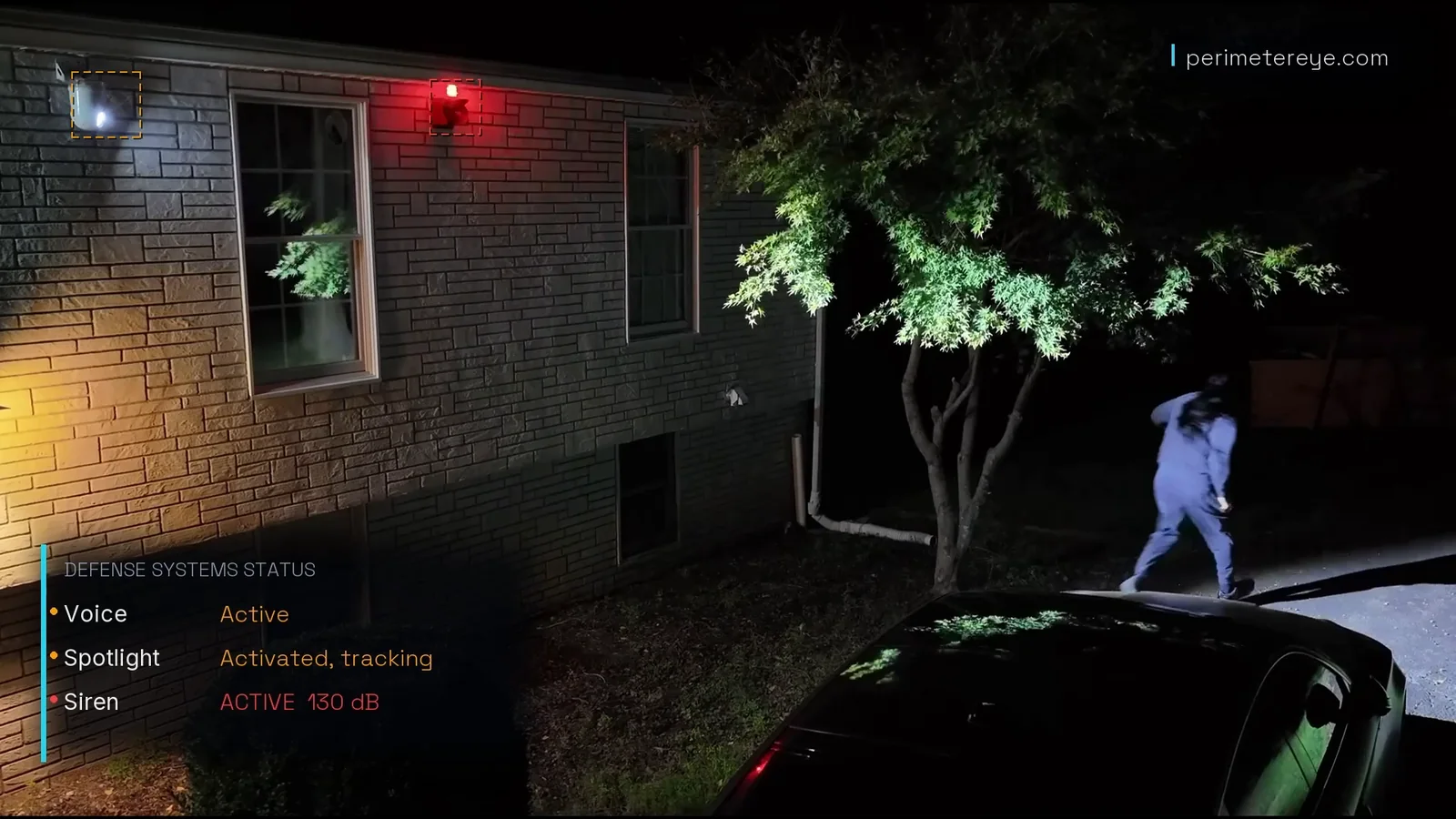
Then the 130 dB siren
The siren joins the voice and the light, and the person runs from the car.
4 of 4 · FollowedView full size
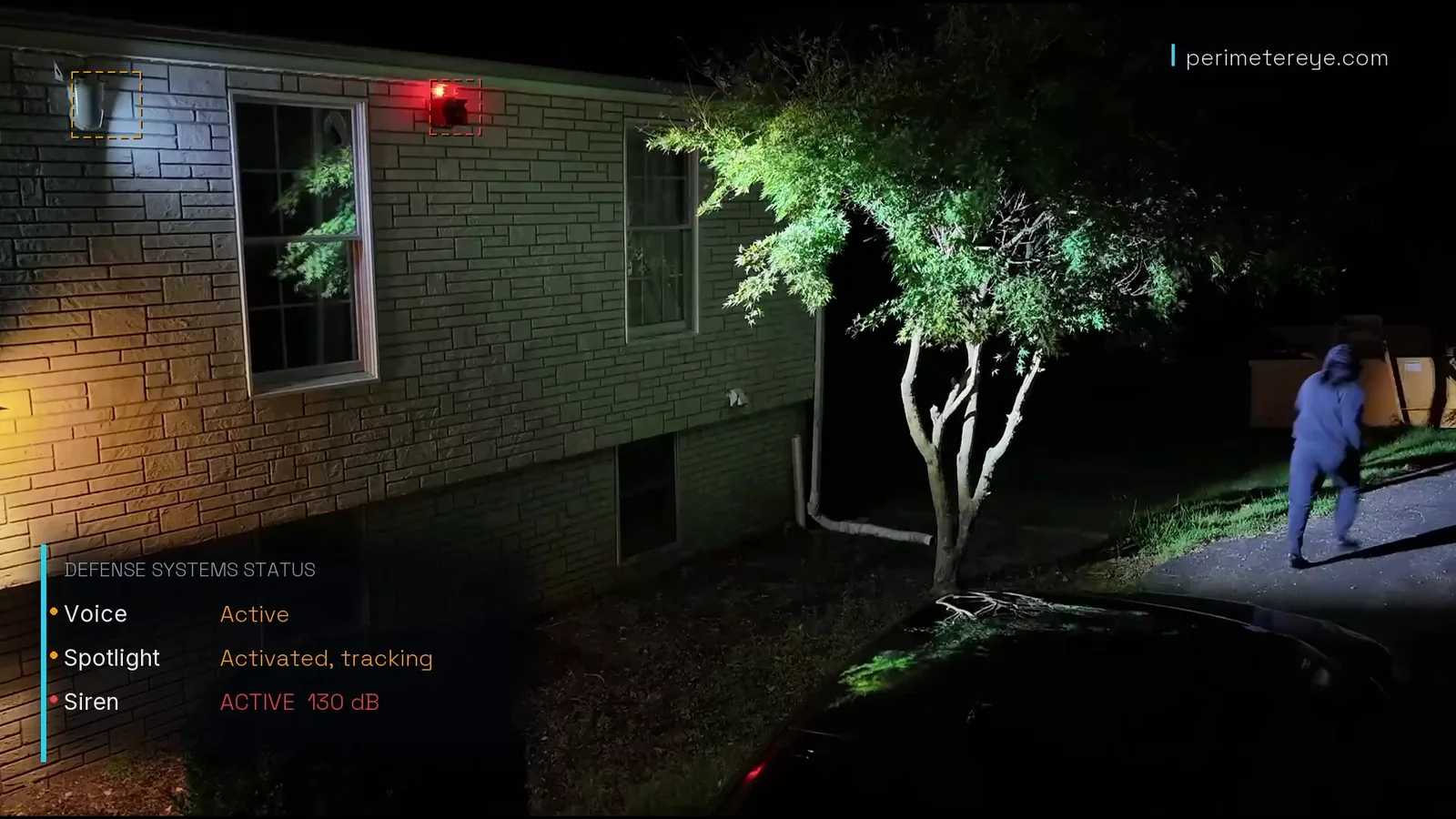
Followed as they go
The beam stays on them as they run past the tree, with every part of the response still active.
Filmed on a real property. The attempt was staged for filming; the system’s response was automatic, with no operator.
What changes
Built to Speak First
- The AI speaks first — a live, targeted callout in seconds, not a recording and not a human who has to wake up.
- Every word is backed by a tracking searchlight already locked on and a 130 dB siren one rung up the ladder.
- It knows the household, so your family and the mail carrier never get called out by the jacket they are wearing.
Most talking cameras are speakers waiting for input — a clip, your thumb on the app, an agent in a queue. PerimeterEye inverts that. The system's on-site AI verifies what it sees and initiates the conversation itself, in seconds, with a warning composed for the exact person in frame. Nobody has to notice an alert for the property to respond.
The voice also never stands alone. It arrives with a motorized searchlight already locked on and physically tracking, and it sits one rung below a 130 dB siren and priority alerts with live video. You can listen in, cut in with your own voice, or take manual control at any point — but nothing depends on you doing so.
What every system includes
- On-site edge computer (the Brain)
- 4K AI cameras
- Tracking searchlights
- Live targeted AI voice
- 130 dB siren escalation
- Doorbell video intercom
- Wall panel command center
- iOS app with live 4K video
01
The Four Kinds of Talking Camera, Ranked by Who Actually Speaks
"Talking camera" covers four very different products, and the differences matter more than any spec sheet. The right question is not whether the camera has a speaker — nearly all of them do. It is who does the talking, how fast they start, and whether the person on your lawn has any reason to believe the voice can actually see them.
Ranked from weakest to strongest: pre-recorded clips that play on motion; two-way talk, where you speak through the camera yourself; call-center talk-down, where a paid agent eventually speaks; and live, targeted AI speech that starts in seconds and describes the exact person in frame. Only the last one works when you are asleep, in a meeting, or on a plane — and only the last one is specific enough to be believed.
- Canned clips: a motion sensor triggers "You are being recorded" — the same loop for a raccoon, a courier, and a burglar.
- Owner two-way talk: a real voice, but only after you notice the alert, open the app, and decide what to say.
- Call-center talk-down: a human agent speaks on your behalf — competent, but staffed, queued, and typically $80–$100 per month as of mid-2026.
- Live targeted AI speech: PerimeterEye's on-site AI addresses the specific person — "You, in the dark hoodie by the garage" — within seconds, unprompted.
02
Why Canned Clips Stopped Working
The first generation of talking cameras taught intruders a lesson their vendors did not intend: a generic voice means nobody is actually watching. When the same "You are being recorded" clip plays for every squirrel, the message an experienced prowler hears is that the speaker is a motion sensor, not a person. They wait, the clip ends, nothing follows, and they carry on.
The people doing the breaking in are more calculating than the clips assume. When journalist Kyle Iboshi surveyed 86 convicted Oregon burglars for KGW-TV in 2017 — a journalistic survey, not a peer-reviewed study — nearly all said they knocked or rang the doorbell first to test whether anyone was home. Intruders probe for a response. A canned clip fails that probe instantly, because it responds identically no matter what they do.
What survives the probe is specificity. A voice that says what you are wearing and where you are standing cannot be a loop. That is the entire design premise behind PerimeterEye's live warnings — see /voice-warnings for how the callouts are built.
03
Two-Way Talk and Call Centers: Someone Has to Pick Up
Two-way talk — standard on Ring, Nest, Eufy, and most video doorbells — is genuinely useful for waving off a courier or telling a visitor you will be right down. As a deterrent it has one structural flaw: it requires you. You must feel the buzz, recognize it among a day's worth of notifications, open a live view, and start talking, all while the person keeps moving. At 3 a.m., that chain almost never completes.
The call-center tier fixes the 3 a.m. problem by paying humans to be awake. As of mid-2026, Deep Sentinel puts live guards in a surveillance center from roughly $100 per month, SimpliSafe's Active Guard puts live agents on up to three outdoor cameras, 24/7 on a tier around $80 per month, and Ring's Virtual Security Guard is a professional agent add-on at about $99 per month. These are competent monitoring services staffed by real people.
But a relay is still a relay. The AI flags, the clip routes to a queue, an agent opens the feed, assesses, then speaks. Every step is reasonable; the sum is time — and the whole model bills you monthly for reaction speed that an on-site system delivers by default.
04
What Speaking First Actually Sounds Like
PerimeterEye's AI watches every camera, verifies what it sees, and — when a person has no business being there — speaks immediately, live, in plain language: "You, in the dark hoodie standing by the garage door — you are not authorized to be on this property. You are being documented and the owner has been alerted." It is not a recording. The words are composed in the moment to describe that specific person in that specific place.
The voice never fires blind. It comes after verification, and after a motorized tracking searchlight — 355 degrees of rotation, 90 degrees of tilt, searchlight-class output — has locked onto the person and started physically following them. Homeowners compare the effect to a police helicopter beam. Being lit, followed, and described in one sentence is a categorically different experience from hearing a speaker crackle somewhere in the dark.
And it knows the household. Family arrivals and the regular mail carrier never trigger deterrence, in any mode. Package detection and delivery guidance work in every mode except Off and Quiet, so a courier hears helpful directions while an unknown person circling your cars hears a warning. The voice is reserved for exactly the people it should be reserved for.
05
The Voice Is One Rung on a Ladder
A talking camera that can only talk is a bluff, and bluffs get called. PerimeterEye's warning sits in the middle of an escalation ladder: the AI verifies, the searchlight locks on and follows, the targeted voice warning is delivered, and if the person stays, a 130 dB siren fires alongside priority alerts with live video to your phone and wall panel. You can watch, cut in with your own voice, or take manual control at any point.
There is no operations center behind any of this. PerimeterEye is not an alarm-monitoring service — alerts and control go directly to you. The talking happens on your property, from a system you own, whether or not you are reachable — and core defense keeps running even if your internet goes down. That is the honest answer to the search you typed: you do not want a camera you can talk through. You want a property that talks first.
What separates PerimeterEye
Three kinds of talking camera. One that talks first.
Most cameras that talk need you, or a paid agent, to do the talking. PerimeterEye speaks on its own, about the person in front of it.
| Option | How the voice works | What the person hears |
|---|---|---|
| Camera with a canned clip | Plays the same recorded clip whenever anything moves: a delivery, a raccoon, a person. | A generic announcement they have heard before. |
| Two-way talk | You speak through the camera, if you see the alert in time and open the app. | Whatever you manage to say, whenever you get there. |
| Live agent add-on | A remote agent reviews your camera and may speak through it. | An agent’s voice, once an agent is on your camera. |
| PerimeterEye | Speaks on its own the moment the activity warrants it, then adds the tracking searchlight and a 130 dB siren. | Their own description: “You, black hoodie, get away from the car now.” |
Watch it at full speed
The same response, on film.
Real footage of the working system. Play it with sound to hear the voice warning and the siren.
Detection, tracking searchlight, spoken warning and siren escalation, end to end — all recorded output from a working system.
Play with sound to hear the voice warning and siren.What it costs
See what a system costs for your property.
Essential system
As low as$146/mo*Essential covers a driveway and the approaches to the house. Larger properties usually suit Advanced or Estate; a specialist can size it with you before you order.
What’s included
- 5 ultra-HD 4K cameras
- 1 tracking spotlight
- 1 speaker/siren unit
- PerimeterEye Access intercom, included with every complete system
- 1 PerimeterEye control panel
- 1 PerimeterEye AI processor
*Essential system, $0 down: 36 monthly payments of $145.17 at 10% APR on the hardware price before sales tax, shown rounded up to the dollar. Affirm rates 0–36% APR; Klarna terms are shown at checkout. Subject to eligibility and lender approval; your rate, term and down payment may differ. US only; not available in all states. Software is billed separately: first 6 months included, then $99/month.
Before you choose
Common questions
How does the camera know what the intruder is wearing?
PerimeterEye's on-site AI writes a plain-language analysis of every event on every camera — who is in frame, what they are wearing, where they are standing. The live warning draws on that same analysis, which is why it can say "you, in the dark hoodie by the garage" instead of playing a generic clip.
Will it yell at my family or the delivery driver?
No. The system knows the household, so family arrivals and regular mail carriers never trigger deterrence. Deliveries get the opposite treatment: package detection and delivery guidance work in every mode except Off and Quiet, so a courier hears directions while an unknown person circling the property at 2 a.m. hears a warning.
Can I still talk through it myself?
Yes, any time. Every camera has two-way audio, and the doorbell intercom carries full video conversations from the iOS app or wall panel. The difference is that you are never the single point of failure — if you do not pick up, the AI has already spoken, with the searchlight and siren behind it.
Is a human call center doing the talking?
No. PerimeterEye is not an alarm-monitoring service — alerts and control go directly to you. The voice is the system's own live AI, running on the Brain installed at your property, which is why it starts in seconds instead of waiting for an agent to pull your clip out of a queue.
Why does a voice that describes them work?
Intruders probe for a response. In a 2013 UNC Charlotte survey of 422 incarcerated burglars (industry-funded), about 60% said they would seek another target on finding an alarm. A voice that describes the person proves the response is real and about them, and PerimeterEye follows it with the searchlight, the siren, and full documentation. No security system can guarantee prevention of every incident.
Keep exploring
Related reading
Put a response behind your property.
Tell a specialist about your property, your driveway, and where people approach. They’ll size the cameras, searchlights, and sirens with you, or book a call first if you’d rather talk it through.
Explore an upgrade for your existing camerasSystem launch offer
Your first 6 months
of service included.
First 6 months included from activation. Then $99/month.
Compare system packages