AI Security Guard for Home: the Human-Relay Model vs. the System That Acts Itself
Most products sold as an AI security guard for home are really AI detection plus a human: software flags motion, then an agent in a distant center decides what to do — usually an $80–$100 monthly add-on as of mid-2026. PerimeterEye takes the opposite approach: it is an Automatic Property Defense System whose on-site AI verifies, locks a tracking searchlight on, calls the person out by description, and escalates to a 130 dB siren — on its own, in seconds.
 View photo
Frame by frame, from the film
Five seconds from the door handle to running away.
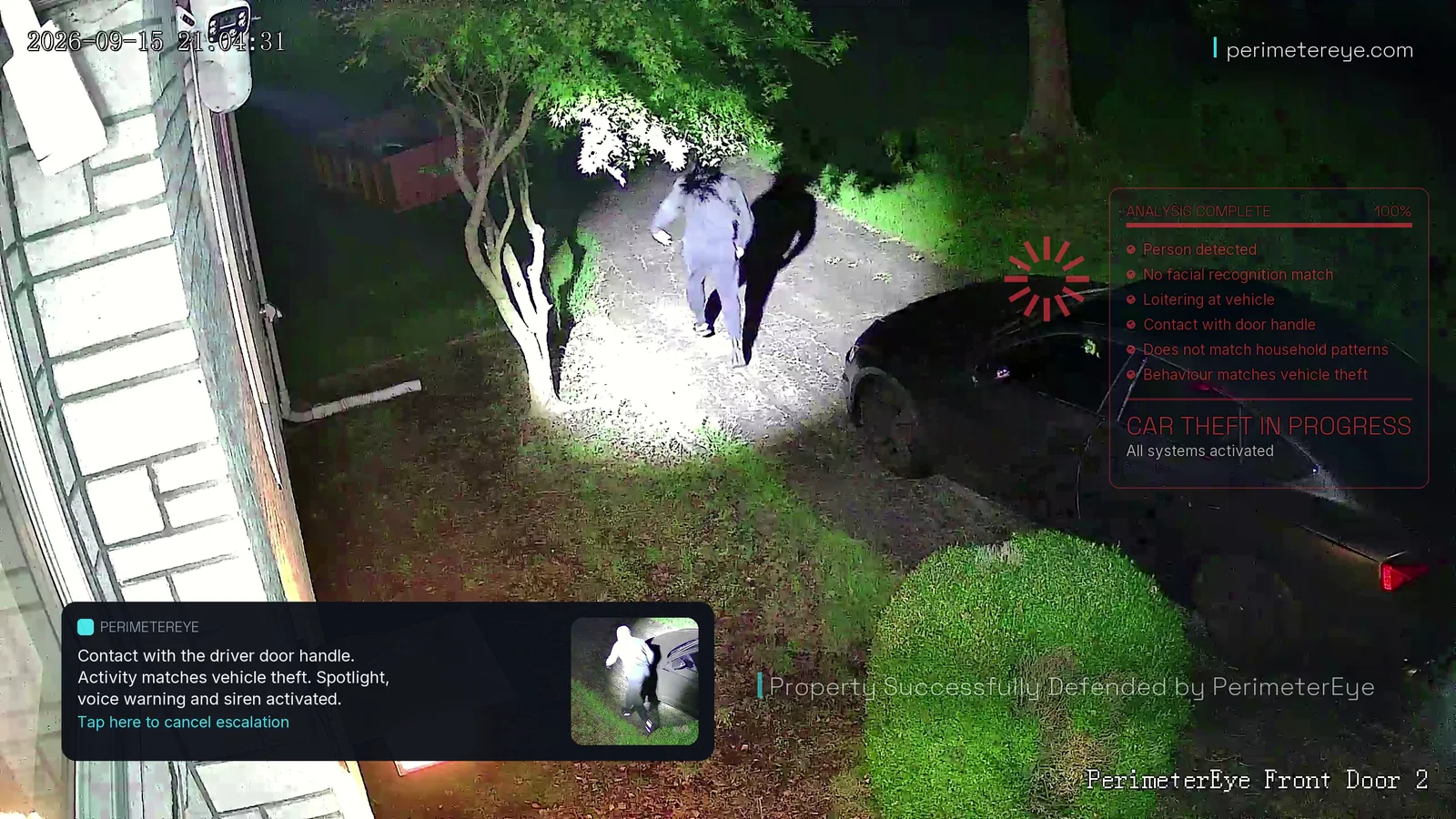
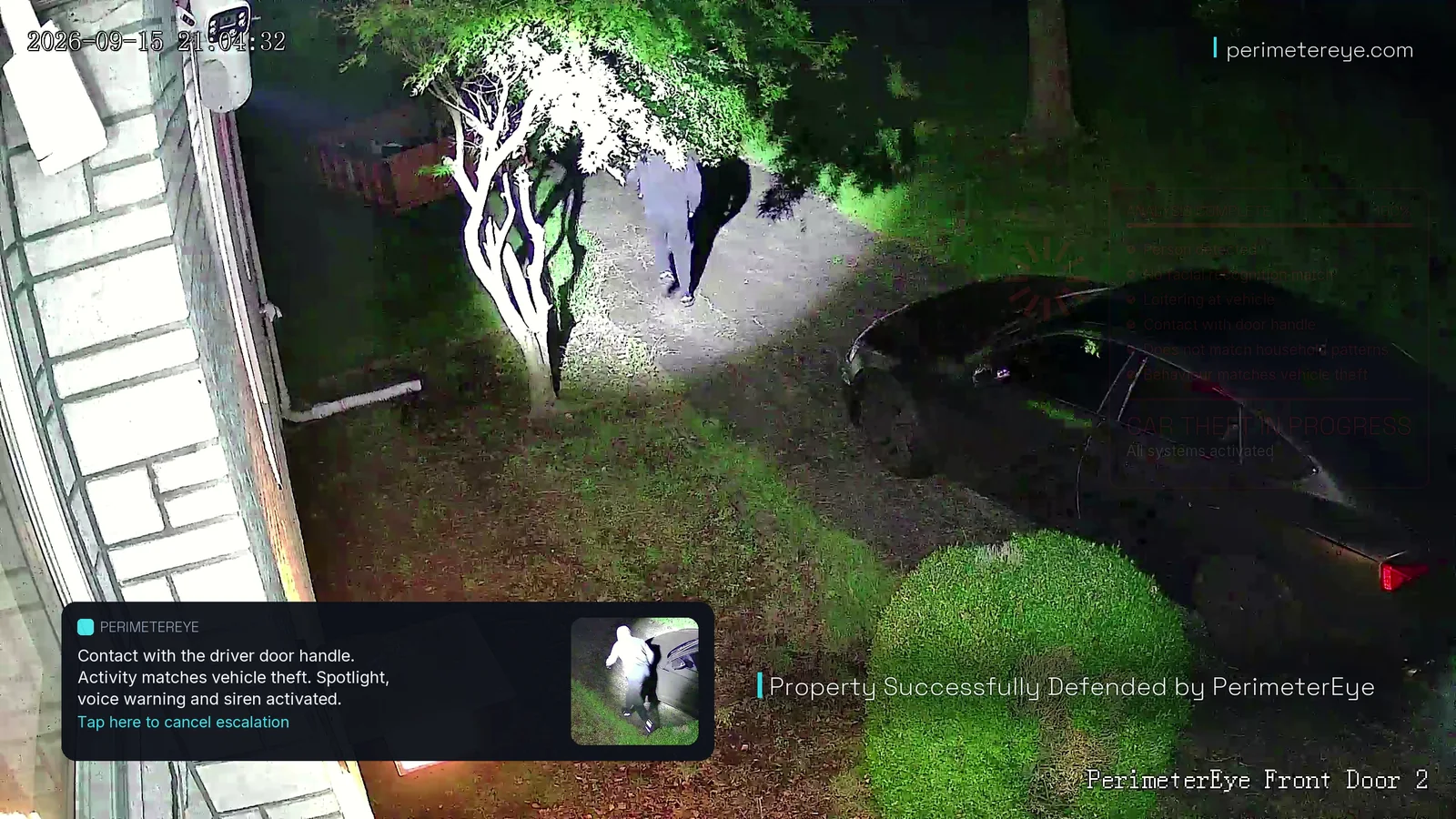
Stills from the film with its on-screen analysis and phone alert, on the Front Door 2 camera’s own clock. The door handle registers at 21:04:26. By 21:04:29 all systems are activated, and at 21:04:31 the person is running.
1 of 6 · 21:04:23View full size
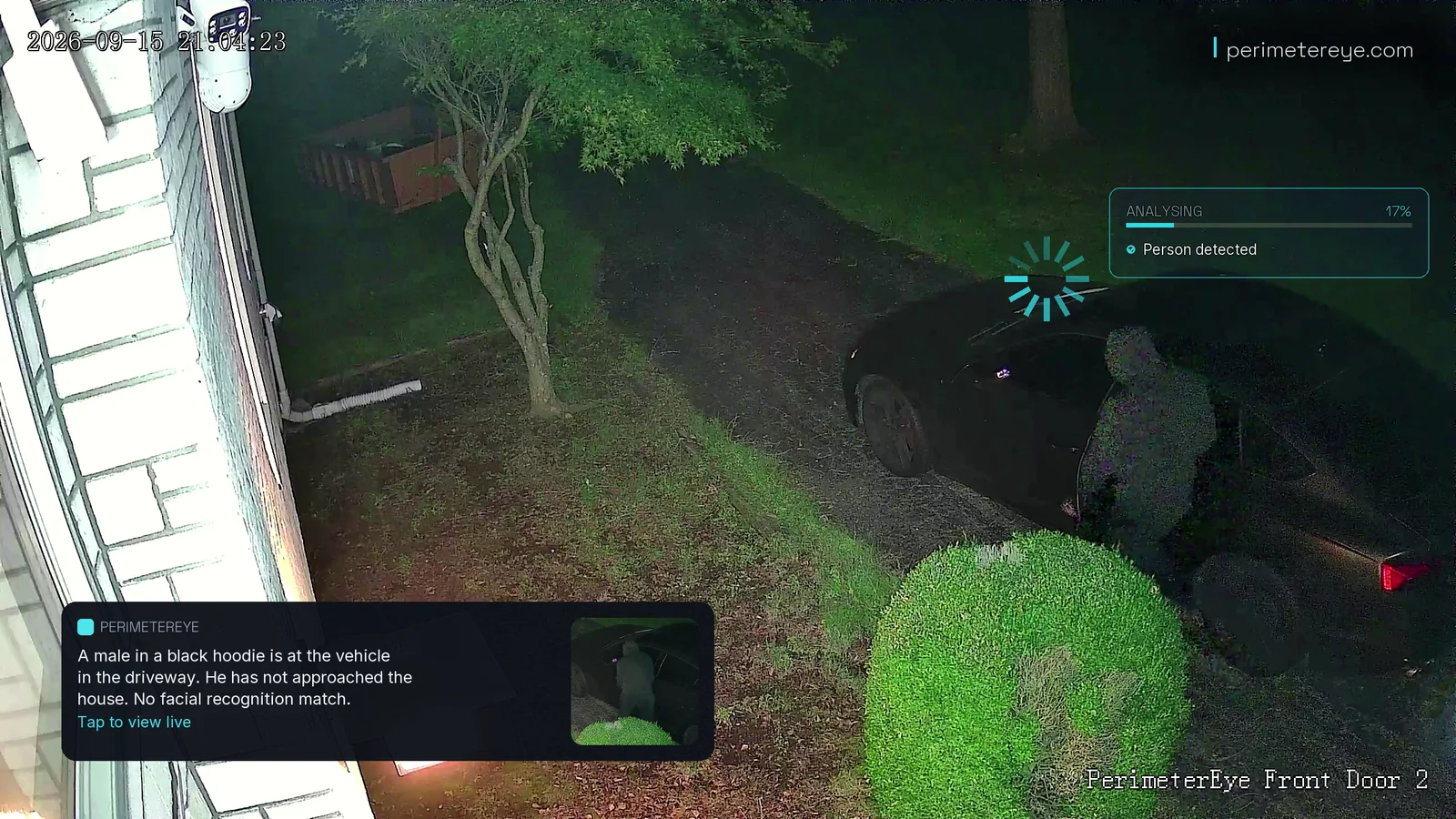
The first alert
The person in the black hoodie is at the car, and the first alert already describes them: at the vehicle in the driveway, and has not approached the house.
2 of 6 · 21:04:26View full size
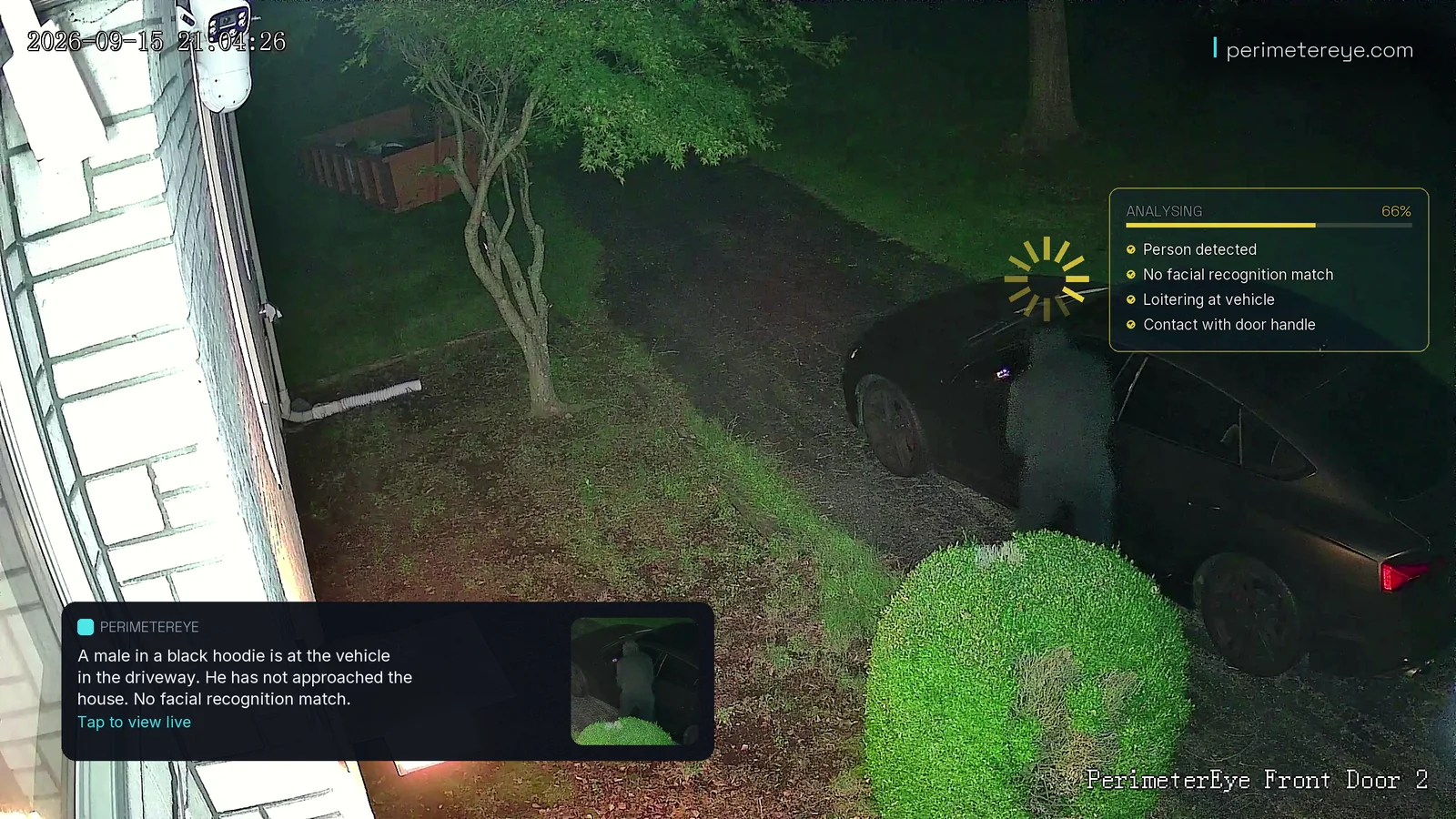
Contact with the door handle
The person reaches for the driver’s door. The analysis builds second by second: a person, no match to anyone it knows, loitering at the vehicle, and now contact with the door handle.
3 of 6 · 21:04:29View full size
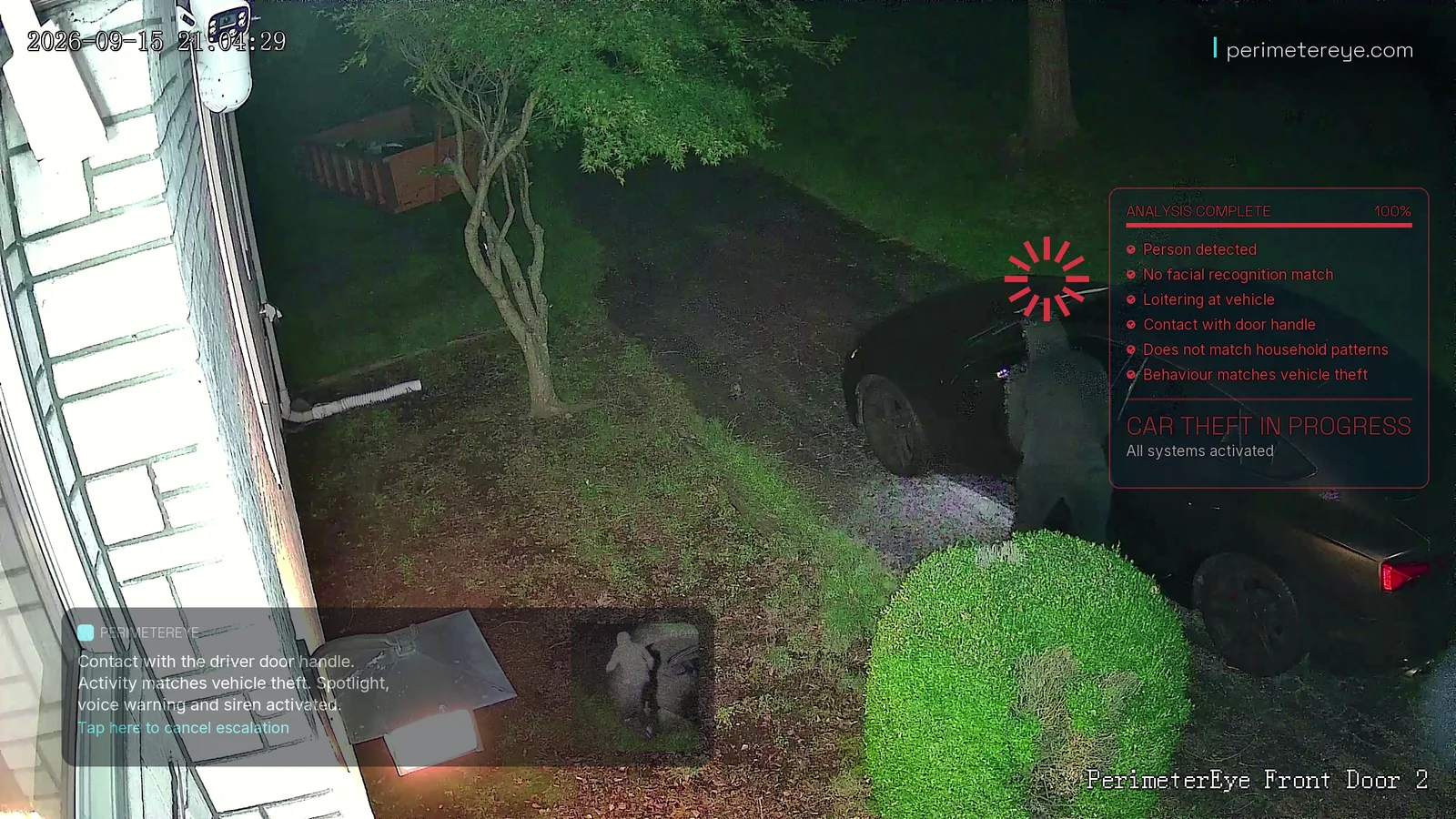
Car theft in progress
Three seconds after the door handle, the analysis is complete: the activity doesn’t match the household’s patterns and matches vehicle theft. All systems activate.
4 of 6 · 21:04:30View full size
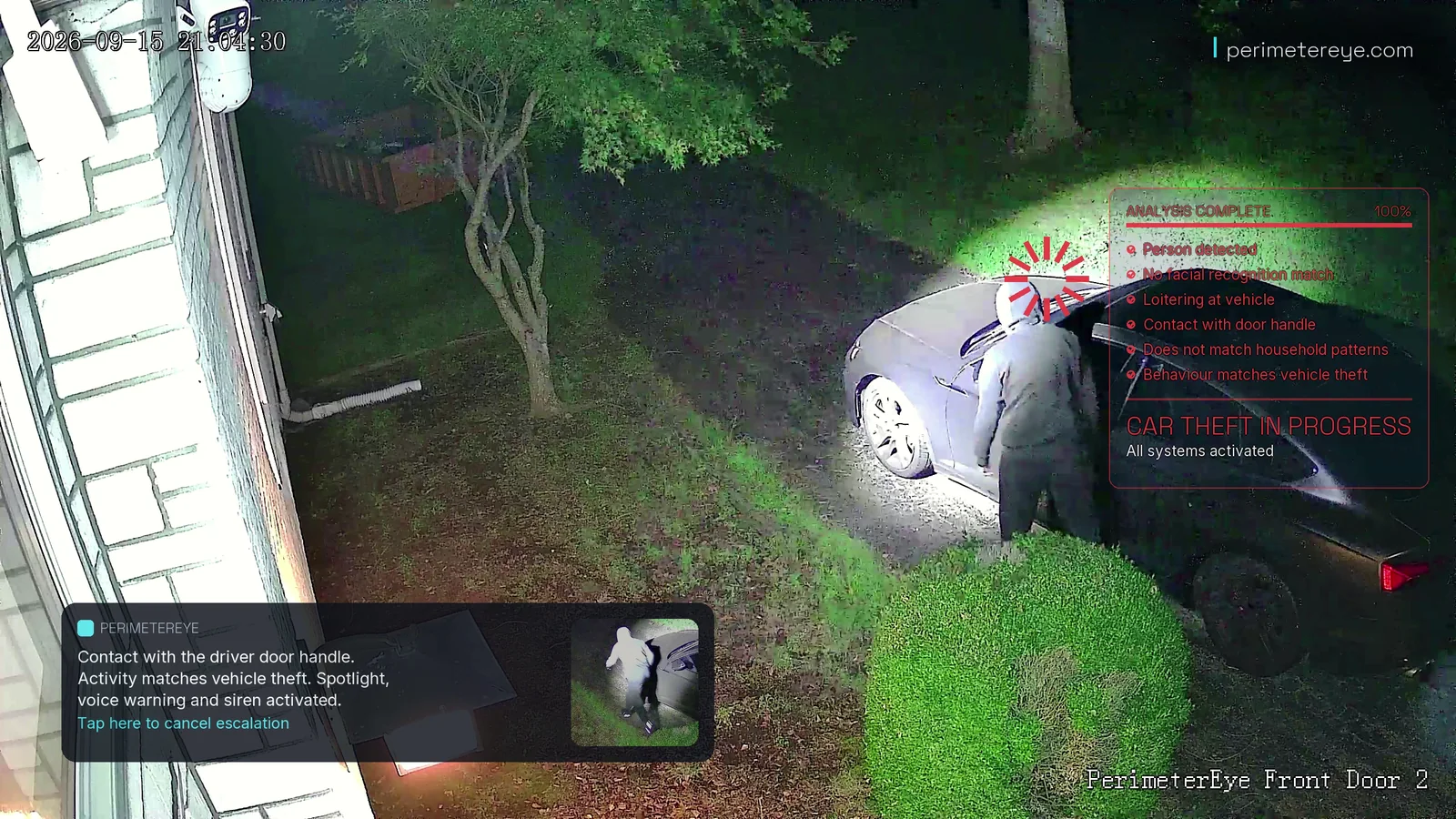
The searchlight lands
The searchlight hits the person at the driver’s door. The alert reads: spotlight, voice warning and siren activated, with a tap to cancel the escalation.
5 of 6 · 21:04:31View full size
Running, and the beam follows
Five seconds after touching the door handle, the person is running down the drive, and the searchlight has moved with them, away from the car.
6 of 6 · 21:04:32View full size
Followed away from the car
The searchlight follows the person past the tree and along the drive. The car hasn’t moved.
Filmed September 15, 2026, on a real property. The break-in was staged for filming; the system’s response was automatic, with no operator.
What changes
The Job People Want a Guard For, Done by the Property
- The intelligence lives on your property — a dedicated on-site computer, not a chair in someone else's operations center.
- It acts in seconds — verify, light, speak, siren — with no hold queue, no shift change, and no per-agent fee.
- $99 per month runs the AI itself; you own the hardware, and there is no monitoring contract to sign.
Human guard services sell attention by the hour, and attention has a shift schedule, a queue, and a monthly price that reflects both. PerimeterEye gives that job to the property itself: an on-site AI with eyes on every camera simultaneously, all night, every night, responding the same way at 3 a.m. on a holiday as it does at noon on a Tuesday.
That autonomy is bounded by design. Deterrence is light, voice, and sound — never anything more. Family and regular visitors are recognized and left alone, and you can watch, speak, or take manual control at any moment from the app or the wall panel.
What every system includes
- On-site edge computer (the Brain)
- 4K AI cameras
- Tracking searchlights
- Live targeted AI voice
- 130 dB siren escalation
- Doorbell video intercom
- Wall panel command center
- iOS app with live 4K video
01
What "AI Guard" Means Everywhere Else
Search for an AI security guard and nearly every result is the same architecture wearing different branding: software flags motion, and a human — somewhere else — decides what to do about it. The AI is a doorbell for an agent. As of mid-2026, Deep Sentinel staffs live guards in a surveillance center from roughly $100 per month, SimpliSafe's Active Guard puts live human agents on up to three outdoor cameras, 24/7 on a tier around $80 per month, and Ring's Virtual Security Guard is a professional agent add-on at about $99 per month.
The category is moving — Alarm.com introduced an automated AI deterrence service called AID at CES 2025, and RAD launched its RADCam talking camera in 2024 — but the dominant model is still AI-flags-it, human-handles-it. These are competent services run by serious companies. They are also, structurally, monitoring: the intelligence lives in a building far from yours, and the response arrives over a relay.
02
Human-Relay Guards vs. an On-Property System
Put the two models side by side and the differences are structural, not incremental. A relay guard can be attentive and well trained; it cannot be instant, because the model inserts a queue and a decision-maker between detection and response. An on-property system collapses that chain to a single step.
None of this makes human agents useless — for a business with complex liability requirements, a staffed service may be exactly right. For a home, the question is simpler: when someone steps over your fence at 2 a.m., do you want the first response measured in seconds on-site, or routed through a shift schedule in another state?
- Where the intelligence lives: relay guards run in a distant operations center; PerimeterEye runs on the Brain, a dedicated edge computer installed at your home.
- Who responds: relay guards route a clip to whichever agent is free; PerimeterEye's AI responds itself, immediately, on every camera at once.
- First response: a relay needs flag, queue, human review, then action; PerimeterEye verifies and has a tracking searchlight locked on within seconds.
- The voice: an agent reads your address off a screen; PerimeterEye describes the person live — "you, in the dark hoodie by the garage."
- What the subscription buys: relay pricing ($80–$100 per month as of mid-2026) buys agent hours; PerimeterEye's $99 per month runs the on-site AI itself.
- Internet outage: a relay guard goes blind; PerimeterEye's live view, recording, rewind, spotlights, and siren keep working on the Brain.
03
What the On-Property System Does All Day
A guard who only reacts to break-ins is a bad guard. PerimeterEye's AI writes a full plain-language analysis of every event on every camera — deliveries, residents, visitors, vehicles, service workers, unknowns — each with a live threat level. It composes a daily briefing report, and every event is searchable in plain language: "the white pickup that stopped at the gate last Tuesday."
It knows the household, so your family's arrivals and the regular mail carrier never trigger deterrence. And each night, one hour after sunset, the tracking searchlights run a configurable Perimeter Sweep — a visible patrol across your property line that never crosses the boundary. Like a guard walking rounds, every night, without a wage.
04
When It Escalates, It Escalates Alone
When the system finds someone who should not be there, it climbs a ladder without waiting on anyone. Verification first. Then a motorized searchlight — 355 degrees of rotation, 90 degrees of tilt, searchlight-class output — locks on and physically follows the person, the way homeowners describe a police helicopter beam. Then a live, targeted voice warning describing the specific person in frame. If they stay: a 130 dB siren, plus priority alerts with live video.
You are in the loop the entire time, but never in the chain. Watch live in 4K, cut in with your own voice, or take manual control of lights and siren from the app or wall panel. The point of an autonomous system is not to exclude you — it is that nothing waits on you.
05
What $99 a Month Buys — and What It Does Not
The $99 per month software and AI subscription runs the on-site AI: the written analysis of every event, the live voice, the daily briefings, the plain-language search, the app. It is not buying hours in an operator's chair, which is why it does not climb with how many agents your nights require. You own the hardware outright, with no contract: pay monthly, as low as $145.17/mo for Essential (36 monthly payments at 10% APR, $0 down, through Affirm or Klarna, subject to approval), or in full at checkout.
What it does not buy is a middleman. PerimeterEye is not an alarm-monitoring service — alerts and control go directly to you. If you want a human in the loop, you are the human — with better information than any agent ever gets: live 4K, the AI's written analysis, and two-way audio on every camera.
What separates PerimeterEye
Who acts, and how fast.
Human-relay services put a person between your camera and the response. PerimeterEye is the response.
| Option | Who acts in the moment | How fast |
|---|---|---|
| Alarm company call center | An operator calls you or your contacts to rule out a false alarm, then may request police. | After the calls, and after officers triage the request. |
| Live-guard camera service | A remote guard reviews your camera and speaks through it. | As fast as a guard gets to your camera. |
| PerimeterEye | The system itself, on the property: tracking searchlight, live AI voice, and a 130 dB siren. | Seconds. In the filmed break-in, three seconds from the door handle to all systems activated. |
Watch it at full speed
The same response, on film.
Real footage of the working system. Play it with sound to hear the voice warning and the siren.
A staged vehicle break-in on a real property. Voice warning, tracking searchlight and a 130 dB siren — automatic, on-site, no operator. The scenario was staged for filming; the system's responses were not.
Play with sound to hear the voice warning and siren.What it costs
See what a system costs for your property.
Essential system
As low as$146/mo*Essential covers a driveway and the approaches to the house. Larger properties usually suit Advanced or Estate; a specialist can size it with you before you order.
What’s included
- 5 ultra-HD 4K cameras
- 1 tracking spotlight
- 1 speaker/siren unit
- PerimeterEye Access intercom, included with every complete system
- 1 PerimeterEye control panel
- 1 PerimeterEye AI processor
*Essential system, $0 down: 36 monthly payments of $145.17 at 10% APR on the hardware price before sales tax, shown rounded up to the dollar. Affirm rates 0–36% APR; Klarna terms are shown at checkout. Subject to eligibility and lender approval; your rate, term and down payment may differ. US only; not available in all states. Software is billed separately: first 6 months included, then $99/month.
Before you choose
Common questions
Is anyone watching my cameras?
No human, ever. The AI on your property's Brain does the watching, and PerimeterEye is not an alarm-monitoring service — alerts and control go directly to you. That is also a privacy difference: no distant operations center has a feed into your home. What the AI sees, it explains to you in plain language.
How is this different from Deep Sentinel or Active Guard?
Those services put live human agents in a surveillance center — roughly $80–$100 per month as of mid-2026, and a competent monitoring model. PerimeterEye removes the relay: the on-site AI itself verifies, locks a tracking searchlight on, delivers a targeted voice warning, and escalates to a 130 dB siren in seconds, while you watch live.
What happens when the internet goes out?
The system stays on duty. Everything essential runs on the Brain, the edge computer installed at your property, so live view, recording, instant rewind, the tracking spotlights, and the siren keep working through an internet outage. A guard that lives in someone else's data center cannot make that promise.
Can the AI guard call the police?
No, and that is by design. PerimeterEye is not an alarm-monitoring service — alerts and control go directly to you. You see live video and the AI's written analysis within seconds, so if a call is warranted you make it with real information: what the person looks like, where they are, what they are doing.
What does the evidence say about an automatic response?
Light changes behavior: a randomized experiment across 77 NYC public-housing developments (NBER Working Paper 25798, 2019) found added lighting cut nighttime outdoor index crimes by roughly 36%. PerimeterEye puts that light on the person, with detection, a live AI voice, a siren, and documentation, done automatically in seconds. No security system can guarantee prevention of every incident.
Keep exploring
Related reading
Put a response behind your property.
Tell a specialist about your property, your driveway, and where people approach. They’ll size the cameras, searchlights, and sirens with you, or book a call first if you’d rather talk it through.
Explore an upgrade for your existing camerasSystem launch offer
Your first 6 months
of service included.
First 6 months included from activation. Then $99/month.
Compare system packages