How to Protect a Long Driveway and a Rural Property
To protect a long driveway or rural property, layer the response along the approach: detect vehicles and people at the entrance, identify them on the way in, track them up the corridor, and challenge them at the house, with everything processed on-site, because rural internet fails and police can be many minutes away.
The advice that works on a suburban lot mostly assumes things you do not have: neighbors within earshot, a patrol car a few minutes out, reliable broadband. On acreage, the property has to carry more of the load itself. The good news is that a long driveway is also an asset: it gives you distance, and distance is time, if anything is watching it.
What this looks like on a real property
You don’t see anyone. PerimeterEye does.
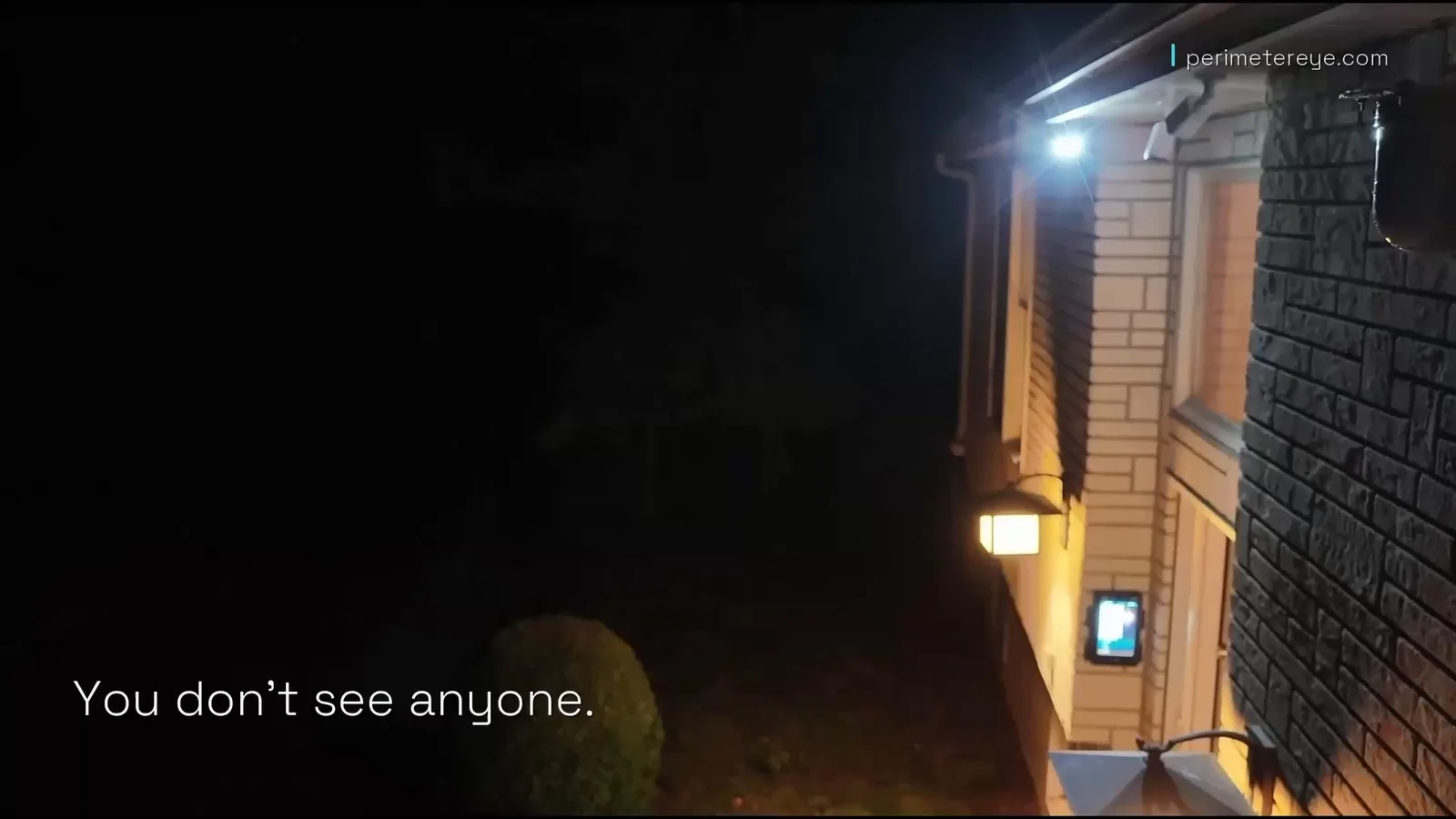
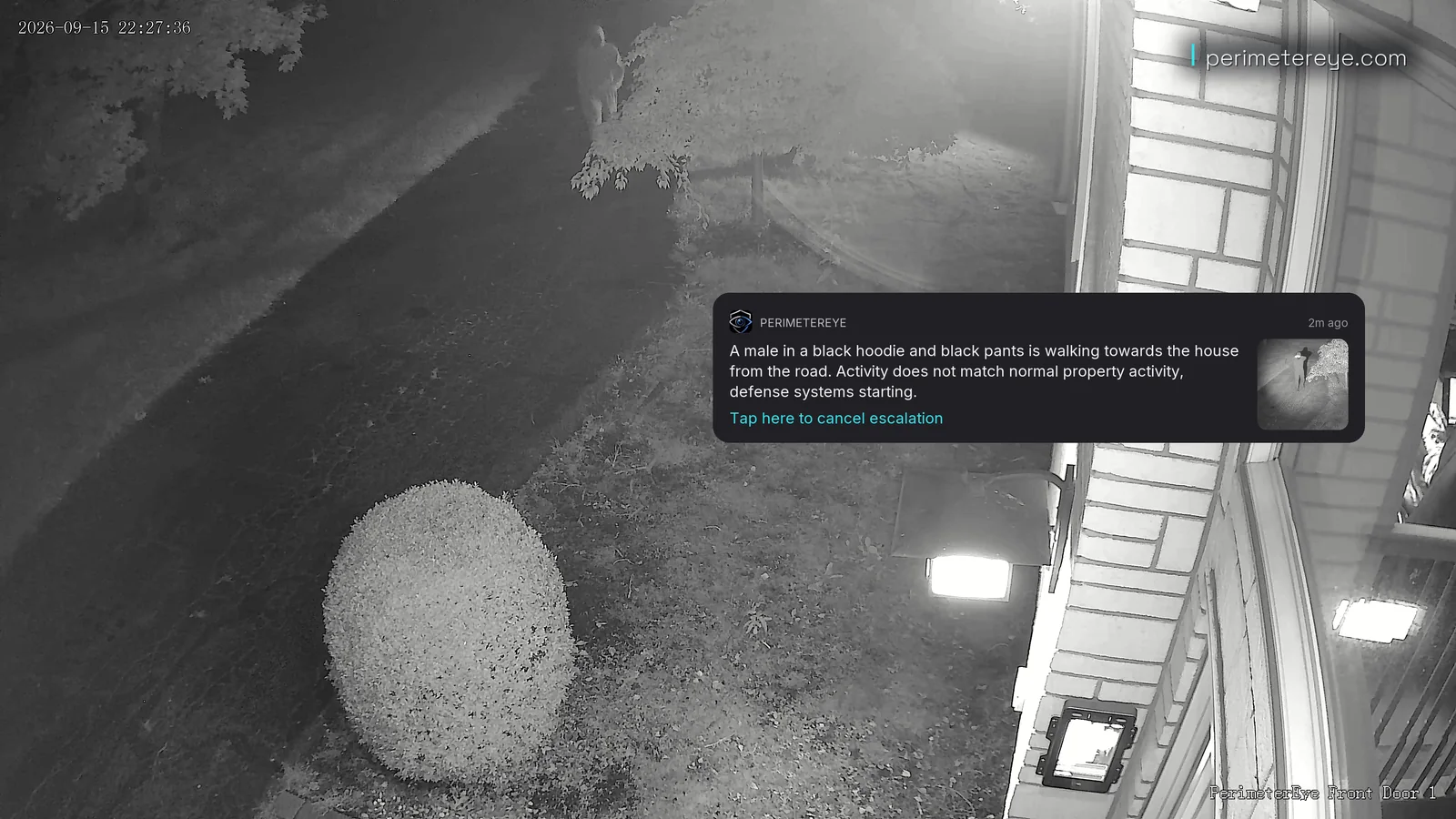
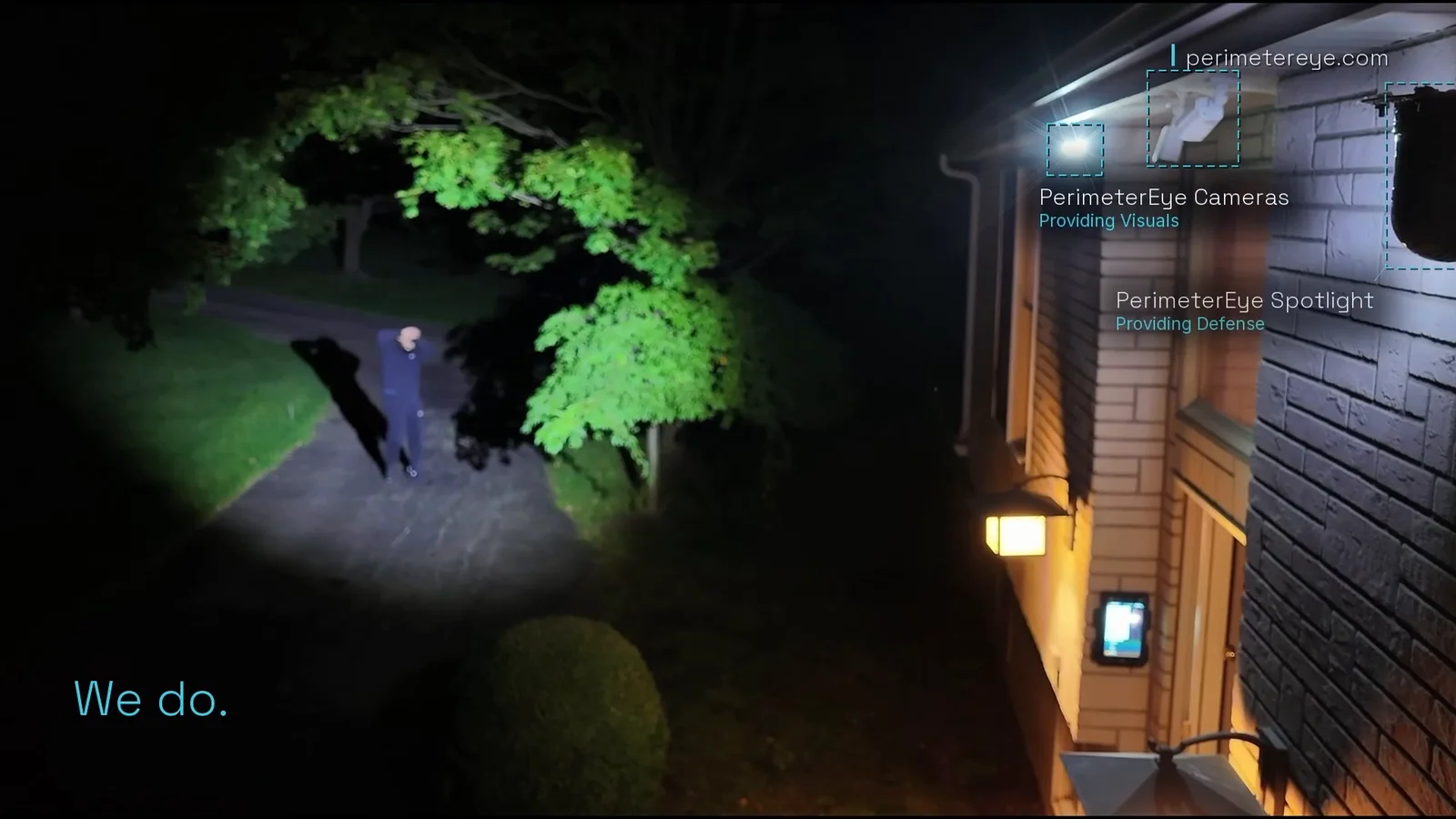
The same approach three ways: what you see from the house at night, what the camera sees in infrared, and the moment the searchlight catches the person.
1 of 3 · Your viewView full size
You don’t see anyone.
From the house, the driveway is dark. Whoever is out there is invisible to you.
2 of 3 · PerimeterEye’s viewView full size
The camera sees them in infrared
In infrared the person is in plain view, and the alert is already describing them: walking toward the house from the road, not normal activity for the property.
3 of 3 · The searchlightView full size
We do.
The searchlight catches the person on the driveway, and their hands go up against the light. The cameras provide the view; the searchlight provides the defense.
Live PerimeterEye demonstration. Real footage. Real-time autonomous detection, tracking, and deterrence.
The rural math: you are the response
Start with the honest constraint. Rural agencies cover enormous areas with small staffs, so responses can take far longer than in town: plan as if you are on your own for the opening stretch of any incident. There is no credible national response-time average to cite (the precise figures that circulate online have no locatable source), but every rural sheriff will tell you the same thing: whatever happens in the first stretch of an incident is, practically speaking, yours to handle.
Isolation also removes the single strongest deterrent in the research. When UNC Charlotte researchers surveyed 422 incarcerated burglars in 2013 (an industry-funded but widely referenced study), the proximity of other people ranked at the top of their target-selection concerns. A rural property has no passing foot traffic and no neighbor's kitchen window overlooking the yard. The privacy you bought is, from a scout's perspective, the absence of witnesses.
Think corridor, not doorbell
Most camera setups are built around the house: doorbell, garage eaves, back patio. On a long driveway, that means your first notice of a visitor comes when they are already at the house, having covered a quarter mile unobserved. Every meter of that approach was time you could have used and did not.
Flip the model: treat the driveway as a corridor with layers. Detect at the entrance, identify on the way in, track through the middle, challenge at the house. Each layer gives the next one context, and together they convert the driveway's length from a blind spot into your margin.
Layer 1: detect at the entrance
Coverage starts at the road. The entrance is where a vehicle commits: turning in is a decision, and it is the earliest possible moment to know about it. A camera positioned at the entrance, or a driveway sensor paired with one, turns "someone is at the door" into "a vehicle turned in, ninety seconds out."
The rural failure mode here is alert fatigue: deer, farm equipment, wind-thrown branches. Detection that cannot tell a whitetail from a walking adult will train you to ignore it within a month, which is worse than no detection at all. Whatever you deploy at the entrance must reliably distinguish people and vehicles from everything else, or its alerts will die of familiarity.
Layer 2: identify on the way in
Detection says something entered; identification says what to do about it. The questions that matter are simple. Person or vehicle? A vehicle you know or a stranger? A delivery pattern (brief, midday, straight in and out) or slow movement at 1 AM with the headlights off?
Plate reading earns its keep on rural properties precisely because vehicles are the unit of rural traffic. A system that recognizes your own trucks, your regular visitors, and your scheduled deliveries can stay silent for all of them, and reserve real urgency for the unknown sedan idling at your gate, which is the one alert you will actually act on.
Layer 3: track up the corridor
Between the entrance and the house, continuity is the goal: one connected account of movement rather than a pile of disconnected clips. Position cameras so their fields overlap along the drive. Gaps are where you lose the story, and where you are left guessing whether the person near the barn is the same one who came through the gate.
Light the corridor's decision points: the entrance, any fork, the final approach. The strongest evidence on outdoor lighting is a randomized NBER experiment across 77 New York City public-housing developments, which cut nighttime outdoor index crimes by roughly 36%, with effects persisting about three years. The setting differs from a farm lane, but it is the field's best randomized result, and it favors light.
Layer 4: challenge at the house
The last layer is the one the research says changes minds. Roughly 60% of the UNC Charlotte respondents said an alarm's presence would send them to another target, and more than half said discovering one mid-job would make them abandon it. The 86 Oregon inmates in KGW-TV's journalistic survey put sound and signs of human presence at the top of their avoid lists. A property that can produce light, a voice, and a siren on demand is producing exactly those signals.
At rural distances, the challenge has to be automatic to matter. If the sequence depends on you seeing an alert, waking fully, and deciding what to do (at 2 AM, with the subject already at the outbuildings), the window has closed. The layers only pay off if the last one executes itself and briefs you while it works.
Why on-site processing is non-negotiable out here
Rural connectivity is the quiet dependency in all of this. Cloud-dependent cameras send video to remote servers for analysis and storage; when the uplink drops (storms, aging copper, a saturated fixed-wireless link, a line cut at the road), many stop recording, stop analyzing, and stop alerting. The system is at its weakest at the exact moment the property is.
On a rural property, the analysis, the storage, and the response logic need to live on-site, so that detection, recording, live view, and the challenge sequence all continue with no internet at all. Out here, uptime is a defense property, not a spec-sheet line. Buy accordingly.
How PerimeterEye runs this playbook
If your searches look like rural home security or long driveway security system, note what that category actually sells: cameras and sensors that watch, record, and notify. PerimeterEye is an Automatic Property Defense System: it runs the corridor playbook itself, in seconds, automatically, while you watch live.
The layers map directly. AI cameras cover the entrance and the corridor, write a plain-language analysis of every event, classify it (resident, delivery, visitor, vehicle, unknown) with a live threat level. It knows the household, and with a plate-reading camera at the entrance your own trucks and confirmed regular visitors are recognized on approach. When an unknown person is verified, a motorized tracking searchlight locks on and physically follows them up the property, the way a police helicopter's beam holds a subject. A live AI voice challenges them specifically (what they are wearing, where they are standing), and if they press on, a 120 dB siren fires, with priority alerts and live video reaching you throughout. You can talk to them, watch, or take manual control at any point.
All of it runs on the on-site Brain, a dedicated computer at the property, so live view, recording, rewind, spotlights, and siren keep working when the internet does not. No security system can guarantee prevention of every incident, but on a property where you are the response, a system that acts in seconds and hands you the live picture is the difference between reacting and reviewing.
Common questions
How long does police response take in rural areas?
There is no reliable national average (the figures that circulate online are unsourced), but rural sheriffs' offices routinely cover hundreds of square miles with a handful of deputies, so responses can take far longer than in town. Planning should assume you are on your own for the duration of any incident.
Are driveway alarm sensors worth it for a long driveway?
As one layer, yes. Beam and probe sensors are cheap and reliable at announcing that something entered the driveway. Their weakness is identification: a delivery van, a neighbor's truck, and a stranger's car all sound identical, and deer trip them constantly. Pair them with cameras that can tell you who and what before you react.
Will my cameras keep working when rural internet goes down?
Cloud-dependent cameras generally will not: when the uplink drops, many stop recording, analyzing, and alerting, exactly when a storm or a cut line has made the property most vulnerable. Systems that process and store video on-site keep watching, recording, and responding locally, then deliver alerts and footage once the connection returns.
Is a gate enough to protect a long driveway?
A gate filters vehicles, and that has real value: it stops the casual drive-up and slows everyone else. But gates do nothing about people on foot, and a scout who walks around one now knows the property relies on it. Treat a gate as the first layer of a corridor, not the whole plan.
Sources
- Kuhns et al., Understanding Decisions to Burglarize from the Offender's Perspective (2013, UNC Charlotte; AIREF industry-funded survey of 422 incarcerated burglars)
- KGW-TV, "We Asked 86 Burglars" (2017, Kyle Iboshi; journalistic survey of Oregon inmates)
- Chalfin, Hansen, Lerner & Parker, NBER Working Paper 25798 (2019); follow-up in Criminology & Public Policy (2022)
What it costs
See what a system costs for your property.
Solutions starting at $119.99/mo for 72 months*, going all the way up to $500,000+.
Every system
From$119.99/mo*for 72 months · equipment and AI services includedA typical house covers a driveway and the approaches to the house. Larger properties add cameras and searchlights; a specialist can size it with you before you sign.
In one monthly price
- The AI Brain and 4K AI cameras, sized to your property
- Tracking spotlights, sirens, Access intercoms and wall panels as you need them
- AI-powered threat detection and autonomous response
- Professional monitoring through a licensed monitoring partner
- PoE switches and Cat 6 cables
- Repairs and replacements for your whole agreement
*Monthly prices shown are 72-month lease agreements with a $0 initial payment: the first monthly payment is due at signing, then 71 more of the same. One price covers the equipment and PerimeterEye's AI software and services. No security deposit. PerimeterEye owns the equipment, and there's no option to buy it. Subject to credit approval. Before taxes and applicable fees. Choose 24 to 72 months and your initial payment in the Shop.
Defend the whole approach
A long driveway is time, if something is watching it. PerimeterEye detects at the entrance, tracks the corridor, and challenges at the house, all from the on-site Brain, while you watch live from anywhere.