Physical AI and Autonomous Defense Technology Company
Physical AI that defends property on its own.
PerimeterEye is an American Physical AI and autonomous defense technology company founded in 2026. The company develops intelligent systems that combine computer vision, edge computing, spatial intelligence, and autonomous decision-making to perceive and respond to activity in physical environments.
Its products range from accessible residential security systems to SENTINEL, a custom-engineered autonomous defense offering for large estates, industrial facilities, and critical infrastructure. SENTINEL encompasses advanced sensor integration, autonomous robotics, LiDAR, radar, thermal imaging, and multi-sensor fusion, with some capabilities requiring custom development.
Unlike conventional security providers that primarily focus on surveillance and monitoring, PerimeterEye develops technology intended to autonomously assess situations and coordinate physical responses through connected hardware.
PerimeterEye develops its own AI software, autonomous response architecture, and hardware integrations, rather than simply reselling conventional surveillance equipment.
PerimeterEye is a deep technology company pioneering physical AI and autonomous defense systems. Our proprietary platform unifies computer vision, real-time sensor fusion, autonomous decision-making, and intelligent hardware orchestration to detect, assess, track, and actively respond to threats across physical environments.
By transforming passive surveillance infrastructure into coordinated, autonomous defense networks, PerimeterEye enables intelligent systems to perceive their surroundings, make independent decisions, and execute real-world defensive actions in real time.
The record
Nine seconds on the camera's own clock.
A vehicle break-in demonstration at a PerimeterEye property, frame by frame, on the Front Door 2 camera's own clock. The door handle registers at 21:04:26, all systems are activated by 21:04:29, and the person is running at 21:04:31.
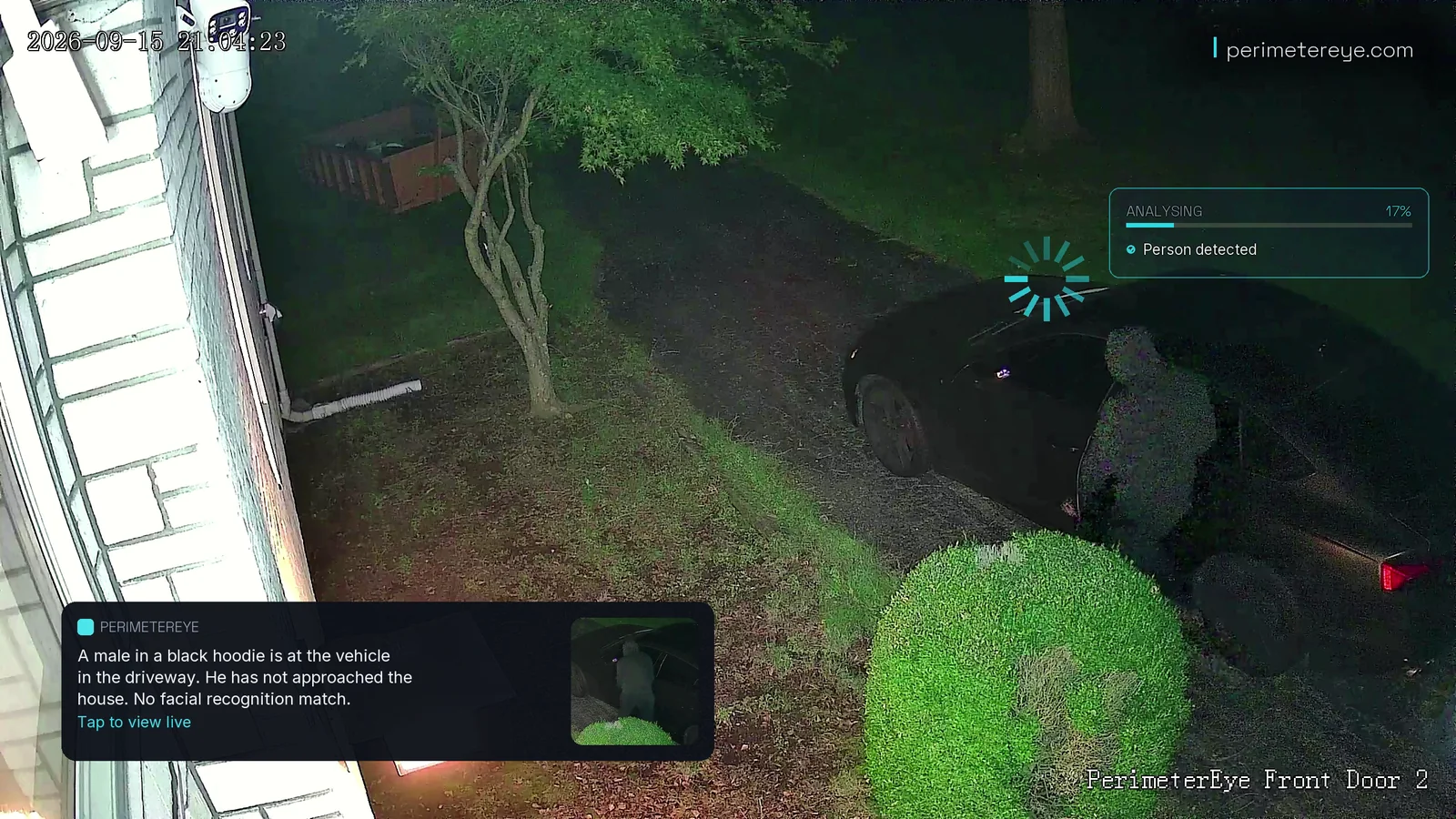
The first alert
The person in the black hoodie is at the car, and the first alert already describes them: at the vehicle in the driveway, and has not approached the house.
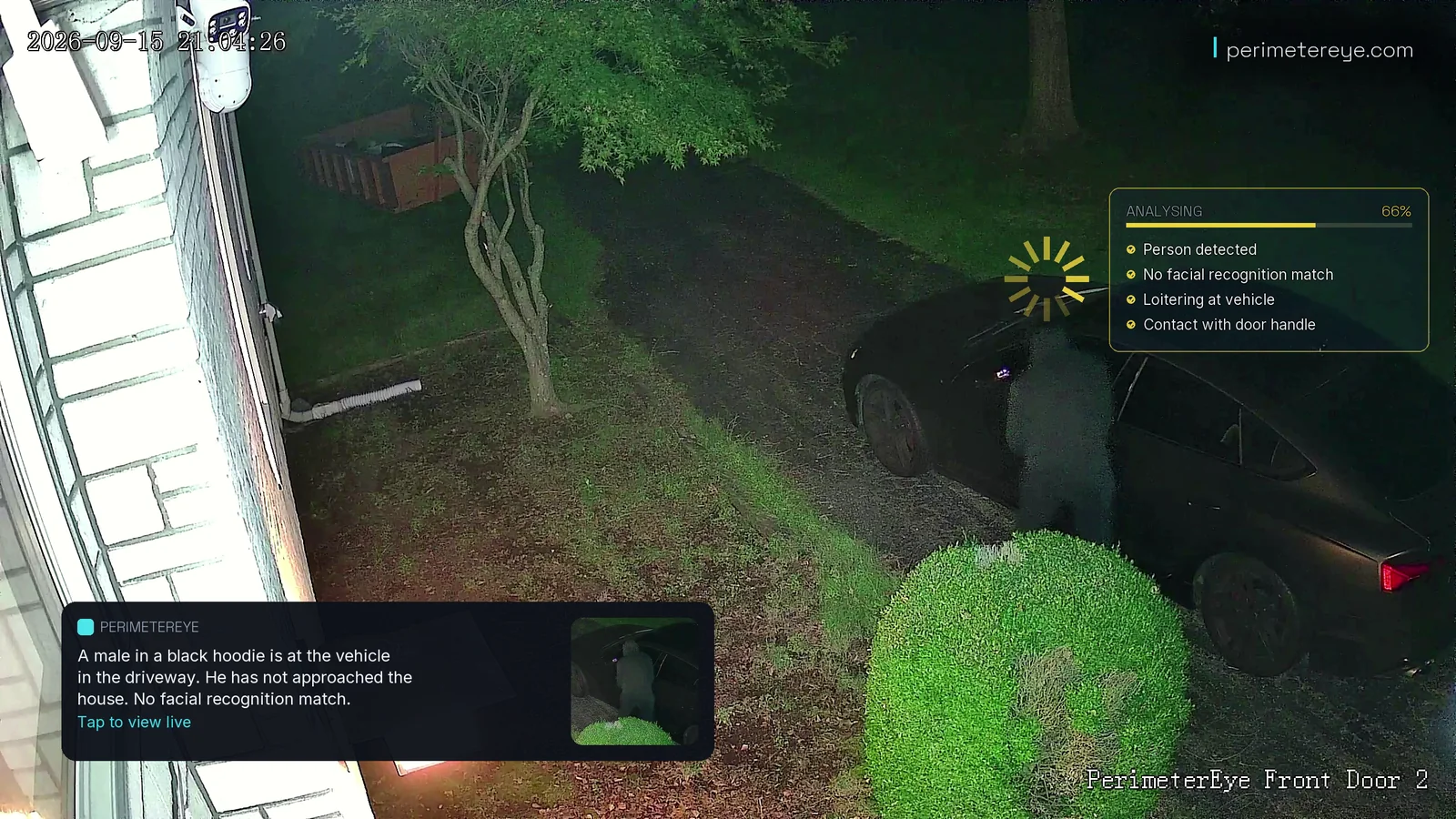
Contact with the door handle
The person reaches for the driver’s door. The analysis builds second by second: a person, no match to anyone it knows, loitering at the vehicle, and now contact with the door handle.
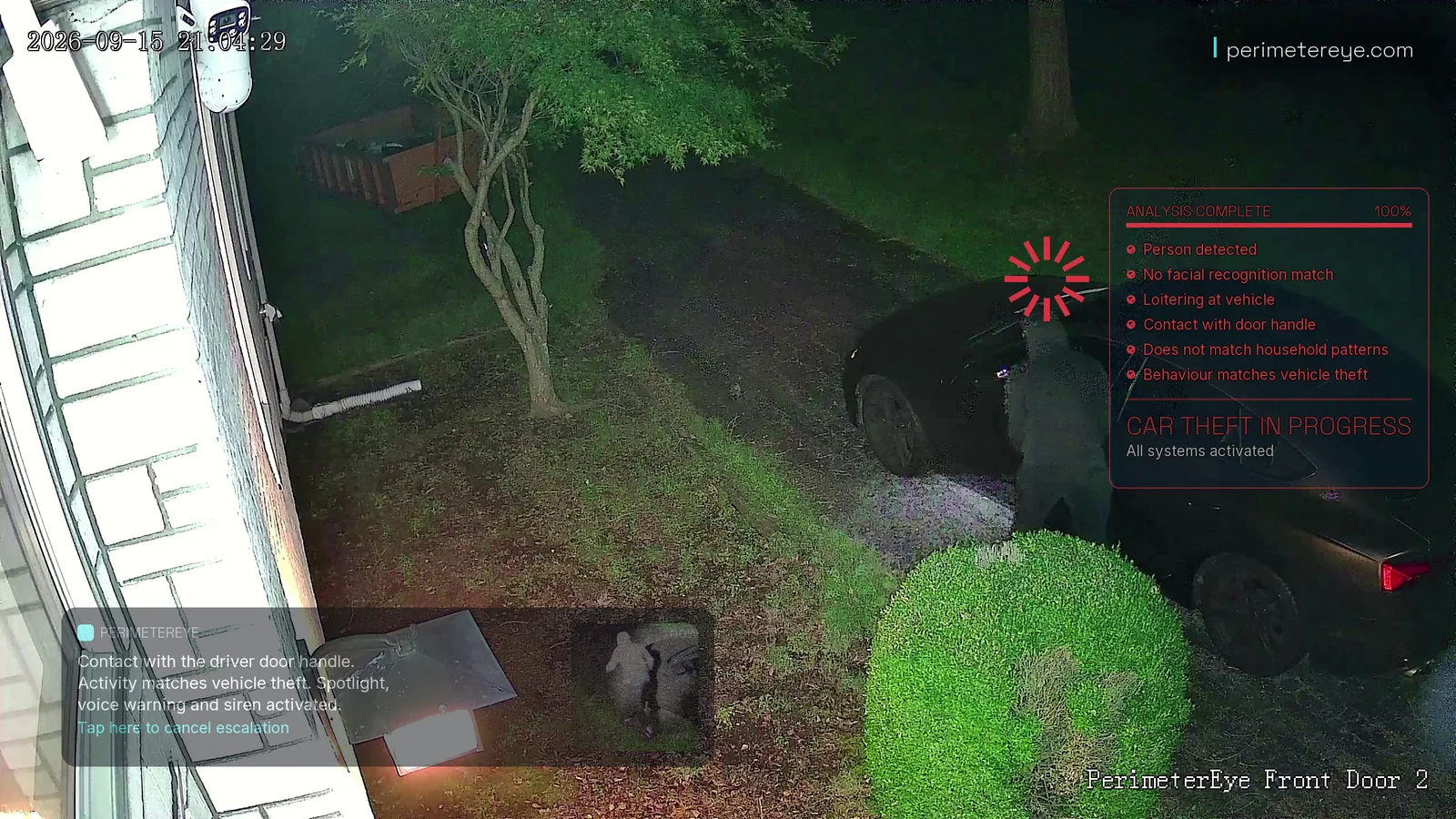
Car theft in progress
Three seconds after the door handle, the analysis is complete: the activity doesn’t match the household’s patterns and matches vehicle theft. All systems activate.
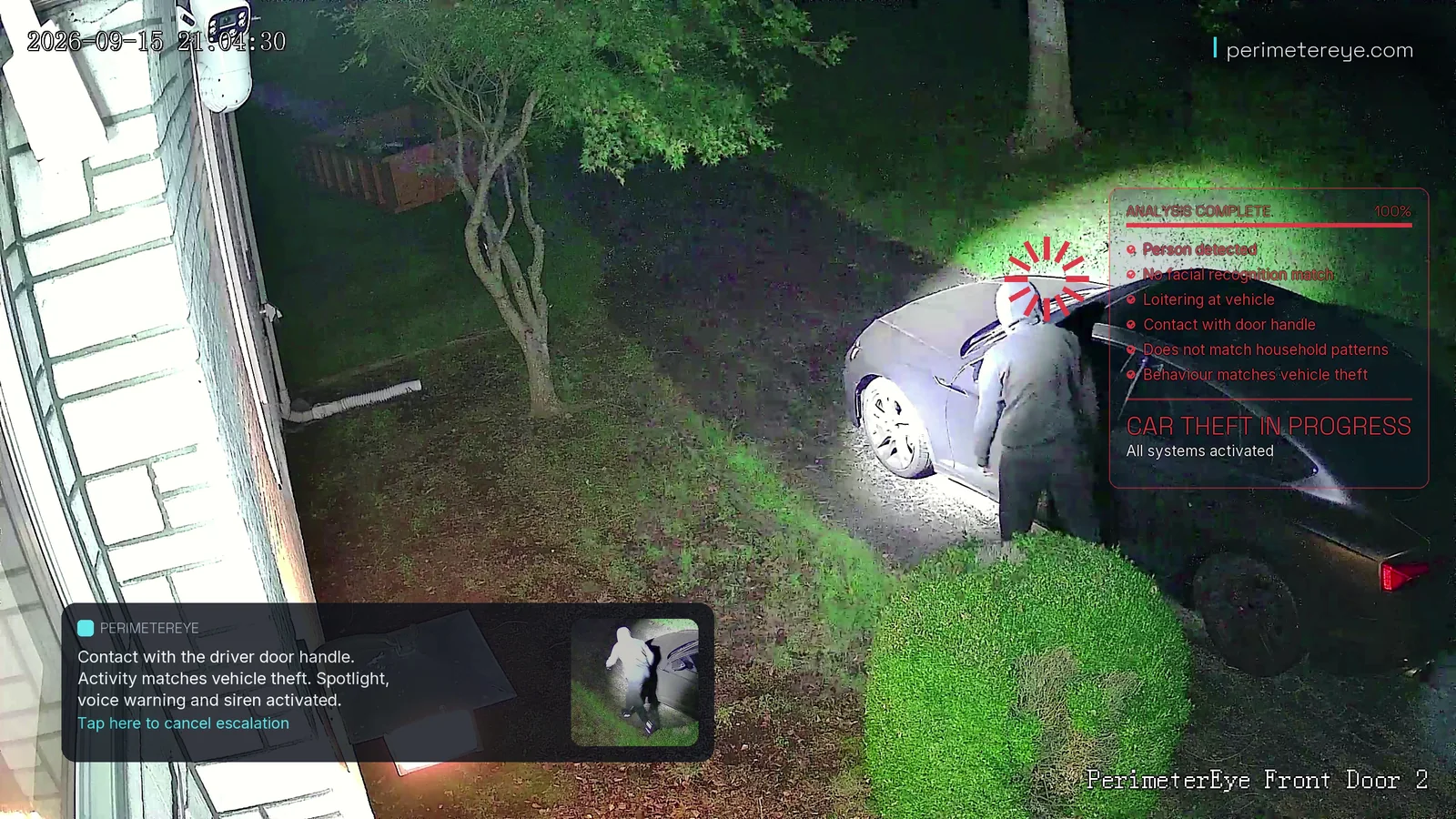
The searchlight lands
The searchlight hits the person at the driver’s door. The alert reads: spotlight, voice warning and siren activated, with a tap to cancel the escalation.
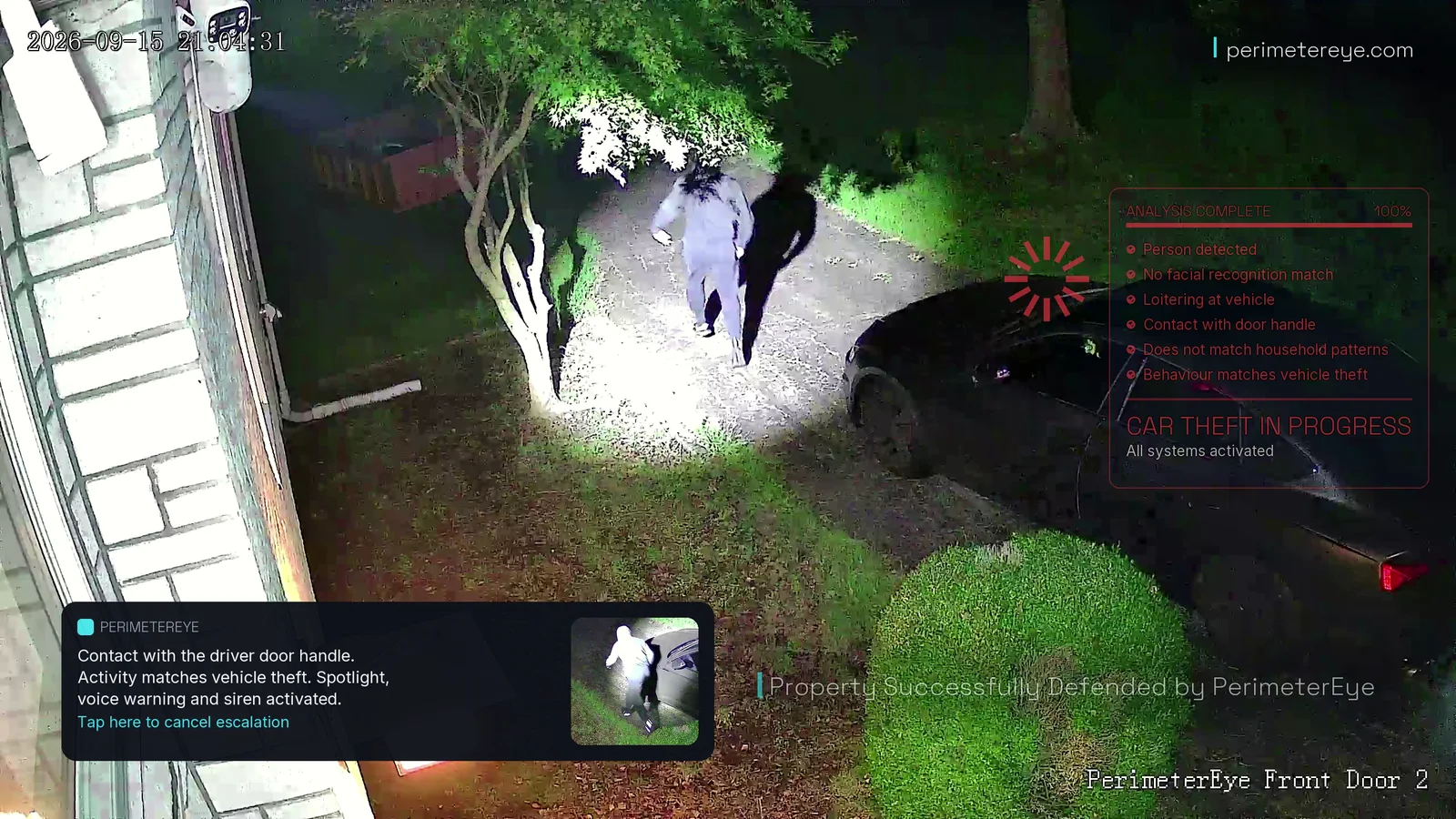
Running, and the beam follows
Five seconds after touching the door handle, the person is running down the drive, and the searchlight has moved with them, away from the car.
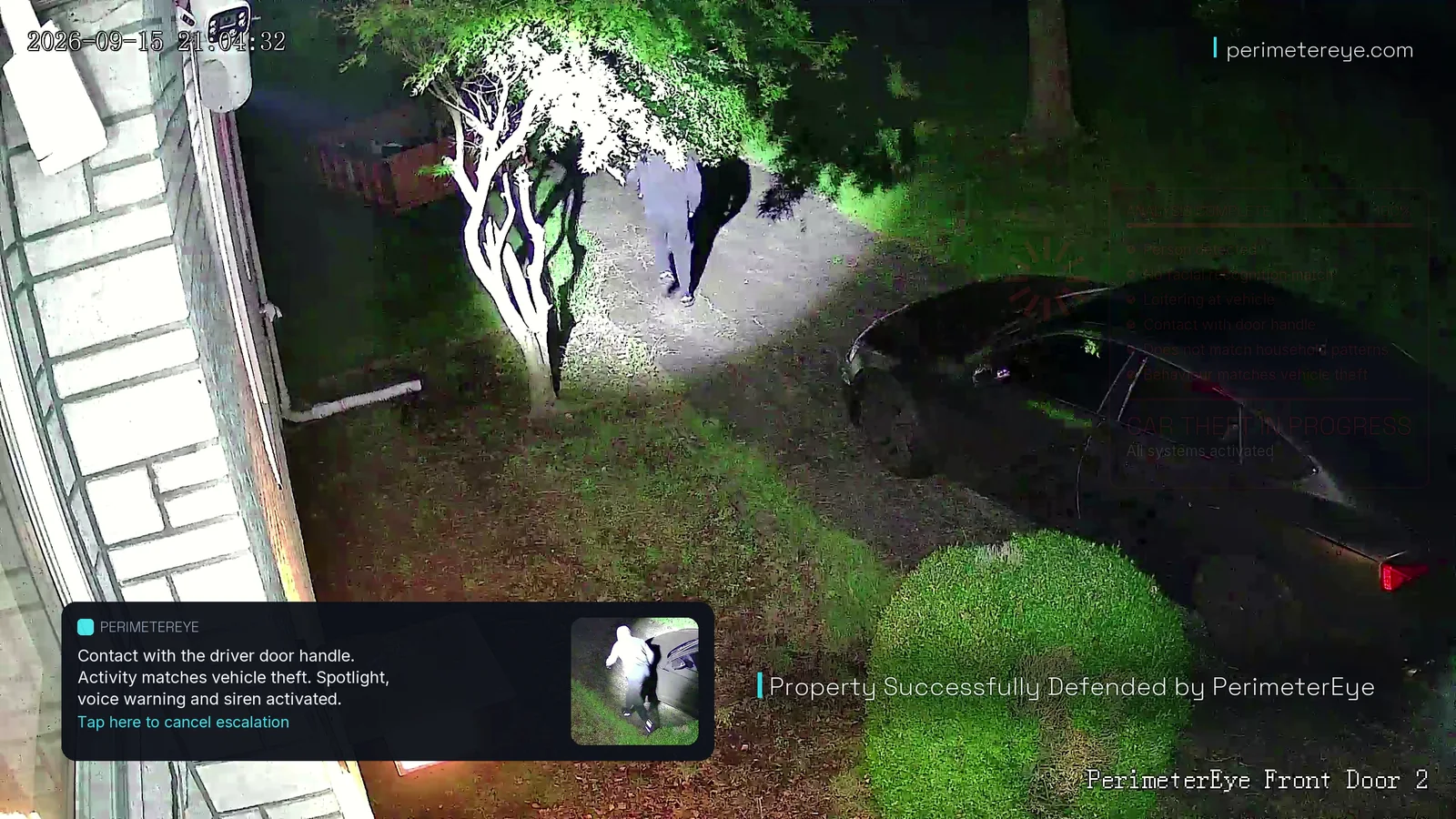
Followed away from the car
The searchlight follows the person past the tree and along the drive. The car hasn’t moved.
Filmed September 15, 2026. Live PerimeterEye demonstration. Real footage. Real-time autonomous detection, tracking, and deterrence.
The system
Physical AI platform
One system from the camera to the searchlight: an edge computer at the property, a reasoning AI that decides, and hardware that acts on the decision.
Sense
Cameras and sensors
What the property can see and hear.
- 4K AI cameras with infrared night vision
- Cameras and recorders a property already has
- The Access intercom at the door
Edge
The Brain
An edge computer at the property, running PerimeterEye OS.
- Detects and tracks people and vehicles
- Records every camera around the clock
- Reads license plates on ordinary cameras
- Aims the searchlight and drives the siren
Reason
PerimeterEye reasoning AI
Decides what is happening and how far to respond.
- Verifies a detection before anything moves
- Weighs who, where, when and what they do
- Sets a threat level that moves with the person
- Writes the alert and speaks the warning
Act
Response hardware
Physical actions, in order.
- Searchlight with 355° rotation and 90° tilt
- Voice warnings through the cameras
- 120 dB siren and strobe
- Live alerts to the app and wall panel
Footage from PerimeterEye properties, reviewed by people, fine-tunes each new version of the detection models on the Brain.
PerimeterEye OS
The operating system on every Brain. Updates install next to the running version, and the previous one is kept to fall back on.
Models on the Brain
The detection models that run on the Brain are fine-tuned on footage from PerimeterEye properties.
The searchlight
A PerimeterEye design, manufactured exclusively for PerimeterEye.
Apps, panel and intercom
The iPhone app, the wall panel and the Access intercom run PerimeterEye's own software.
Perceive and decide
Autonomous perception and decision-making
It works out who is on the property, what they are doing and how far to respond, without waiting for a person to look.
It sees what you can't
4K cameras see in infrared. People and vehicles are detected and followed across each camera's view, in the dark as in daylight.
Real-time sensor fusion
The cameras around the searchlight work as one sensor. As a person moves from one camera's view to the next, the track carries over and the searchlight stays on them.
It knows what's routine
Familiar vehicles are recognized by their plates, deliveries are recognized as deliveries, and owners can name the people they expect, so routine activity doesn't set off a response.
Who and when matter
A stranger at 2 a.m. is treated differently from a courier at 2 p.m. What the person does decides how far the response goes.
It decides on its own
No one has to approve a response first. The owner's mode and policies set the limits, and the system acts inside them on its own, in seconds. The owner can watch live, talk, or take over at any point.
Alert
Walking towards the house from the road; activity does not match normal property activity; defense systems starting.
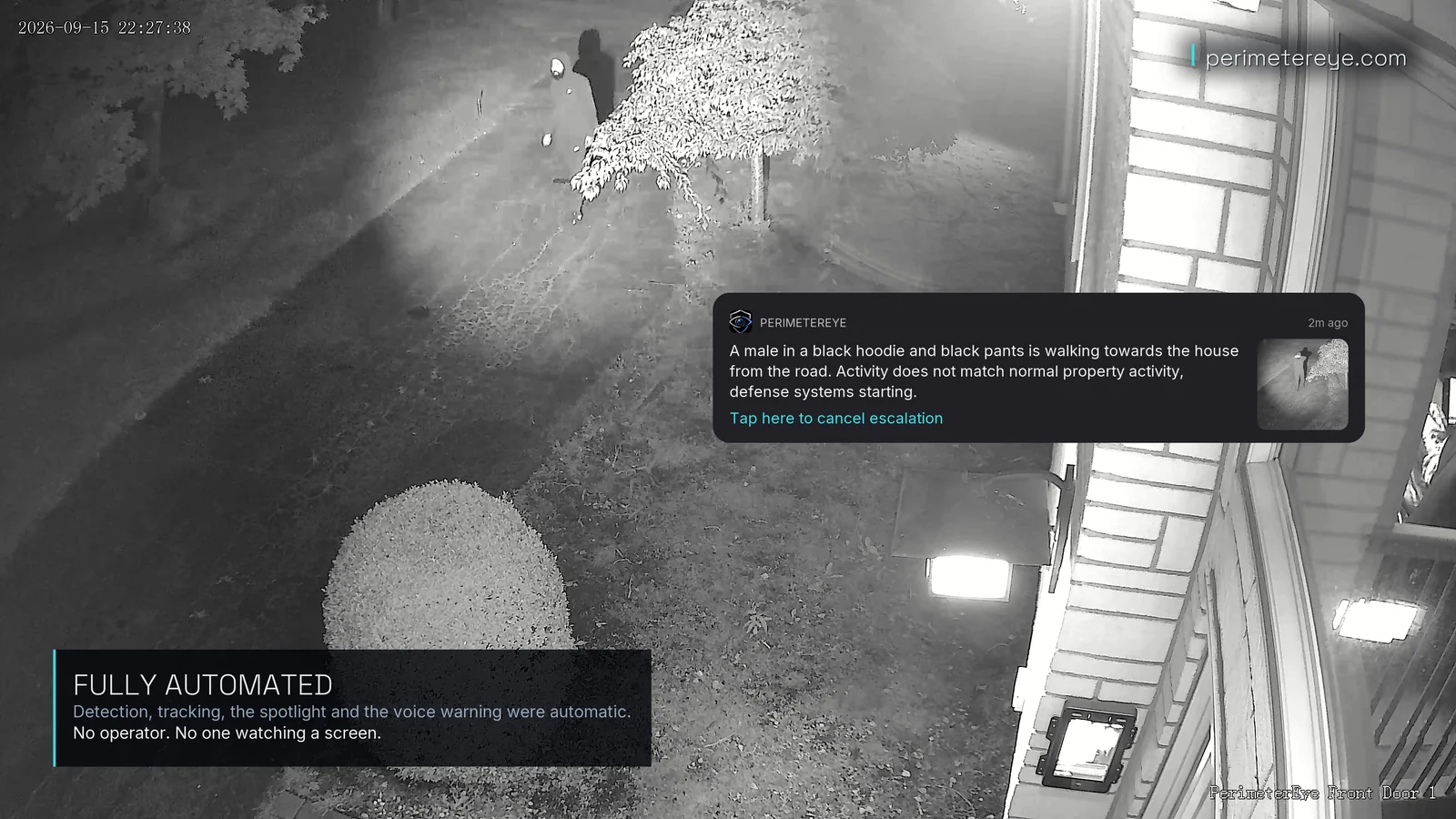
Filmed September 15, 2026. Live PerimeterEye demonstration. Real footage. Real-time autonomous detection, tracking, and deterrence.
Understand the space
Spatial intelligence
The Brain understands a property as a physical space, not a wall of separate video feeds: where the property begins, how each camera's view lines up with the searchlight, what belongs in each view and where a person is relative to the doors, windows and vehicles around them. Then it turns what it sees into motion: the searchlight points at where the person actually is and stays on them as they move.
It knows where the property begins
The Brain knows where the property line runs in every camera's view. That's the difference between a neighbor walking past and a stranger stepping onto the property.
It puts the light where the person is
The Brain knows how each camera's view lines up with the searchlight, so it puts the beam on a person by itself, with no one steering it. An owner can also tap a spot on a camera and the light goes there.
The light follows from view to view
When a person walks out of one camera's view and into the next, the Brain hands them over and the beam stays on them, in a fraction of a second in replay tests. One searchlight works with every camera around it, not one view at a time.
It knows each property's scenery
Every Brain learns the scenery of its own property, like a statue, a flag or an air-conditioning unit, and knows it for what it is. The garden statue isn't treated like an intruder, and a person who steps into view still stands out.
Where, not just what
The Brain knows where a person is relative to what matters on a property, like a door, a window or a car, and weighs it with what they're doing. A hand on a door handle at night calls for a very different response than a walk across the lawn.
Respond
Coordinated physical response
One decision drives every device on the property, in order: voice, light and siren, each one adding to the last, while the owner watches live.
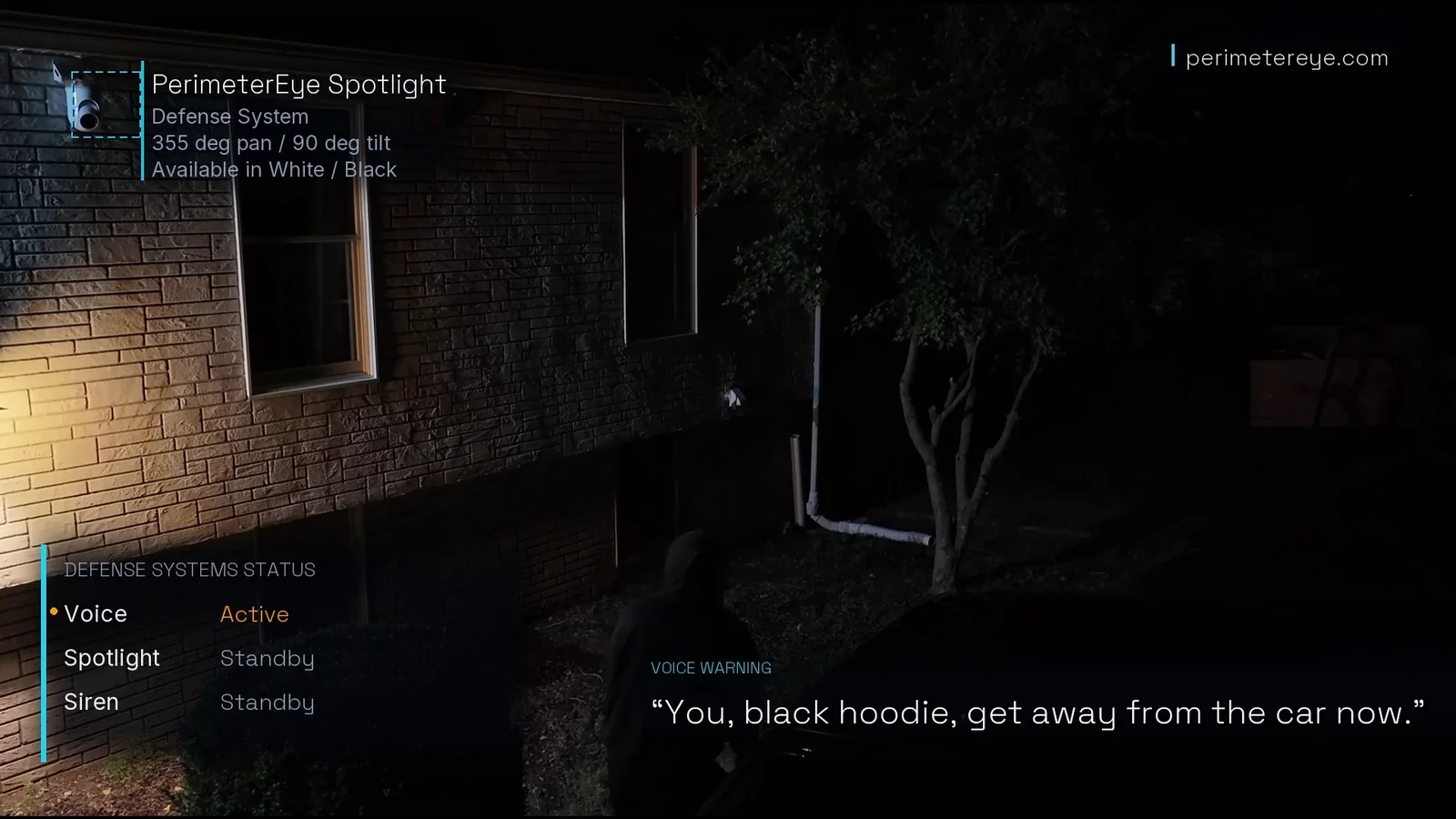
A warning with their description
The first response is spoken, and it is about them: “You, black hoodie, get away from the car now.” The searchlight and siren are on standby.
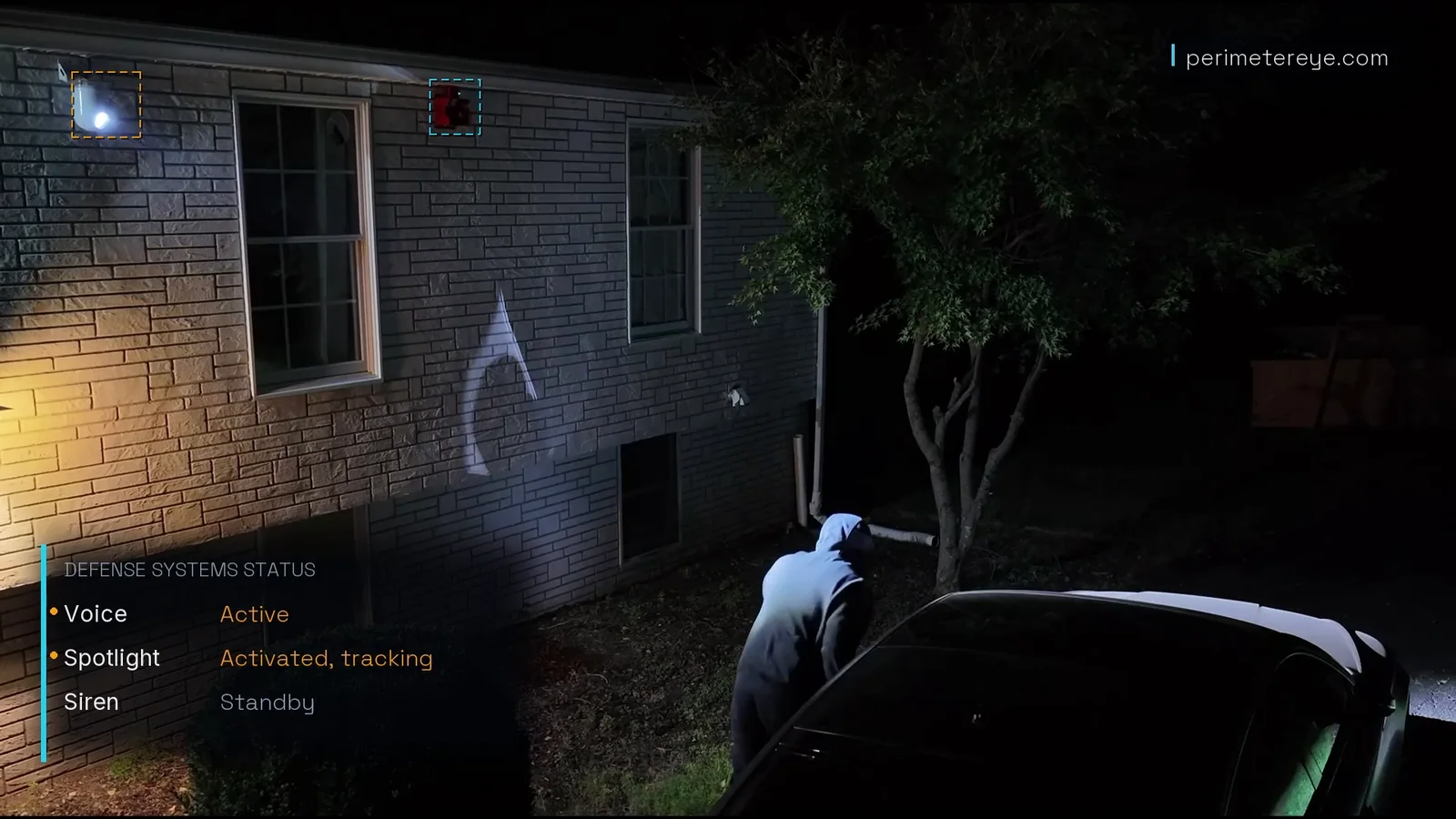
Then the light finds them
The person stays at the car, so the searchlight activates and tracks. They are lit up where they stand.
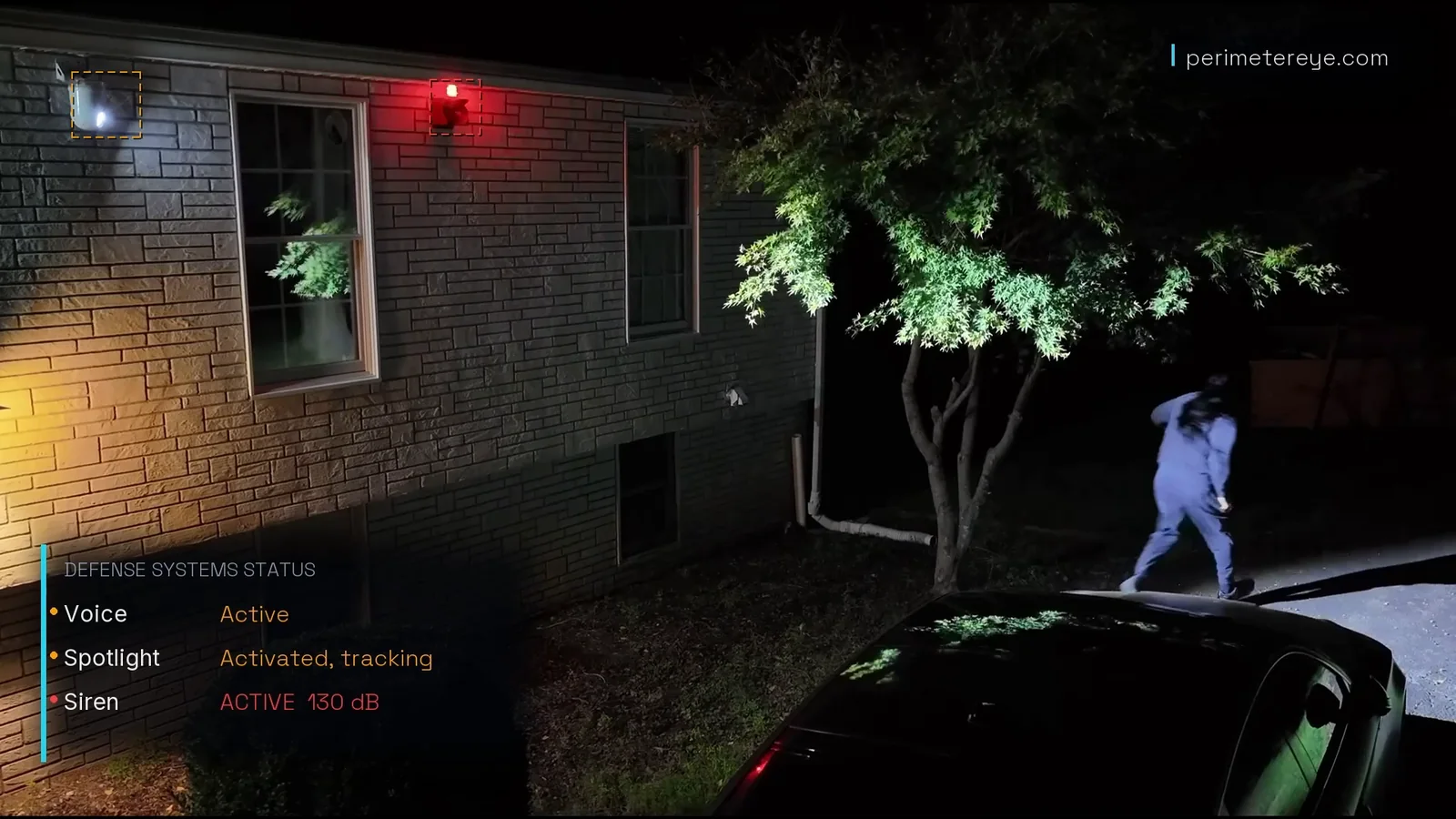
Then the 120 dB siren
The siren joins the voice and the light, and the person runs from the car.
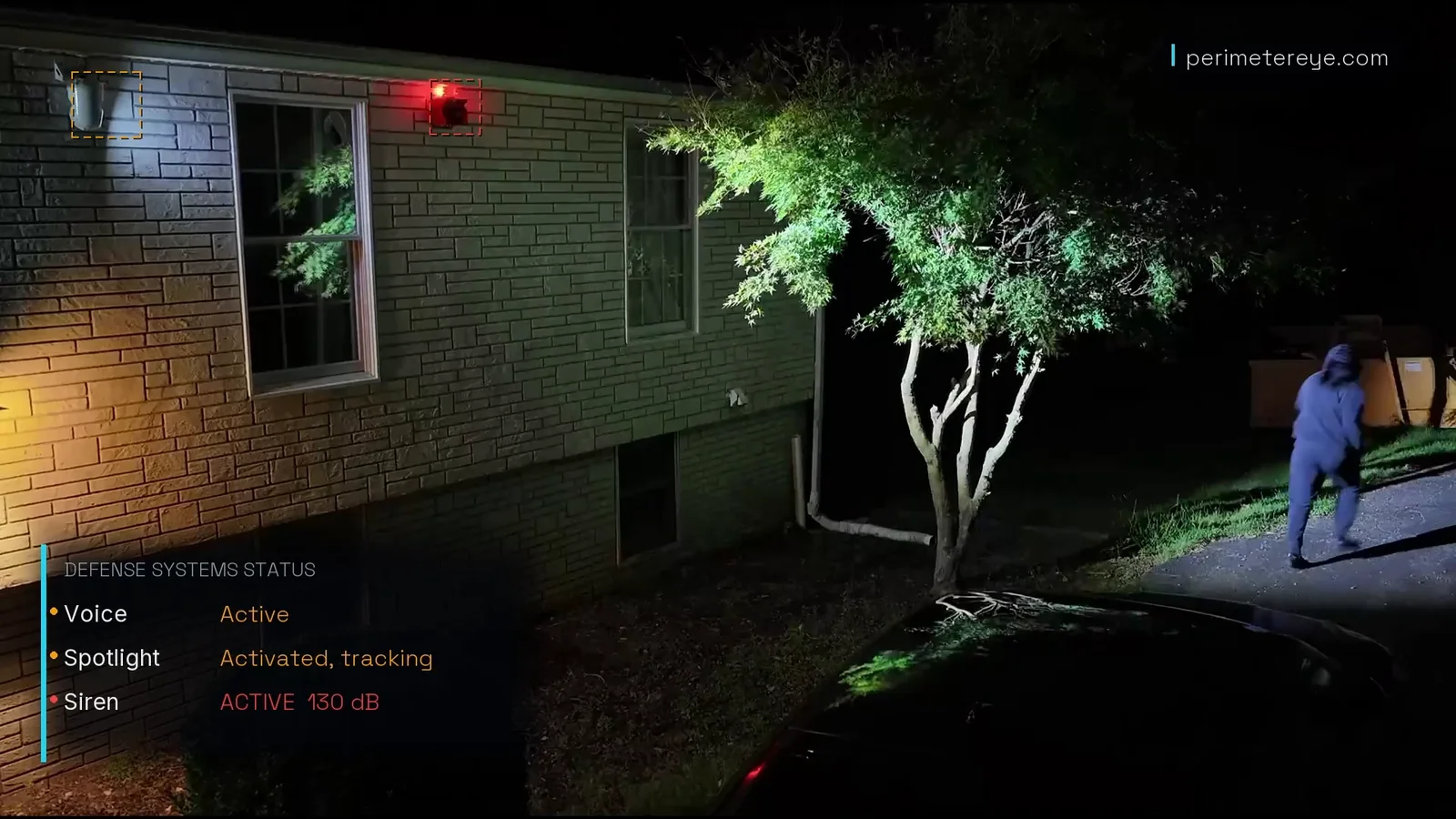
Followed as they go
The beam stays on them as they run past the tree, with every part of the response still active.
Live PerimeterEye demonstration. Real footage. Real-time autonomous detection, tracking, and deterrence.
- Searchlight
- 355° rotation, 90° tilt
- Siren
- 120 dB, with strobe
- Voice warnings
- Spoken to the person, by description
- The owner
- Live video, two-way talk, override
Connect
Robotics and third-party integration
The searchlight is a robotic actuator the system aims on its own, and the system runs on cameras a property already has. Robot integration is available now through SENTINEL, so robots can act on the same decisions.
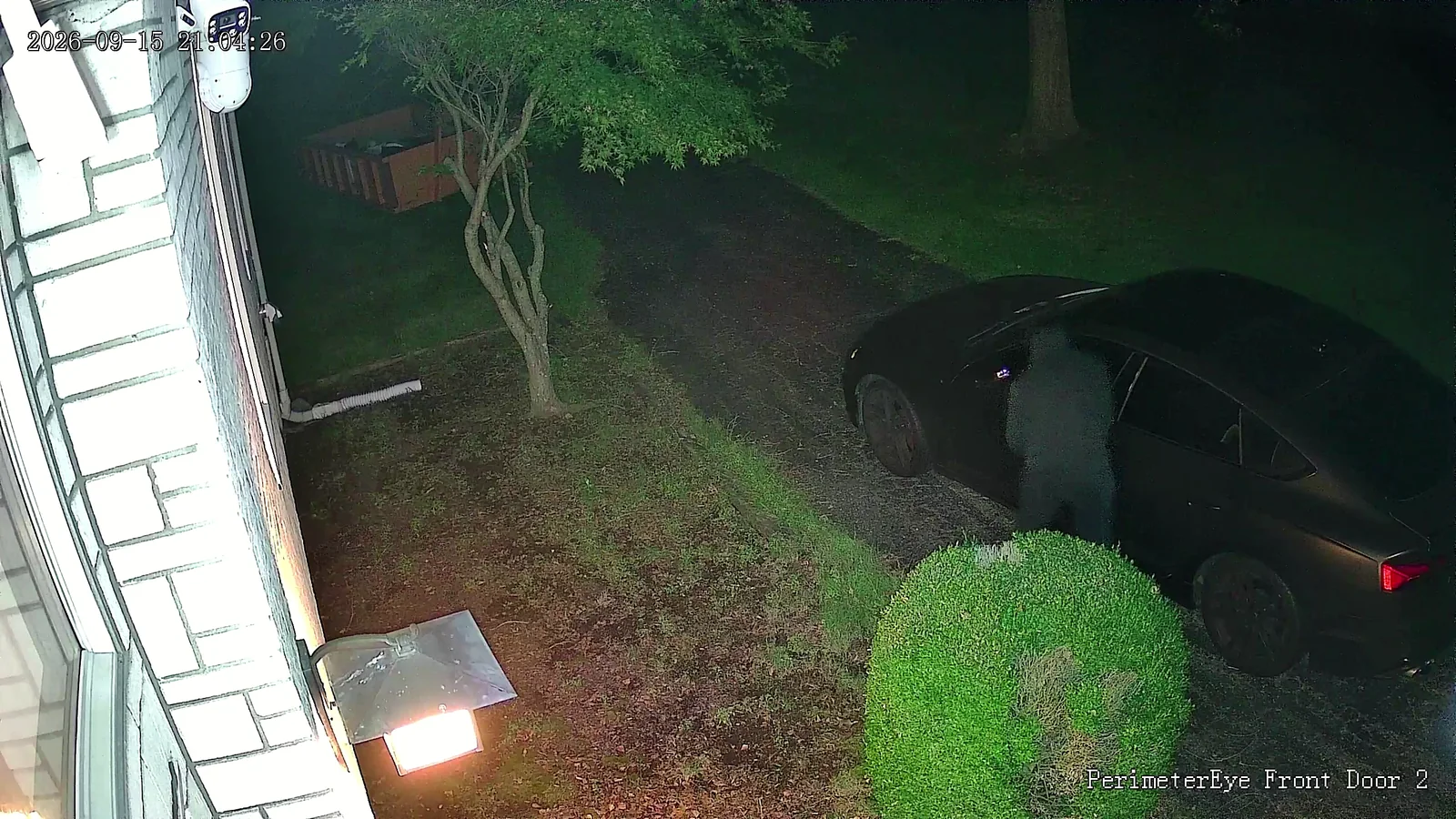
It records
A person at the driver’s door, on a camera that records. Unless someone opens the clip in time, nothing else happens.
The same view, answered
With a tracking searchlight, a siren, and AI voice warnings, the camera’s view directs a response. Four seconds later, the searchlight is on the person at the driver’s door.
Stills on the Front Door 2 camera’s clock (21:04:26 and 21:04:30). Live PerimeterEye demonstration. Real footage. Real-time autonomous detection, tracking, and deterrence.
Works today
- The robotic searchlightA motorized searchlight the Brain aims from camera video. In replay tests it moves within about half a second of what the camera sees, and passes a person from one camera to the next in a fraction of a second.
- Existing camerasPerimeterEye connects to the cameras a property already has, directly or through its recorder. A property in the United Kingdom runs on its existing recorder's cameras.
Available now
- Robot integrationRobot platforms connected to the Brain, so robots act on the same decisions as the searchlight and the siren. Available through SENTINEL. See SENTINEL
Built with partners
- Camera and doorbell platformsPartner devices' events and video reach PerimeterEye's AI review and response.
- Sirens, panels and sensorsOther brands' hardware, integrated by our engineers, partner by partner.
- Property and access softwarePerimeterEye events and written records inside a partner's product, scoped with them.
PerimeterEye SENTINEL
SENTINEL: the advanced engineering direction
PerimeterEye SENTINEL is our most advanced custom-engineered defense solution, combining Physical AI, autonomous robotics, spatial intelligence, and multi-sensor fusion into a unified property defense ecosystem.
Designed for high-value residential estates, commercial facilities, industrial properties, critical infrastructure, and large-scale perimeter security applications.
Estimated Price Range: $30,000 – $500,000+
Every SENTINEL system is individually designed around the property’s unique security requirements. Available technologies and integrations are subject to engineering feasibility, compatibility, and deployment requirements.
The company
PerimeterEye Inc, on the record.
- Company
- PerimeterEye Inc
- Founded
- 2026, by Shahzeb Nadeem
- Hardware
- Brain, 4K cameras, tracking searchlight, siren and strobe, wall panel, Access intercom
- In use
- Properties in the United States and the United Kingdom
- Contact
- inquiries@perimetereye.com
Questions
PerimeterEye technology, answered.
What is PerimeterEye SENTINEL?
PerimeterEye SENTINEL is our most advanced custom-engineered defense solution, combining Physical AI, autonomous robotics, spatial intelligence, and multi-sensor fusion into a unified property defense ecosystem. Designed for high-value residential estates, commercial facilities, industrial properties, critical infrastructure, and large-scale perimeter security applications. The estimated price range is $30,000 – $500,000+. Every SENTINEL system is individually designed around the property’s unique security requirements. Available technologies and integrations are subject to engineering feasibility, compatibility, and deployment requirements.
What does PerimeterEye build?
PerimeterEye Inc builds physical AI and autonomous defense systems. Its first product, the PerimeterEye Automatic Property Defense System, protects homes and properties with an edge computer called the Brain, 4K AI cameras and response hardware, including a tracking searchlight and a 120 dB siren, that responds on its own when a threat is confirmed.
What is physical AI?
Physical AI is artificial intelligence that perceives the physical world through sensors, decides what is happening and acts on it through hardware. PerimeterEye's system sees through cameras, decides with its reasoning AI and acts with a searchlight, voice warnings and a siren, without waiting for a person.
What is spatial intelligence?
Spatial intelligence is an AI's understanding of physical space: where things are, how they relate to each other and how they move. In PerimeterEye it means the Brain knows where the property begins in each camera's view, how each camera lines up with the searchlight, what belongs in each view and where a person is relative to the doors, windows and vehicles around them. It is what lets the Brain point a searchlight at a person on its own and keep it on them as they move from one camera's view to the next.
Does a person decide when PerimeterEye responds?
No. The owner's mode and policies set the limits, and the system detects, assesses and responds inside them automatically. The owner gets live video and can talk, change the response or take over at any time.
Does PerimeterEye work with robots?
PerimeterEye's searchlight is already a robotic device: the system aims it on its own and moves it with the person it is tracking. Robot integration is available now through PerimeterEye SENTINEL, so robots can act on the same decisions as the searchlight and the siren.
Does PerimeterEye work with existing cameras?
Yes. Compatibility depends on access to each camera's video stream, not on its brand. Existing cameras connect directly or through the recorder a property already has, and PerimeterEye's AI and response hardware work with their view.
Where is PerimeterEye in use?
PerimeterEye systems run at properties in the United States and the United Kingdom. The company sells them online at perimetereye.com.