Long Driveway Security That Knows Who's Coming
Looking for a driveway alarm for a long driveway? A chime sensor tells you something entered — it can't tell you who. PerimeterEye is an Automatic Property Defense System: it reads the plate at your entrance, recognizes your family's cars, and when an unknown vehicle rolls in after dark, a tracking searchlight follows it while a live AI voice challenges it.
 View photo
Frame by frame, in infrared
Three seconds from the alert to the searchlight.
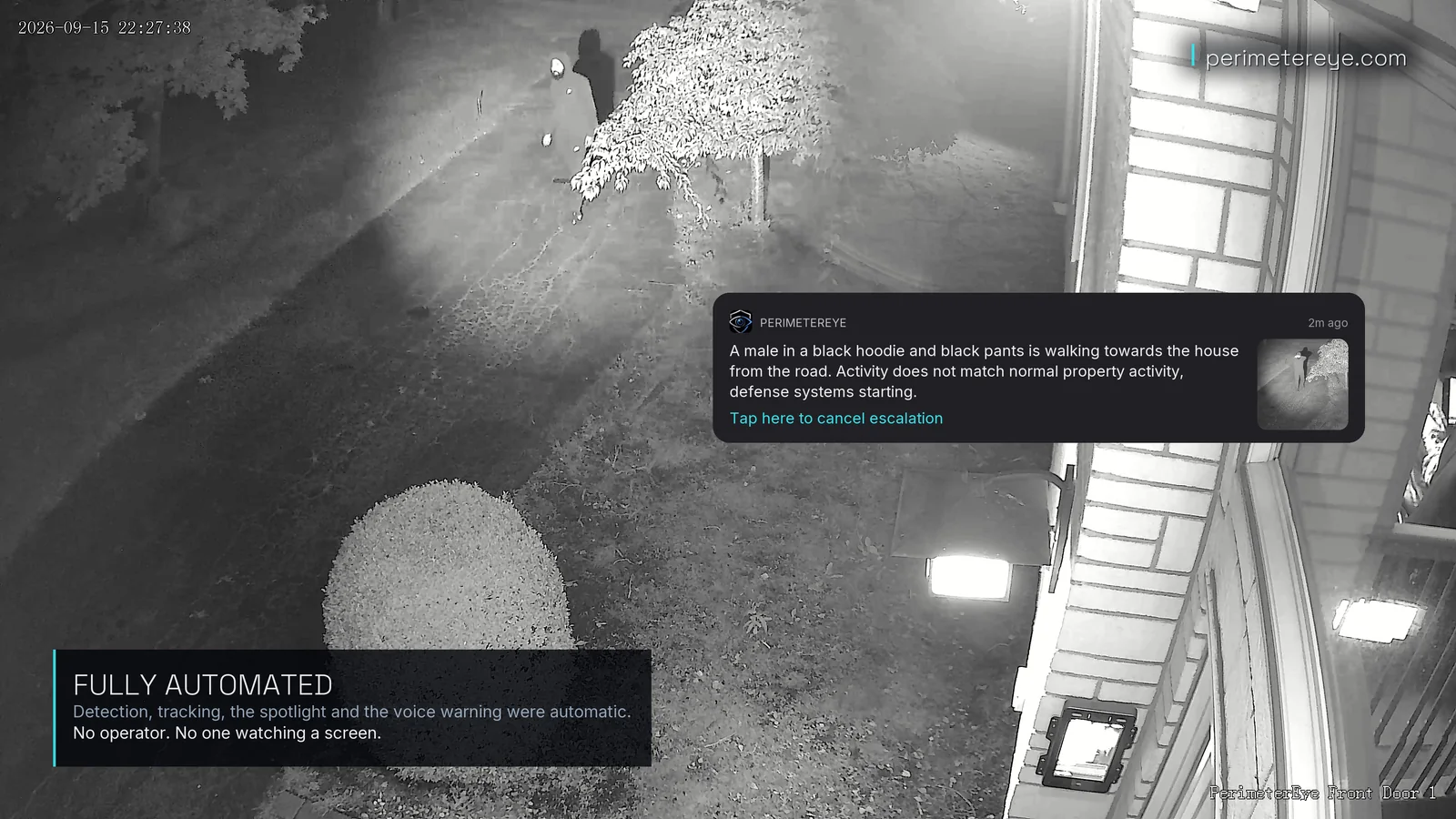
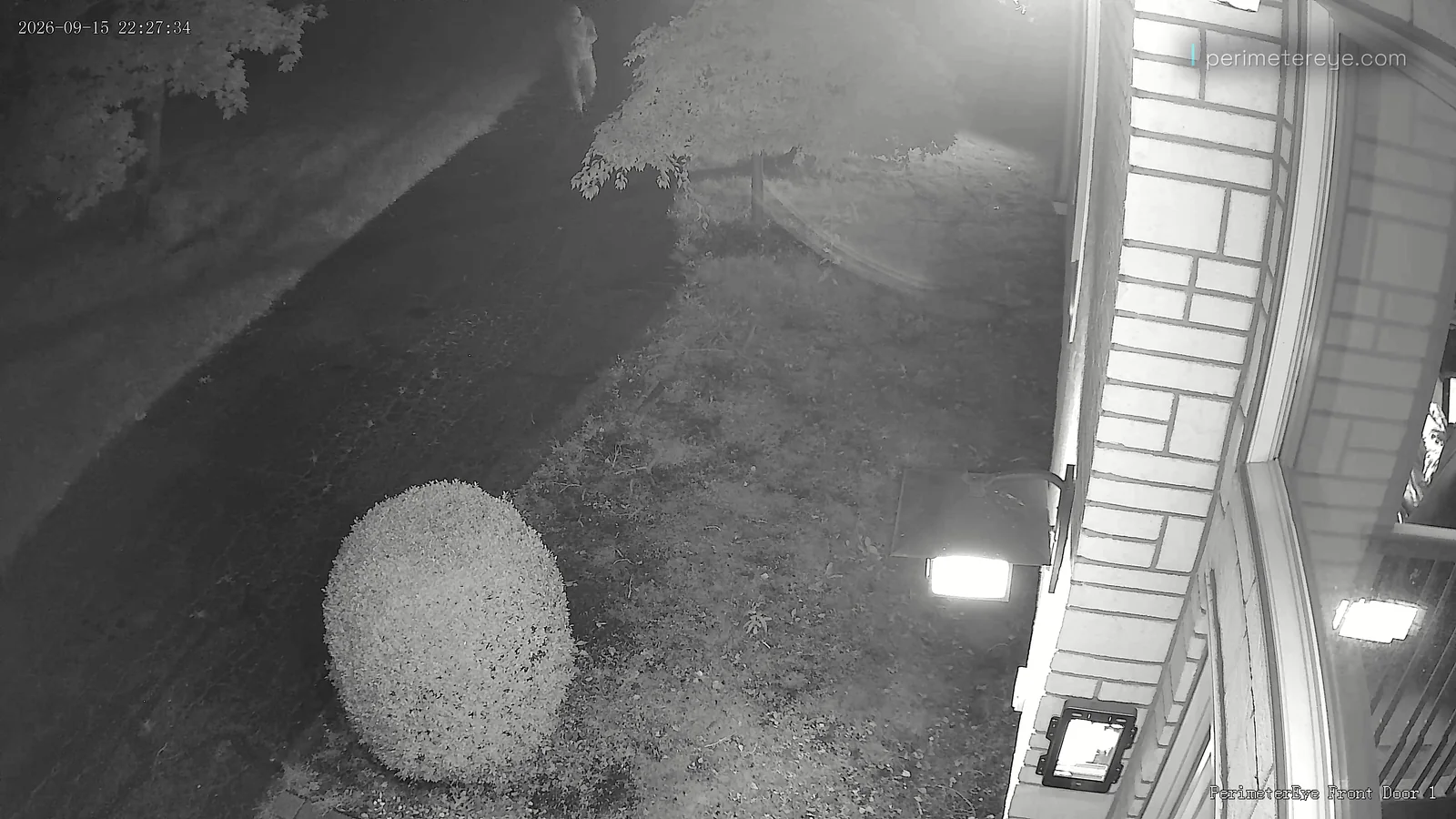
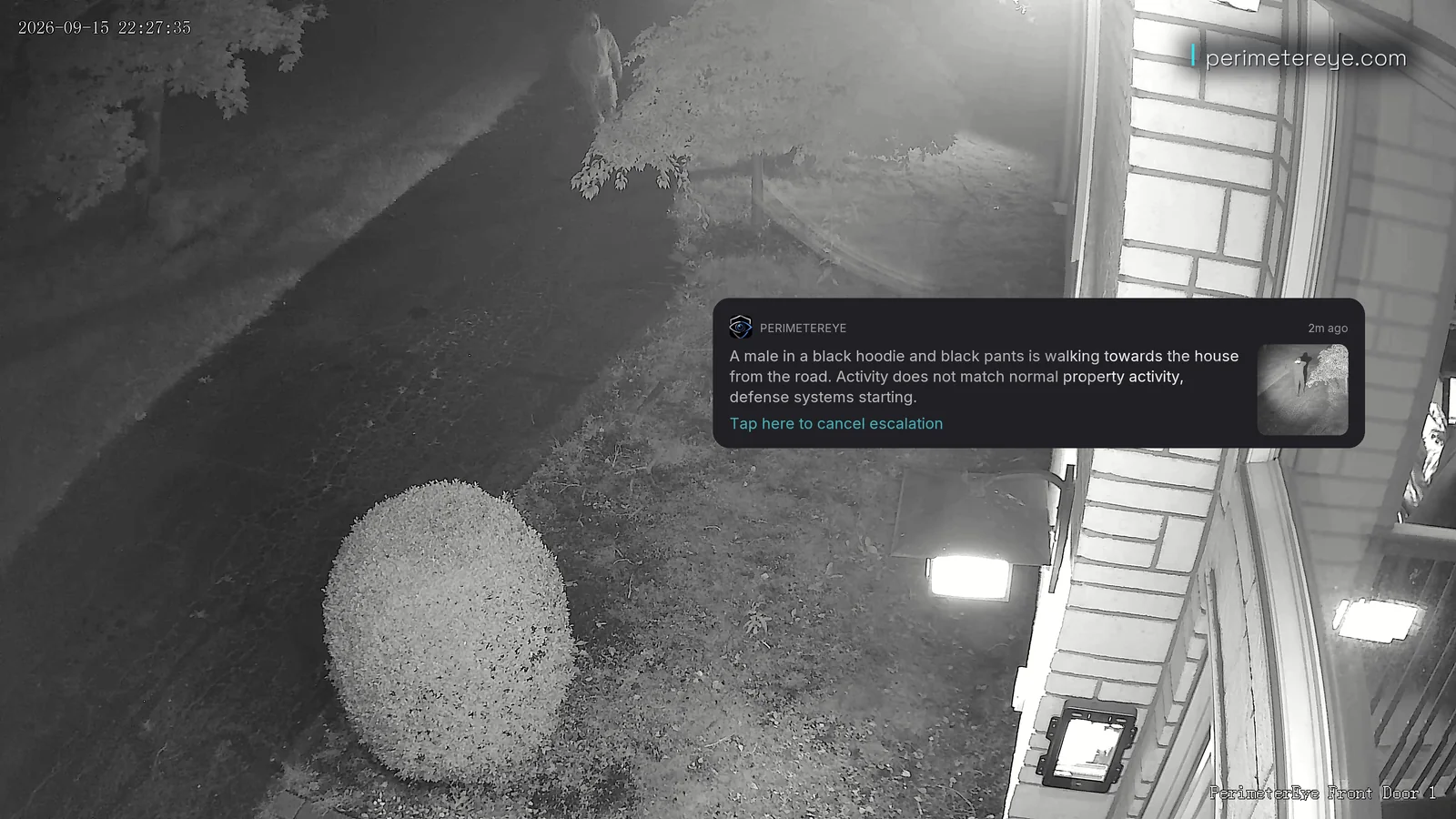
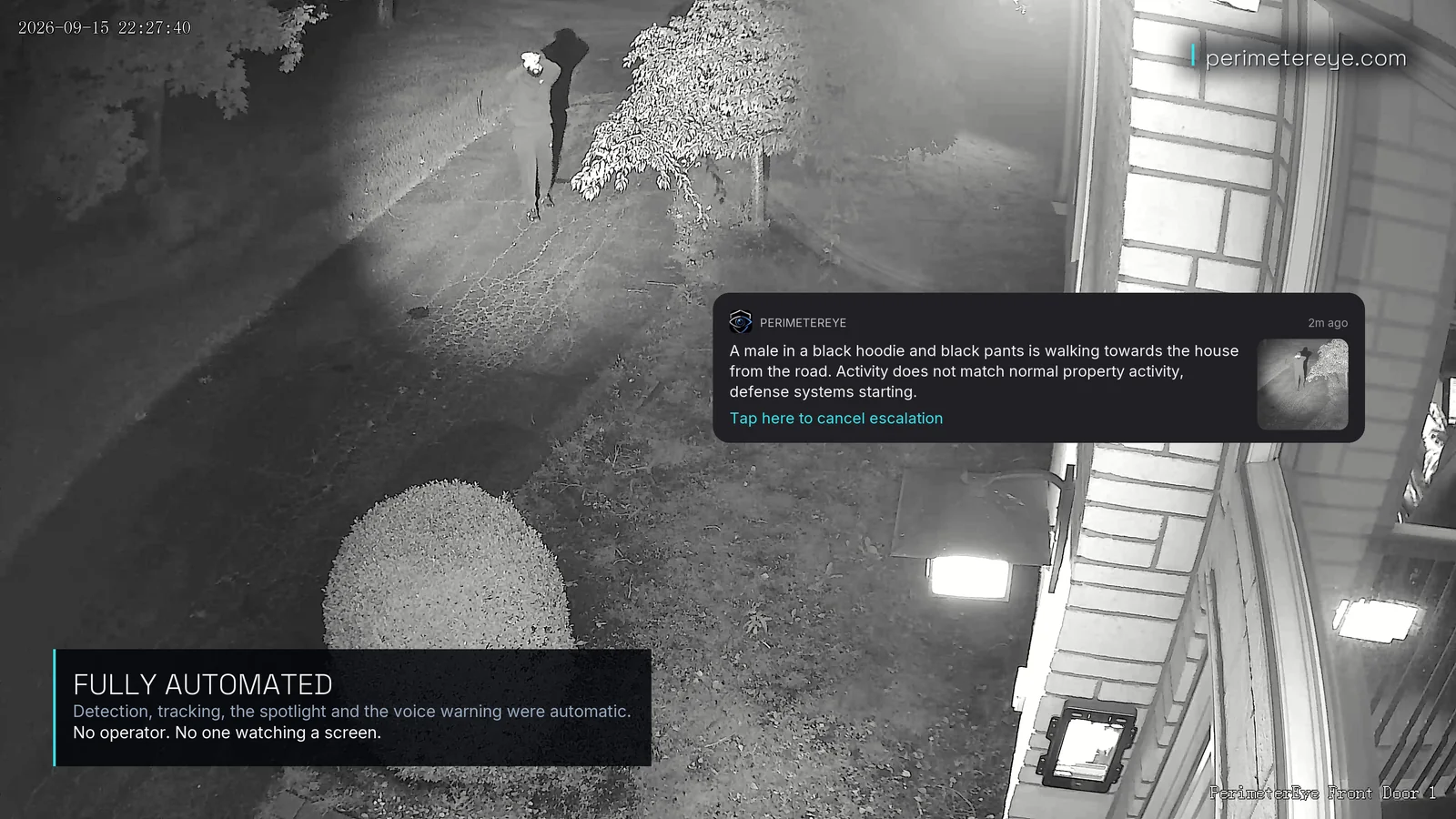
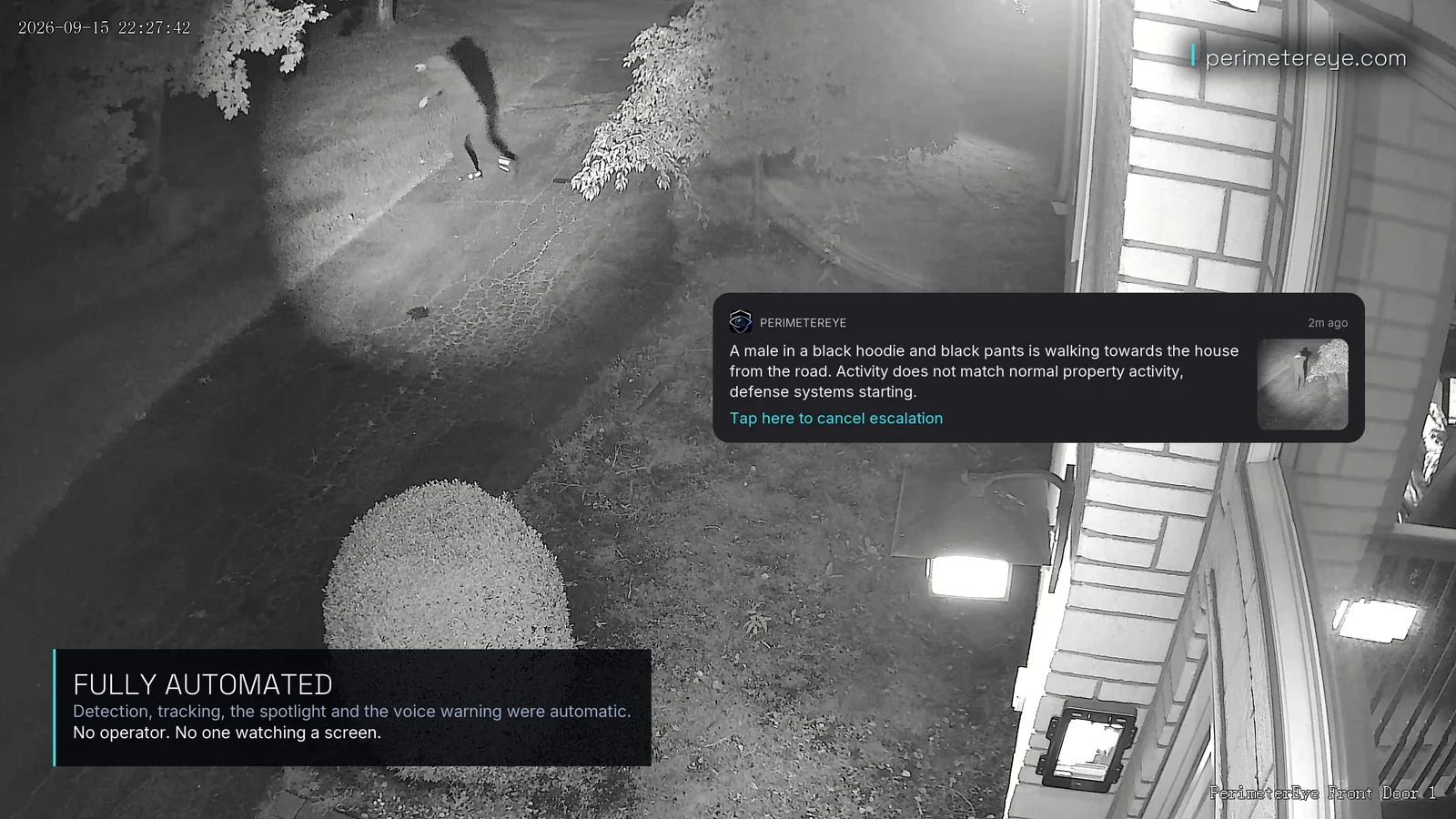
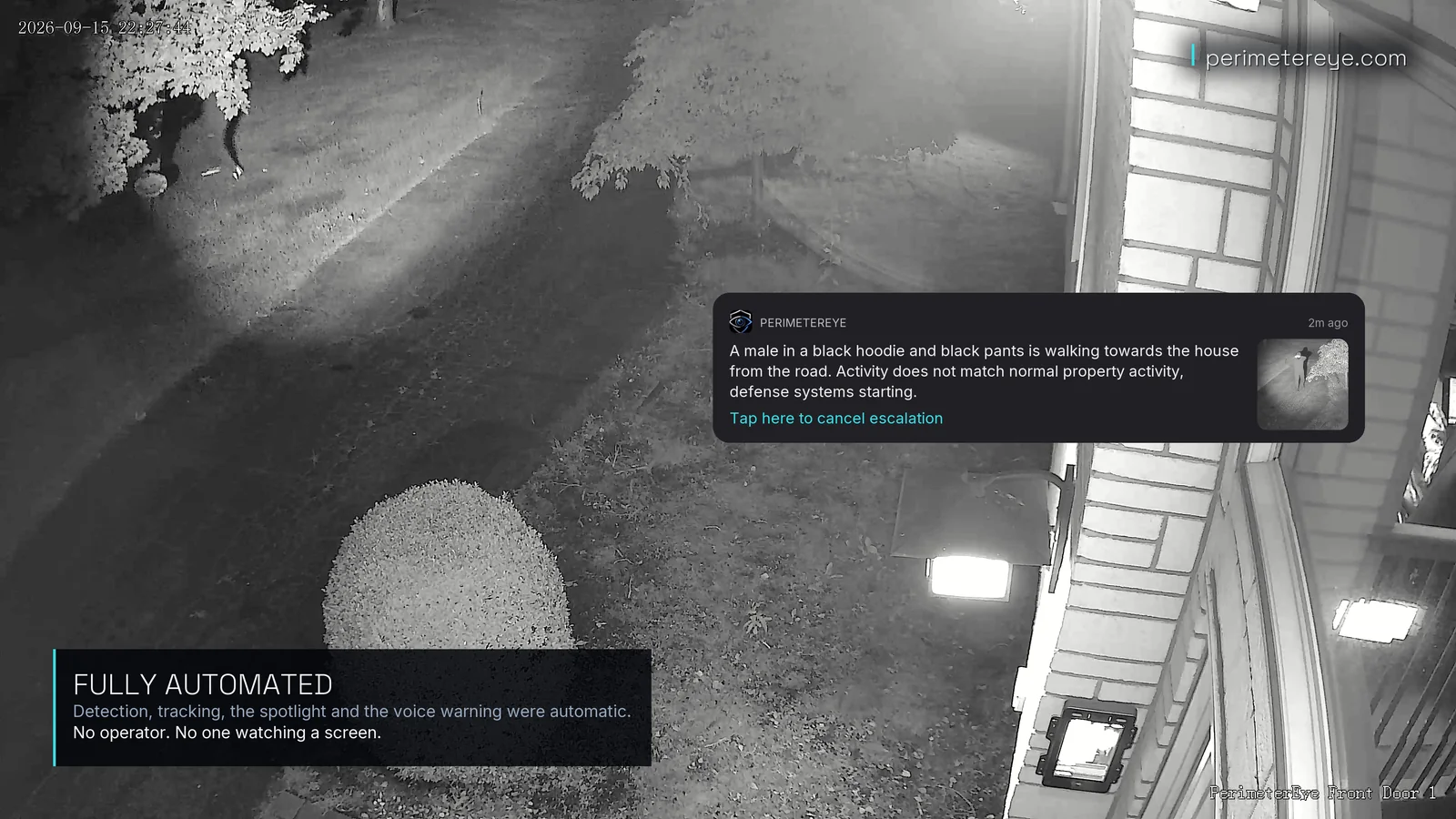
Front Door 1, on the camera’s own clock. The person is visible at the road end at 22:27:34, the alert describes them at 22:27:35, and the searchlight is on them at 22:27:38. By 22:27:42 they are turning away.
1 of 6 · 22:27:34View full size
Walking in from the road
At the far end of the driveway, in the dark, the person is already in view of the camera.
2 of 6 · 22:27:35View full size
The alert
The alert reads: walking towards the house from the road; activity does not match normal property activity; defense systems starting.
3 of 6 · 22:27:38View full size
In the searchlight
Three seconds after the alert, the searchlight is on the person by the tree. Detection, tracking, the light, and the voice warning were all automatic.
5 of 6 · 22:27:42View full size
Turning away
Four seconds in the light, and the person turns away from the house. The beam goes with them.
6 of 6 · 22:27:44View full size
Followed off the lawn
The searchlight stays on them to the edge of the camera’s view.
Filmed September 15, 2026, on a real property with PerimeterEye cameras and a searchlight. The approach was staged for filming; the system’s response was automatic, with no operator.
What changes
Why long driveways outgrow driveway alarms
- Reads the plate at the entrance and knows your family's cars on sight.
- A tracking searchlight follows unknown vehicles up the corridor — no fixed blind spots.
- A live AI voice challenges the specific vehicle and person in frame before they reach the house.
A long private drive concentrates every hard problem in residential defense: the entrance is far from the house, visitors are committed by the time you see them, and a chime can't distinguish a courier from a scout. Identification at the property line — plate, vehicle, person — is what turns distance from a blind spot into reaction time.
PerimeterEye was built for exactly this geometry. The entrance camera reads plates, the registry sorts known from unknown, and the corridor between gate and garage becomes the stage where the searchlight, the live voice, and the siren do their work while you watch from the app or the wall panel.
What every system includes
- On-site edge computer (the Brain)
- 4K AI cameras
- Tracking searchlights
- Live targeted AI voice
- 130 dB siren escalation
- Doorbell video intercom
- Wall panel command center
- iOS app with live 4K video
01
What a driveway alarm actually tells you
A driveway alarm is a sensor at the entrance wired to a chime in the kitchen. When something crosses it, it beeps. That is the entire transaction. A deer, a delivery van, your spouse, and a scout casing the property all produce the identical beep, and on a quarter-mile drive that beep starts a countdown you can't see the end of.
That ambiguity is the real cost. Most owners learn to tune the chime out, because almost every beep is nothing — and the one that matters sounds exactly like the rest. Detection without identification doesn't reduce your uncertainty. It just schedules it.
02
From "something arrived" to "who arrived"
PerimeterEye reads the license plate at the entrance and checks it against a registry of vehicles it knows. Your family's cars are announced as arrivals, not treated as intrusions. Regular visitors and the vehicles you approve get recognized on sight, and the mail carrier never triggers deterrence at all — the system knows the household.
Every event on every camera gets a full plain-language analysis written by the AI: what came in, when, and what it did. You can search all of it in plain English later — "white pickup last Tuesday" — and a daily briefing summarizes each night. A chime tells you a number went up. This tells you what happened.
03
A long driveway is a defensive asset
The distance that makes a long drive hard to watch is exactly what gives an automatic system time to work. The moment an unknown vehicle enters after dark, PerimeterEye verifies a real subject, and a motorized searchlight locks on and physically follows it up the corridor — homeowners compare the effect to a police helicopter spotlight. There is no ambiguity about being seen.
If the vehicle keeps coming, a live AI voice addresses it specifically — the actual vehicle and person in frame, never a canned announcement. Escalate further and a 130 dB siren fires while priority alerts hit your phone with live video. You can watch, speak through the cameras yourself, or take manual control at any point. All of it happens in seconds, before anyone reaches the house.
Light itself carries evidence. A randomized experiment across 77 New York City public-housing developments (NBER Working Paper 25798, 2019) found that added nighttime lighting cut outdoor nighttime index crimes by roughly 36%, with effects persisting about three years. A searchlight that finds you and follows you is that principle, concentrated on one subject.
04
When a simple driveway chime is all you need
Honesty first: if your driveway is sixty feet long, visible from the kitchen window, and you're home most of the day, an inexpensive chime sensor is a perfectly good tool. You want a heads-up that someone is pulling in, and the context — who it probably is — is standing right there in your line of sight. Buy the chime.
The math changes when the entrance and the house live in different worlds: a tree-lined quarter mile, a gate you can't see, a property you leave for days at a time. At that point the missing piece isn't detection, it's identification and response — knowing who arrived, and having something happen when the answer is "nobody we know."
05
Coverage from the entrance to the front door
Every PerimeterEye package pairs 4K AI cameras with two-way audio, motorized tracking searchlights, a policy-gated 130 dB siren, the PerimeterEye Access doorbell intercom with AI Doorman, a wall panel command center, and the PerimeterEye Brain — a true edge computer at your property running PerimeterEye OS. Because it all runs on-site, live view, recording, rewind, siren, and spotlights keep working through internet outages.
Six modes — Off, Quiet, Visitor, Armed, High Alert, Maximum Security — set how assertive the response is, and there's nothing to arm or disarm. One hour after sunset the spotlights run a configurable Perimeter Sweep, a visible patrol of the grounds that never crosses your property boundary. On a long drive, that patrol is the difference between looking dark and looking attended.
What separates PerimeterEye
From “something arrived” to “who arrived.”
On a long drive, the distance is reaction time, if something happens with it.
| Option | When someone turns in | What you know |
|---|---|---|
| Driveway alarm | Beeps in the kitchen when something crosses the sensor. | That something crossed. Not who. |
| Camera at the gate | Records the arrival and sends an alert. | What you can make out of the clip. |
| PerimeterEye | Reads the plate, knows the household’s cars, and lights up an unknown arrival after dark with a searchlight that follows it up the drive. | Who arrived and what they did next, in plain language. |
Watch it at full speed
The same response, on film.
Real footage of the working system. Play it with sound to hear the voice warning and the siren.
Night-vision camera footage as the searchlight finds and holds a person on the property.
Play with sound to hear the voice warning and siren.What it costs
See what a system costs for your property.
Advanced system
As low as$185/mo*Advanced covers larger homes, several entrances, garages, and vehicle areas, with two tracking searchlights. A specialist can size it with you before you order.
What’s included
- 7 ultra-HD 4K cameras
- 2 tracking spotlights
- 2 speaker/siren units
- PerimeterEye Access intercom, included with every complete system
- 1 PerimeterEye control panel
- 1 PerimeterEye AI processor
*Advanced system, $0 down: 36 monthly payments of $184.73 at 10% APR on the hardware price before sales tax, shown rounded up to the dollar. Affirm rates 0–36% APR; Klarna terms are shown at checkout. Subject to eligibility and lender approval; your rate, term and down payment may differ. US only; not available in all states. Software is billed separately: first 6 months included, then $99/month.
Before you choose
Common questions
How is PerimeterEye different from a driveway alarm sensor?
A driveway alarm detects that something crossed the entrance and chimes. PerimeterEye identifies it — plate read, known-vehicle registry, AI classification with a live threat level — then acts on what it finds. Family arrivals are announced; an unknown vehicle after dark gets a tracking searchlight, a live targeted voice challenge, and escalating alerts while you watch live.
Will my family's cars set it off every day?
No. PerimeterEye keeps a registry of the vehicles you approve and knows the household. Your cars are announced as arrivals, regular visitors are recognized, and mail carriers never trigger deterrence. Escalation is reserved for vehicles and people the system cannot account for, under the modes and settings you configure.
What happens when an unknown vehicle comes up the drive at night?
The system verifies a real vehicle, then a motorized searchlight locks on and follows it up the drive. If it keeps coming, a live AI voice challenges it specifically, then the 130 dB siren fires with priority alerts and live video to your phone. You can talk through the cameras or take control at any point.
How does PerimeterEye handle a vehicle it doesn’t know?
It strips away the anonymity drivers count on: the plate is read at the entrance, the vehicle is followed up the drive by a searchlight, the driver is challenged with a live description of what’s in frame, and everything is documented in 4K while you watch.
Does the entrance camera still work if the internet drops?
Yes. Everything runs on the PerimeterEye Brain, a dedicated edge computer at your property, so live view, recording, rewind, spotlights, and the siren keep operating during internet outages. Remote features on your phone resume when the connection does, and the wall panel keeps full local control the whole time.
Keep exploring
Related reading
Put a response behind your property.
Tell a specialist about your property, your driveway, and where people approach. They’ll size the cameras, searchlights, and sirens with you, or book a call first if you’d rather talk it through.
Explore an upgrade for your existing camerasSystem launch offer
Your first 6 months
of service included.
First 6 months included from activation. Then $99/month.
Compare system packages