Do security cameras deter burglars? Honestly, only a little
Security cameras deter burglars only weakly. In a survey of 422 incarcerated burglars, outdoor cameras registered as one sign of security among several, ranked below alarms and occupancy. Some burglars told journalists cameras even suggested valuables inside. Cameras document crime well; on their own they rarely create a consequence in the moment.
That is not the answer camera marketing gives, so it is worth being precise about where it comes from: the two best burglar-interview studies available, plus what a camera structurally is — a device that promises a consequence after the crime rather than during it.
This article walks through that evidence, gives cameras full credit for the jobs they genuinely do well, and finishes with what the research says deters more.
What this looks like on a real property
Same camera. A different outcome.
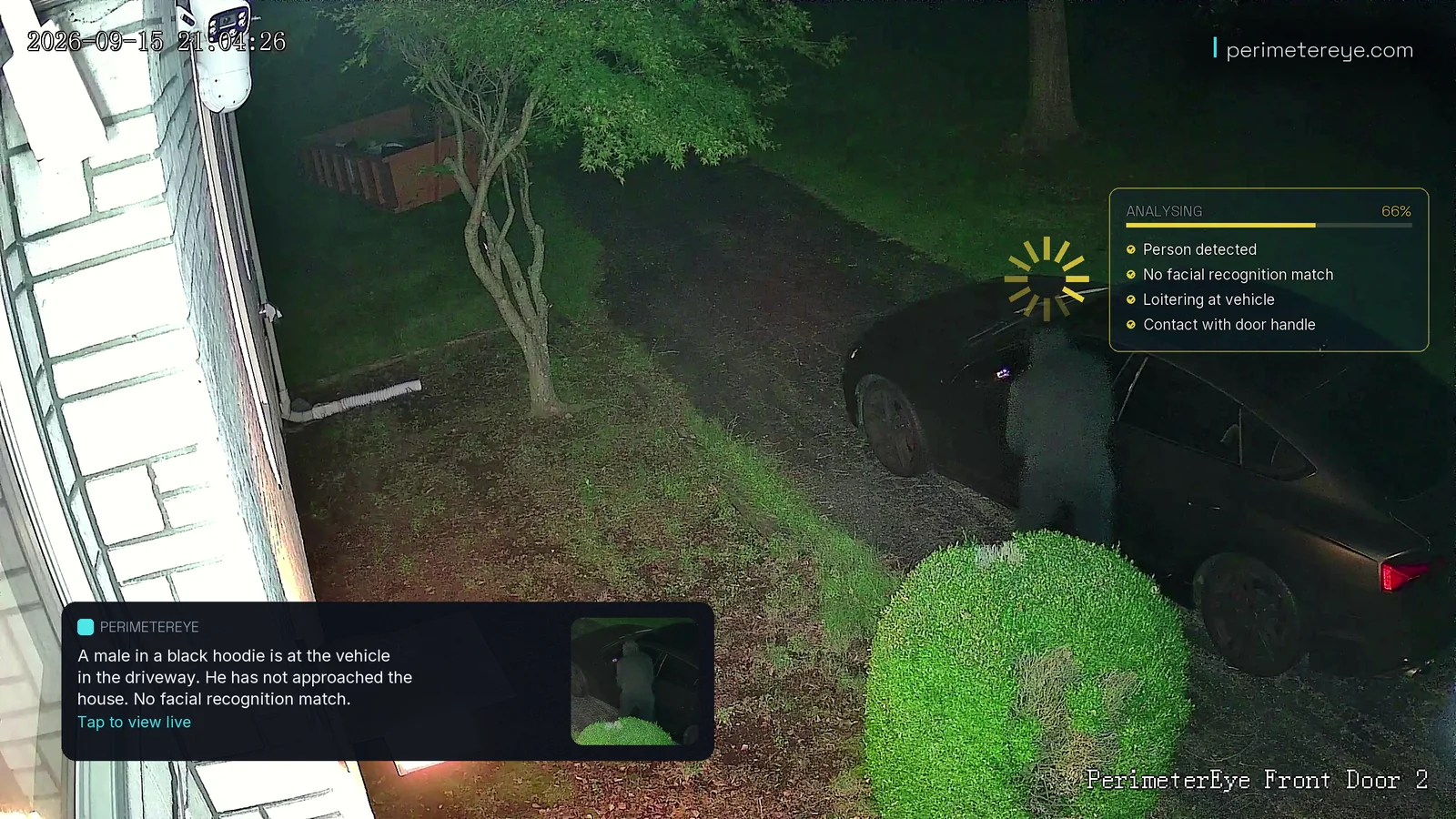
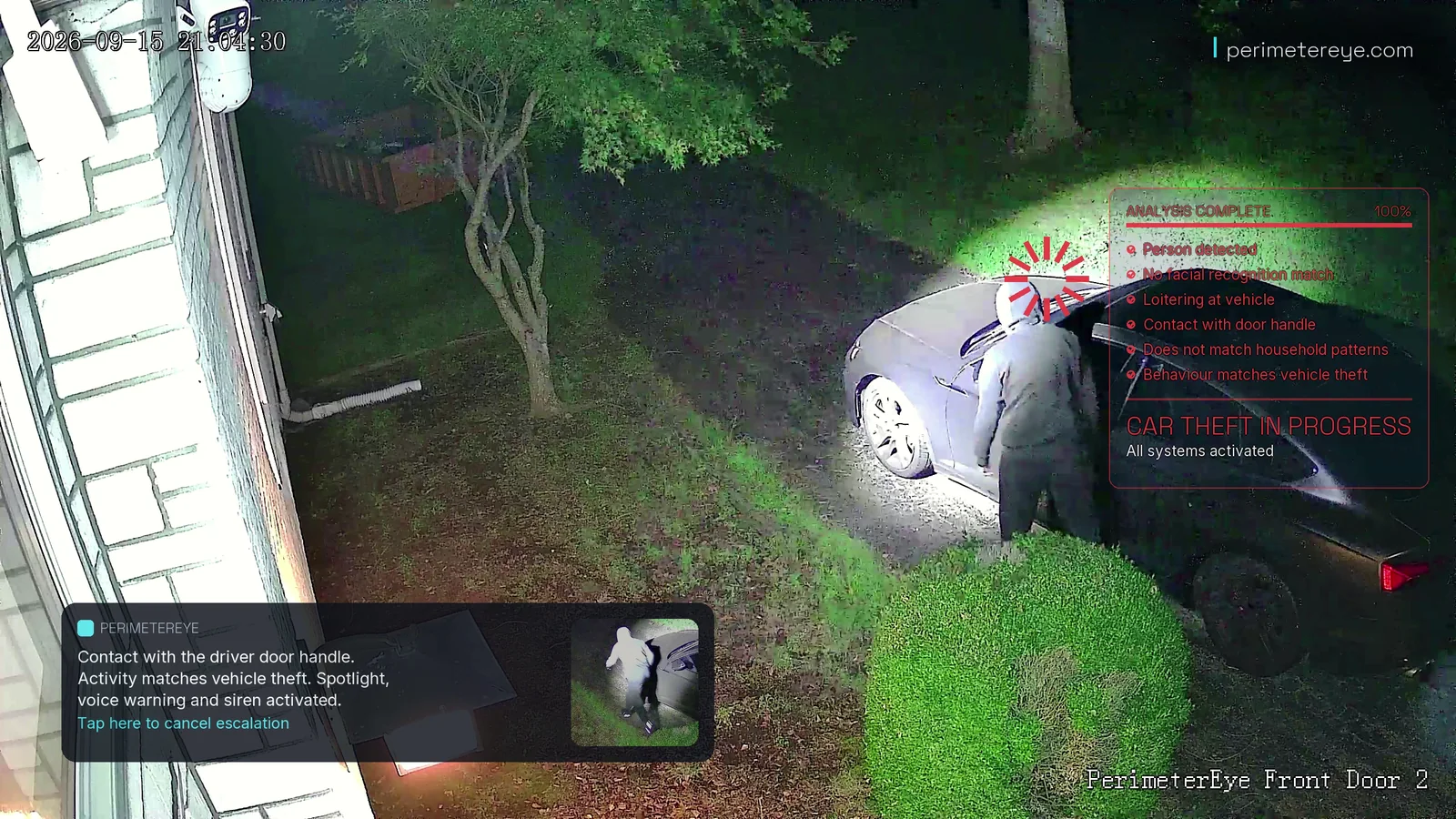
One camera and one staged break-in, shown three ways: the view on its own, with PerimeterEye’s analysis, and with its response hardware.
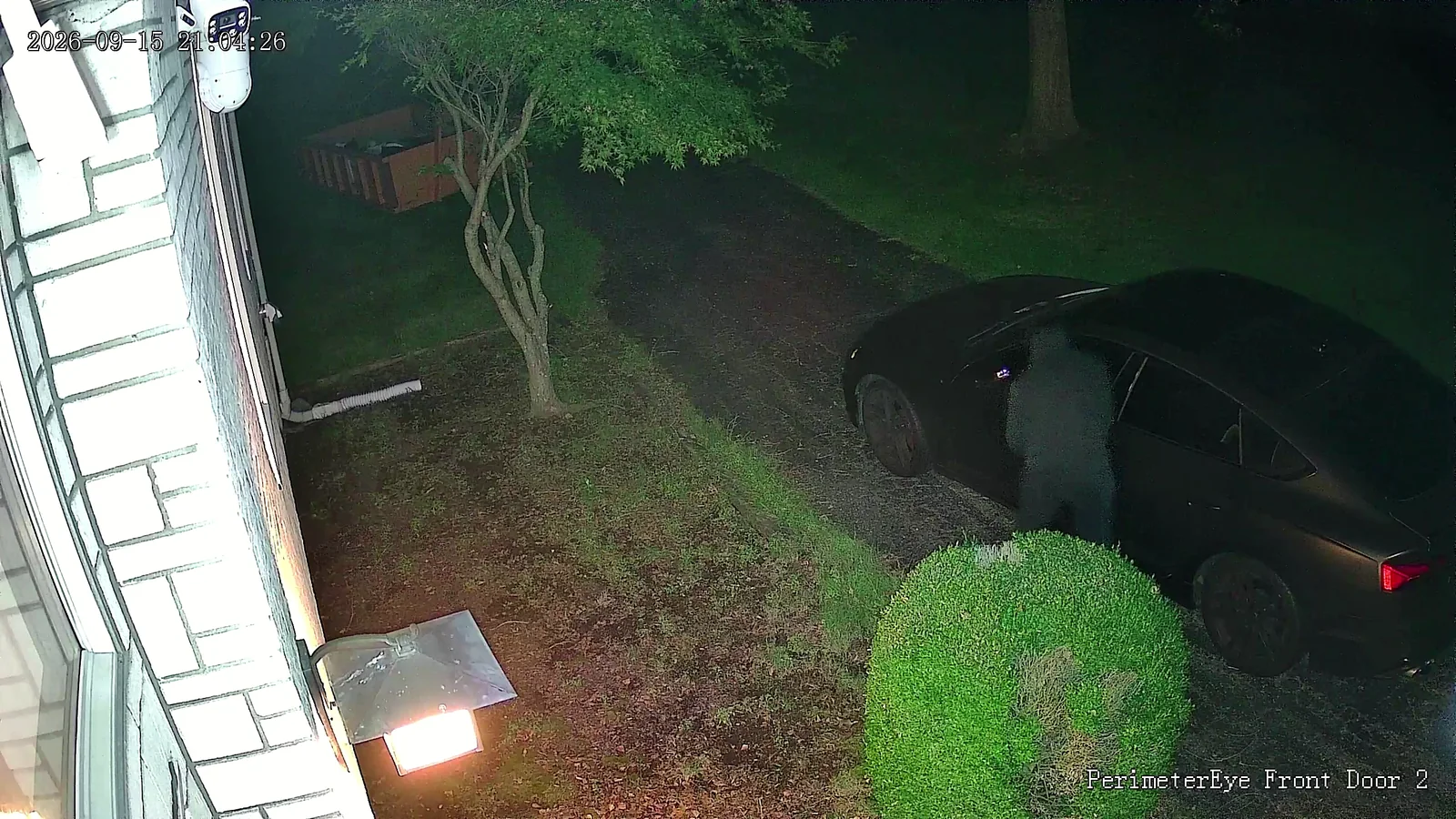
1 of 3 · A camera aloneView full size
It records
A person at the driver’s door, on a camera that records. Unless someone opens the clip in time, nothing else happens.
2 of 3 · UnderstoodView full size
The same view, understood
PerimeterEye reads the same moment: a person, no match to anyone it knows, loitering at the vehicle, contact with the door handle. The alert describes them in plain language.
3 of 3 · AnsweredView full size
The same view, answered
With a tracking searchlight, a siren, and AI voice warnings, the camera’s view directs a response. Four seconds later, the searchlight is on the person at the driver’s door.
Stills from a vehicle break-in staged for filming on a real property, on the Front Door 2 camera’s clock (21:04:26 and 21:04:30). The system’s response was automatic, with no operator.
What burglars actually said about cameras
In the UNC Charlotte survey of 422 incarcerated burglars (Kuhns et al., 2013 — funded by an alarm-industry foundation, which we note wherever we cite it), outdoor cameras appear among the "signs of security" burglars checked when sizing up a target. That cluster mattered, but it sat below the factors burglars weighed most: the proximity of other people and their escape routes. Alarms drew the stronger reaction — about 83 percent said they would check for one, and roughly 60 percent would move on if they found it.
So cameras register. A burglar choosing between two otherwise identical houses may well pick the one without a lens pointed at the door. The evidence just will not support the stronger claim implied by every doorbell-camera ad — that a camera makes a burglar abandon your street.
The valuables problem
The 2017 KGW-TV project — a journalist's questionnaire answered by 86 Oregon inmates, so journalism rather than peer review — surfaced something camera marketing never mentions. The burglars described cameras as a deterrent and as information: a house with visible cameras is a house with something worth protecting.
Hold that finding loosely; 86 self-selected inmates is a small sample. But it fits how burglars in both studies think. Every visible security choice is a signal, and signals get read in more than one way.
Why recording is a weak threat
The deeper issue is structural. Every deterrent burglars rank highly — occupancy, noise, dogs, nearby neighbors — threatens something during the burglary. A camera mostly threatens something after it: footage that may identify them, someday, if anyone follows up. A hood, a turned head, and a fast exit shrink that threat to a size a motivated burglar can accept.
This is why the same person who rings your doorbell to test occupancy will walk past your camera to do it. The camera is not nothing. It is a witness — and burglars have already priced in witnesses who can only act tomorrow.
What cameras genuinely do well
None of this is a reason to skip cameras. Documentation is real value: what time the attempt happened, which door, what they wore, which direction they left. That is the difference between a vague police report and an actionable one, and between a disputed claim and a clean one.
Cameras also verify. When something does trigger a response — an alarm, a light, a phone alert — a camera is how you know within seconds whether it is a raccoon or a person, which keeps you from ignoring the one alert that matters. In any layered setup, verification and evidence, not standalone deterrence, are the camera's real jobs.
What deters more than a camera
By the verified evidence, four things outrank a passive camera, and they share one property: each raises the burglar's odds of being noticed and confronted while still on the property.
That is the bar a camera, by itself, does not clear. It watches the crime; it does not interrupt it.
- Occupancy — the top factor in both burglar studies; most burglars knock or ring first specifically to rule it out.
- Bright lighting — a randomized New York City experiment across 77 public-housing developments cut nighttime outdoor index crimes by roughly 36 percent.
- Alarms — about 60 percent of surveyed burglars said they would pick another target if one was present (industry-funded survey, disclosed above).
- Big, loud dogs — ranked by Oregon burglars alongside occupancy and noise as a strongest avoid signal.
Cameras that act: the category that changes the answer
The industry has noticed the gap between watching and acting. As of mid-2026, Deep Sentinel puts live human guards in a surveillance center from roughly $100 a month; SimpliSafe's Active Guard tier adds live human agents on up to three outdoor cameras, 24/7 at around $80 a month; Ring offers a Virtual Security Guard professional-agent add-on for about $99 a month; Alarm.com introduced an automated AI deterrence service at CES 2025; and RAD launched its RADCam talking camera in 2024. All of them bolt a responder onto a monitoring model — competent products, and all still built around a person or a remote service watching the feed from somewhere else.
PerimeterEye approaches it from the other direction: an Automatic Property Defense System where the response lives on the property. When the system verifies an unknown person, a motorized searchlight locks on and physically follows them, the AI addresses them directly — describing the specific person in frame, never a canned announcement — and a 130 dB siren plus priority alerts with live video follow if they stay. The 4K cameras still record everything, and the AI writes a plain-language analysis of every event; the difference is that recording becomes the paper trail instead of the plan. PerimeterEye is not an alarm-monitoring service — alerts and control go directly to you. And no security system can guarantee prevention of every incident.
Common questions
Do security cameras deter burglars at all?
Some. In the UNC Charlotte survey of 422 incarcerated burglars, outdoor cameras were among the signs of security burglars checked before choosing a target, but they ranked below alarms and far below occupancy. Cameras shift the odds at the margin; they do not create the in-the-moment consequence that actually turns burglars away.
Why don't cameras scare burglars more?
Because recording is a delayed consequence, and burglars discount it. A camera promises that footage will exist later; it does not promise anyone will act now. A hood and a fast exit manage most of that risk. The deterrents burglars described avoiding — occupancy, noise, dogs, confrontation — all threaten consequences during the crime, not after it.
Should I still buy cameras?
Yes, for the right reasons. Cameras are excellent at documentation: what happened, when, who, and which door. That footage supports police reports and claims, and it removes doubt after an incident. Just be honest about the job description — a recording device is a witness, and if deterrence is the goal, pair it with things that act.
Do visible cameras attract burglars by signaling valuables?
A few Oregon burglars told a KGW-TV journalist exactly that: cameras read as protection and as a hint that something inside is worth protecting. That was a small journalistic sample, not peer-reviewed research, so hold it loosely. The practical takeaway is simply that a camera alone is not a complete answer.
What deters burglars more than cameras?
By the evidence: occupancy first, then bright lighting, alarms, and dogs. Roughly 60 percent of surveyed burglars said an alarm would send them elsewhere, and a randomized New York City experiment cut nighttime outdoor crime about 36 percent with intense lighting. Cameras earn their keep as evidence, not as the front line.
What it costs
See what a system costs for your property.
Essential system
As low as$146/mo*Essential covers a driveway and the approaches to the house. Larger properties usually suit Advanced or Estate; a specialist can size it with you before you order.
What’s included
- 5 ultra-HD 4K cameras
- 1 tracking spotlight
- 1 speaker/siren unit
- PerimeterEye Access intercom, included with every complete system
- 1 PerimeterEye control panel
- 1 PerimeterEye AI processor
*Essential system, $0 down: 36 monthly payments of $145.17 at 10% APR on the hardware price before sales tax, shown rounded up to the dollar. Affirm rates 0–36% APR; Klarna terms are shown at checkout. Subject to eligibility and lender approval; your rate, term and down payment may differ. US only; not available in all states. Software is billed separately: first 6 months included, then $99/month.
Looking for a camera that does more than watch?
PerimeterEye pairs 4K AI cameras with tracking searchlights, live targeted voice, and a 130 dB siren — so an unknown person meets a response in seconds, not a clip the next morning.