Honest Comparison

PerimeterEye vs RingRecording the moment vs changing it.

Ring is a good monitoring product: affordable cameras, motion alerts, recorded clips. But everything Ring does ends the same way — a notification and a video of what already happened. PerimeterEye is an Automatic Property Defense System: when it verifies an intruder, a searchlight locks on and follows, a live AI voice calls them out by description, and a 130 dB siren escalates — on the property, in seconds, while you watch.

Ring details checked against Ring's own published pages, September 2026. Sources

The short answer

Choose Ring if

You want affordable cameras and a doorbell, with the option of live agents on eligible cameras for $99 a month.

Choose PerimeterEye if

You want the property itself to respond, with a searchlight, a voice, and a siren in seconds, and to own the system.

At a glance

Ring and PerimeterEye, side by side

The questions that usually decide it, answered for both. Where the other system is the better fit, the table says so.

Ring compared with PerimeterEye
Default responseRingNo: A motion alert and a recorded clipPerimeterEyeYes: A searchlight, a live AI voice, then a 130 dB siren
Live interventionRingPartly: Virtual Security Guard: human agents, $99 a month per location, 175 monitored eventsPerimeterEyeYes: Automatic on every event, on the property
Deterrence hardwareRingPartly: Camera sirens, plus floodlight and spotlight camera modelsPerimeterEyeYes: A motorized searchlight that locks on and follows the person
Speaks to the personRingPartly: Two-way talk when you answer, or an agent on Virtual Security GuardPerimeterEyeYes: A live AI voice that describes the specific person in frame
Entry priceRingYes: A few hundred dollars for a doorbell and a camera or twoPerimeterEyePartly: As low as $145.17/mo (36 payments at 10% APR, $0 down) for a complete system, plus $99/mo software after six included months
ContractRingYes: No contract for Virtual Security GuardPerimeterEyeYes: No contract. You own the hardware outright
When the internet dropsRingPartly: Cloud features depend on a working connectionPerimeterEyeYes: Live view, recording, rewind, siren, and searchlight keep running on-site
Built forRingYes: Doors, porches, and rentersPerimeterEyeYes: Properties with driveways, yards, and approaches

Ring plans and features change. Confirm current details with Ring before you decide. PerimeterEye capabilities depend on the selected package and property layout.

Credit where it's due

What Ring genuinely does well

Worth knowing before any comparison is worth trusting.

The most accessible cameras

Inexpensive hardware, a polished app, and reliable alerts made Ring the default way to see who is at the door.

Live agents, around the clock

Virtual Security Guard puts U.S.-based agents on eligible cameras 24/7 for $99 a month per location. They can talk, sound the camera's siren, and request emergency services.

Easy for renters

A small mounting footprint makes Ring practical where permanent equipment is not an option.

The same moment

Someone walks up the driveway at night.

An illustrative sequence showing how each system is designed to respond. It is not a timed test.

Ring

  1. A camera detects motion and sends a notification with a clip.

  2. If you see it in time, you can open live view and talk through the camera.

  3. With Virtual Security Guard, an agent can review the event, talk, and sound the camera's siren.

  4. If nothing stops it, the recording becomes the evidence.

Fast alerts and optional agents, while the property itself stays passive.

PerimeterEye

  1. The Brain verifies an unknown person on the property. Residents, deliveries, and regular visitors never trigger it.

  2. The nearest searchlight locks on and physically follows them.

  3. A live AI voice describes them and tells them they are not authorized to be there.

  4. If they stay, the 130 dB siren fires, and your phone already has live video.

The property responds on its own, in seconds, while you watch.

What PerimeterEye adds

Same camera. A different outcome.

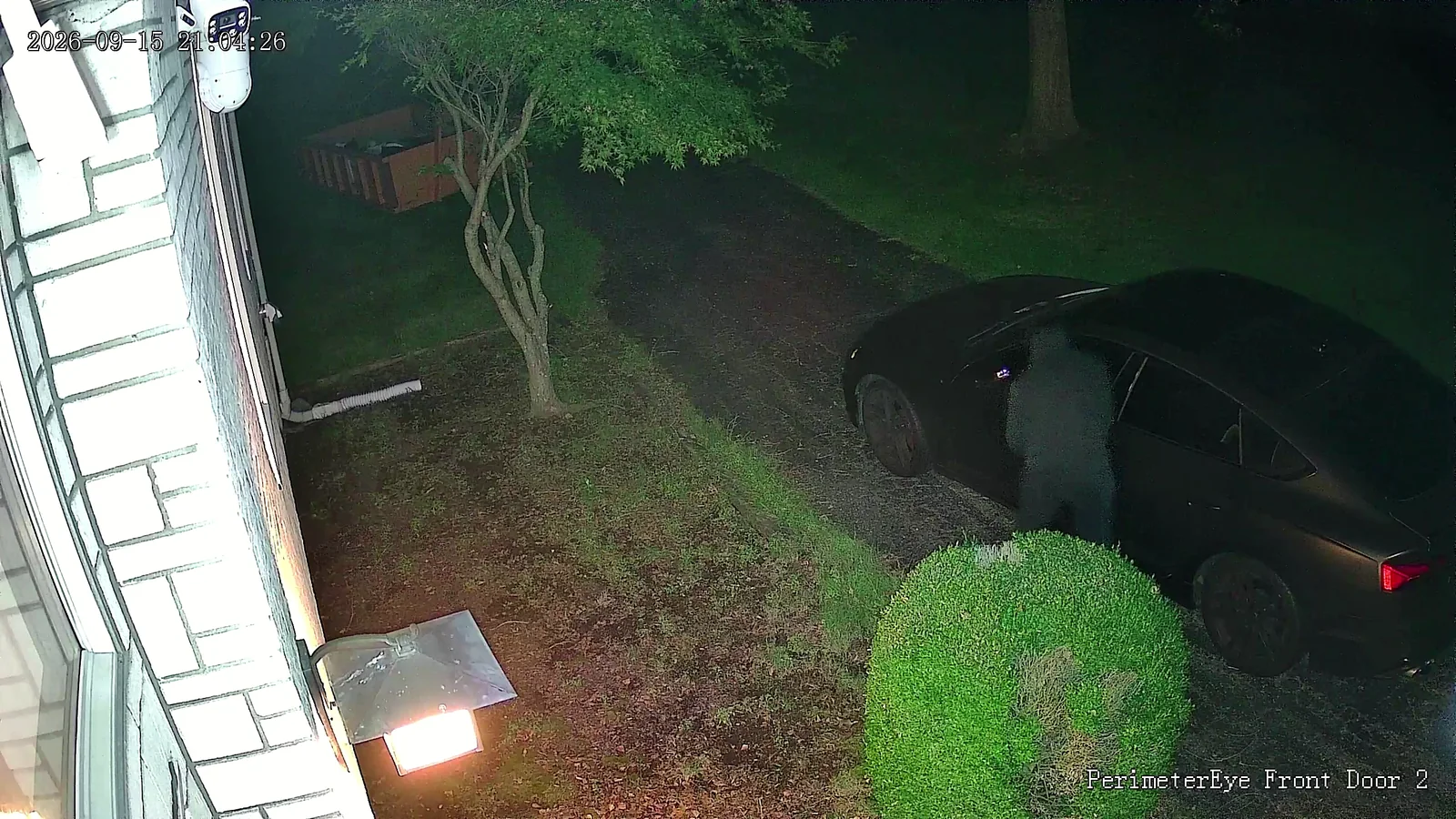
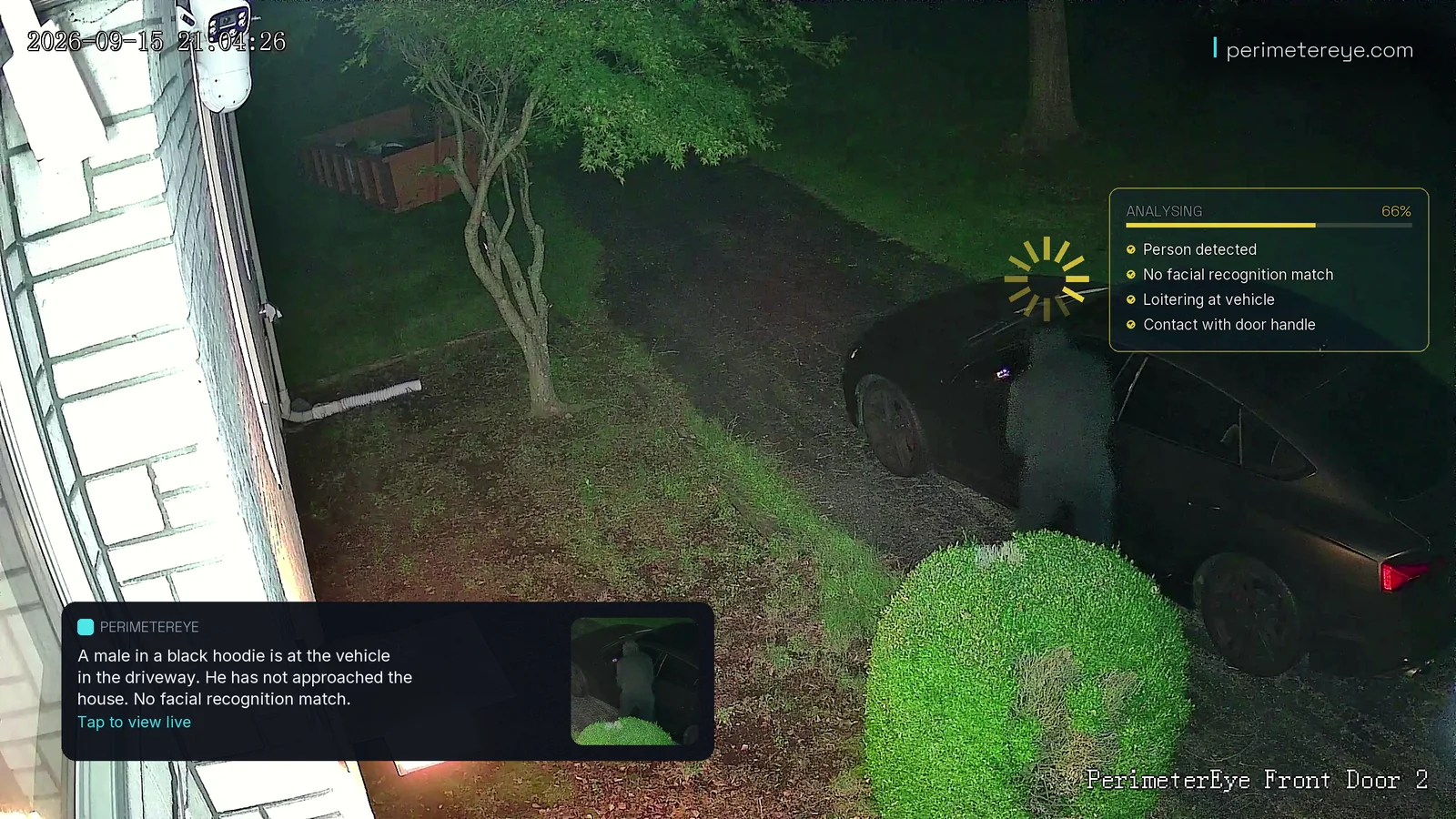
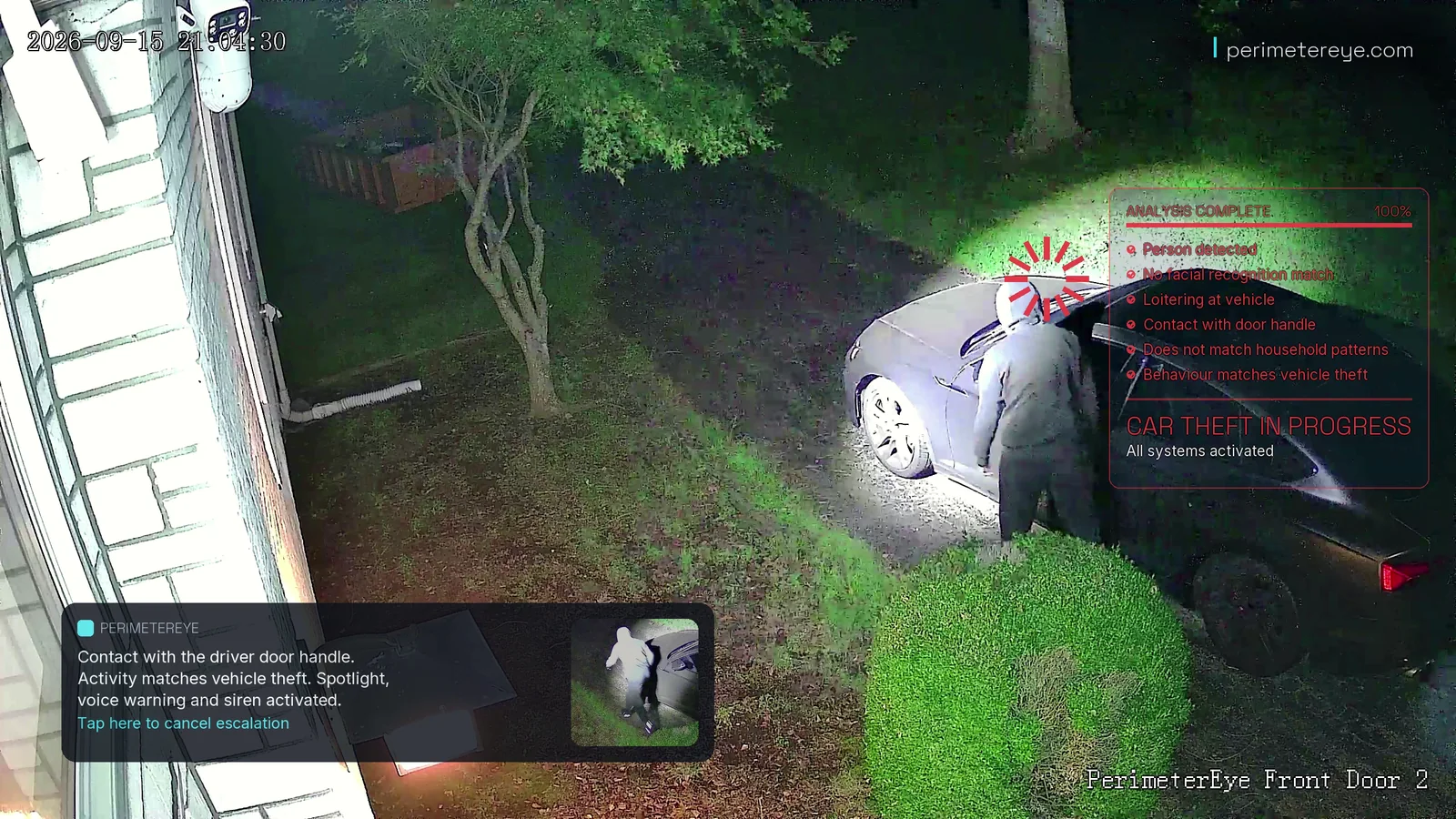
One camera and one staged break-in, shown three ways: the view on its own, with PerimeterEye’s analysis, and with its response hardware.

Plain night camera view of a person at the driver’s door of a parked carThe same view with the PerimeterEye analysis panel and a phone alert describing the person at the carThe searchlight lighting the person at the driver’s door, with car theft in progress on the analysis panel

1 of 3 · A camera aloneView full size

It records

A person at the driver’s door, on a camera that records. Unless someone opens the clip in time, nothing else happens.

2 of 3 · UnderstoodView full size

The same view, understood

PerimeterEye reads the same moment: a person, no match to anyone it knows, loitering at the vehicle, contact with the door handle. The alert describes them in plain language.

3 of 3 · AnsweredView full size

The same view, answered

With a tracking searchlight, a siren, and AI voice warnings, the camera’s view directs a response. Four seconds later, the searchlight is on the person at the driver’s door.

Stills from a vehicle break-in staged for filming on a real property, on the Front Door 2 camera’s clock (21:04:26 and 21:04:30). The system’s response was automatic, with no operator.

Real footage, not a render

Cameras record. This one responds.

Night-vision camera footage as the searchlight finds and holds a person on the property.

Cost and ownership

What you pay, and what you own

What each one costs up front and every month, and what you own at the end.

Ring

Low hardware cost, with agents as a subscription

  • Doorbells and cameras cost a few hundred dollars
  • Virtual Security Guard is $99 a month per location, with 175 monitored events
  • No contract for Virtual Security Guard

PerimeterEye

A complete system you own outright

Essential
$146/mo*
Advanced
$185/mo*
Estate
$254/mo*
  • Every package includes the tracking searchlights, siren, video intercom with AI Doorman, wall panel, and the Brain
  • Financing available through Klarna or Affirm, with no contract
  • The first 6 months of software and AI are included from activation on launch system orders, then $99 a month

*Essential system, $0 down: 36 monthly payments of $145.17 at 10% APR on the hardware price before sales tax, shown rounded up to the dollar. Advanced system, $0 down: 36 monthly payments of $184.73 at 10% APR. Estate system, $0 down: 36 monthly payments of $253.30 at 10% APR. Affirm rates 0–36% APR; Klarna terms are shown at checkout. Subject to eligibility and lender approval; your rate, term and down payment may differ. US only; not available in all states. Software is billed separately: first 6 months included, then $99/month.

Which one fits

The honest recommendation

Different categories, built for different buyers. Here is how to tell which one you are.

Choose Ring if

  • You rent, or only need to cover a single door
  • Your budget is a few hundred dollars
  • You want optional human agents on eligible cameras

Choose PerimeterEye if

  • You have a property to defend, not just a doorway
  • You want the response on-site and automatic, not an add-on
  • You want to own the hardware, with no contract
Order with a Specialist

The full comparison

From Recorded Clips to Real-Time Defense

Ring and PerimeterEye are not rivals in the same category. Ring is a monitoring product — it watches, records, and notifies, and it does those things well for the money. PerimeterEye is an Automatic Property Defense System: it verifies who is on the property and then acts there, in seconds, with a searchlight that follows, a voice that names, and a siren that escalates.

The practical question is not which brand is better but which category your situation calls for. A single door in a rented apartment calls for a camera. A home with a driveway, a yard, and approaches worth defending calls for a system that does something while the event is still happening — and lets you watch live, talk, or take control at any moment.

01

What Ring Does Well

Credit first. Ring built the most accessible camera and doorbell ecosystem in the country: inexpensive hardware, a polished app, reliable motion alerts, and optional subscriptions that add clip storage and smarter notifications. For seeing who is at the door from your phone, it is genuinely hard to beat on price.

Ring has also acknowledged the limits of notifications. Its Virtual Security Guard add-on (around $99 per month as of mid-2026) puts a professional agent behind eligible cameras to review motion events and respond. That is a real upgrade over a silent clip — and a telling admission that recording alone was never the finish line.

02

"Ring Recorded the Theft, But Nothing Happened"

That sentence — some version of it — is why most people land on this page. The doorbell caught the porch pirate in crisp detail. The phone buzzed. You were in a meeting, or asleep, or driving. By the time anyone looked, the package and the person were gone. The system worked exactly as designed. The design is the problem.

The scale of it is well documented: in SafeWise's 2025 Package Theft Report, a survey of 7,500 U.S. adults, 31% said a package had been stolen from them in the previous 12 months, with a median value of $143. A camera that watches a theft produces evidence. It does not produce an outcome.

There is even a wrinkle worth knowing: in KGW-TV's 2017 journalistic survey of 86 Oregon burglars, inmates described cameras as a deterrent — but some also read them as a signal that a home has things worth taking. A passive camera is ambiguous. A property that visibly responds is not.

03

What PerimeterEye Does During the Event

PerimeterEye's response happens while the person is still standing there. The on-site Brain — a true edge computer, not a recording box — verifies the threat first, so a delivery driver or a family arrival never triggers anything. The system knows the household. Package detection and delivery guidance work in every mode except Off and Quiet.

For a verified intruder, the ladder climbs in seconds: a motorized searchlight with 355 degrees of rotation and 90 degrees of tilt locks onto the person and physically follows them — owners compare it to a police helicopter searchlight. Then a live AI voice addresses them specifically: "You, in the dark hoodie — you are not authorized to be on this property." Not a pre-recorded chime. A description of them, spoken to them.

If they stay, a 130 dB siren fires and you get a priority alert with live video. At any rung you can watch, talk through two-way audio, or take manual control. Ring's event ends on your lock screen. PerimeterEye's event ends with light on the intruder's back as they leave.

  • Verify first — the household, deliveries, and regulars never trigger deterrence
  • Searchlight locks on and physically follows the verified target
  • Live, targeted AI voice describes the specific person in frame
  • 130 dB siren plus priority alerts with live video — you can step in at any point

04

Price, Ownership, and What the Monthly Fee Buys

Ring wins on entry price, no argument. A doorbell and a camera or two cost a few hundred dollars, with subscriptions layered on for storage and, if you choose, the agent add-on at around $99 per month as of mid-2026. You are paying modest hardware prices plus recurring fees for watching services.

PerimeterEye is a complete system: the Essential package (5 cameras, 1 tracking spotlight, 1 siren), Advanced for medium properties (7, 2, 2), or Estate (12+, 4, 2) — every package includes the video intercom with AI Doorman, the wall panel, and the Brain. You own the hardware outright, with no contract: pay monthly, as low as $145.17/mo for Essential (36 monthly payments at 10% APR, $0 down, through Affirm or Klarna, subject to approval), or in full at checkout.

After the six included months from activation for launch system orders, the $99 per month software and AI subscription covers the intelligence, not surveillance labor. PerimeterEye is not an alarm-monitoring service — alerts and control go directly to you.

05

When Ring Is the Right Choice

Honestly: sometimes it is. If you rent and cannot mount permanent equipment, Ring's peel-and-stick footprint is the practical answer. If the budget is a few hundred dollars, Ring delivers real value at that price, and a doorbell camera beats no camera.

If your exposure is a single door — an apartment entry, a condo hallway — a full perimeter system is more than the problem requires. PerimeterEye is built for properties with actual perimeters: driveways, yards, approaches, multiple sight lines. If the thing you are protecting is a property rather than a doorway, that is when the categories stop being comparable.

FAQ

PerimeterEye vs Ring: common questions

Sources

Ring details are drawn from Ring's own published materials as of September 2026; plans, prices, and features change, so verify them with Ring. The sequences above are illustrative, not timed tests. Ring is a trademark of its respective owner and is not affiliated with PerimeterEye. No system can promise to prevent every incident.

Build your PerimeterEye system.

Choose a package, add cameras, searchlights, or sirens for your property, and see the total before you check out.